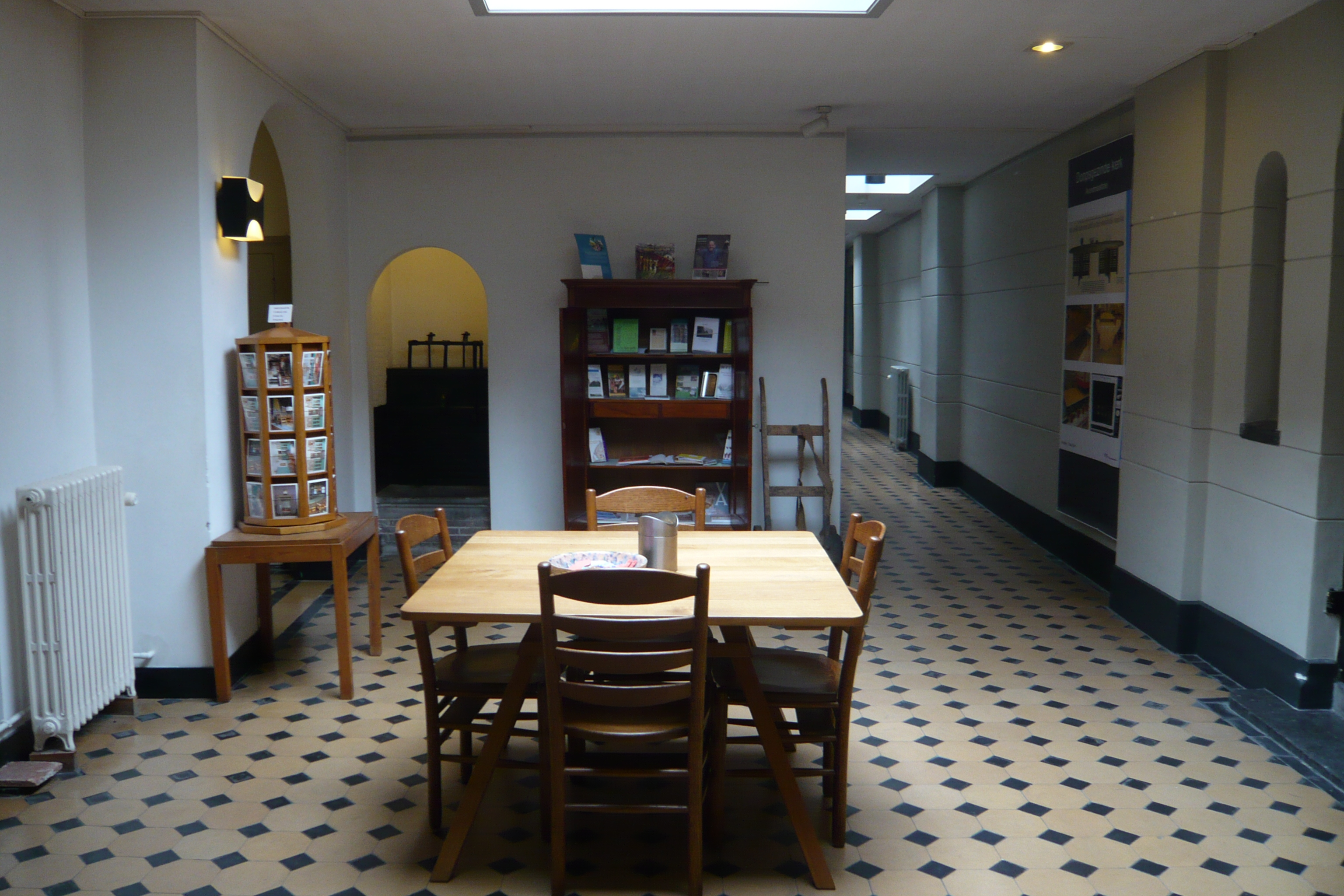
Doopsgezinde kerk, Haarlem
From the Grote Houtstraat, you would walk past it without noticing. A doorway among shopfronts. A long hallway behind that, originally built to admit a carriage. Only after passing through these layers does the Doopsgezinde kerk reveal itself, a 17th-century sanctuary tucked into the middle of a Haarlem block. The Dutch Mennonites called these places Vermaningen, and they built them this way for a reason. Worship in the Dutch Republic was tolerated for Anabaptists, but not celebrated. A church without a visible facade was a church that bothered no one.
A Door in an Alley
The Grote Vermaning was built in 1683, though the congregation that worshipped here was older. The original entrance was a narrow door tucked into the Peuzelaarsteeg, the alley that links the bustling Grote Houtstraat shopping street to the quieter Frankestraat. You had to know it was there. In 1717 the community bought a house on the Frankestraat and cut a larger entrance through it. Forty years later, in 1757, members of the congregation - including the wealthy silk merchant Pieter Teyler van der Hulst - acquired a house on the Grote Houtstraat and added another entrance, modern but unobtrusive, with a generous hallway long enough to admit Teyler's carriage. Over the decades the church bought up most of the surrounding block. The buildings stayed; the church stayed hidden inside them.
The Mennonite Inheritance
Dutch Mennonites trace their roots to the radical Reformation of the 16th century, when adult baptism set Anabaptists apart from both Catholics and the magisterial Protestant churches. They were persecuted by both sides, and many died for it. By the 17th century, the Dutch Republic offered an uneasy refuge - tolerance in exchange for invisibility. So congregations gathered behind plain facades, called their ministers "teachers" rather than priests or pastors, and built sanctuaries whose beauty lived only inside. Step through the hallway here and the interior opens up: a baroque brass sermon-holder on the pulpit, a gallery added for the orphans the congregation cared for, with its own watchhouse where a governess could keep an eye on her charges during long services. The Mennonite name for these buildings, Vermaning, means "admonition" or "exhortation" - the room where the community gathered to remind itself how to live.
Pieter Teyler's Long Reach
The same Pieter Teyler who funded the 1757 entrance bought the corner house at Peuzelaarsteeg and Grote Houtstraat 51 and rented it to the Dutch Society of Science. In 1784, that house opened to the public as the first museum in the Netherlands - which still operates today as the Teylers Museum, just up the street. A Mennonite congregation that had been forced to hide its worship became, through one of its members, the founder of Dutch public science and the patron of one of the most extraordinary collections of fossils, instruments, and curiosities in Europe. The hidden church and the open museum share a wall and a heritage. The Enlightenment in Haarlem came partly through the back door, paid for by a community that had learned its theology in alleys.
Still a Gathering Place
The congregation still meets. Services alternate between the Grote Vermaning here in Haarlem and the smaller Kleine Vermaning in Heemstede, a few kilometres south. Next to the Grote Houtstraat entrance there is now a small shop and cafe called Jansje, run jointly with the Hartekampgroep so that people with intellectual disabilities can work there. Teyler's carriage hallway has become a photo exhibition space. On Open Monuments Day the doors that were once meant to deflect attention swing wide, and visitors discover what generations of Haarlemmers walked past for centuries. Twice a month, a theatrical guided tour walks people through in Dutch, telling the story of a church that learned to thrive by staying out of sight.
From the Air
Coordinates 52.380 N, 4.635 E. The Doopsgezinde kerk is invisible from cruising altitude, embedded inside a Haarlem city block south of the Grote Markt and west of the Spaarne river. Recommended approach altitude is 500-1500 feet AGL for an overview of central Haarlem, with the Sint-Bavokerk's tower as the dominant visual landmark a few hundred metres north. Nearest airports: Amsterdam Schiphol (EHAM) is about 12 km east-southeast; Rotterdam The Hague (EHRD) is approximately 60 km south. North Sea weather is changeable - haze and low cloud are common.