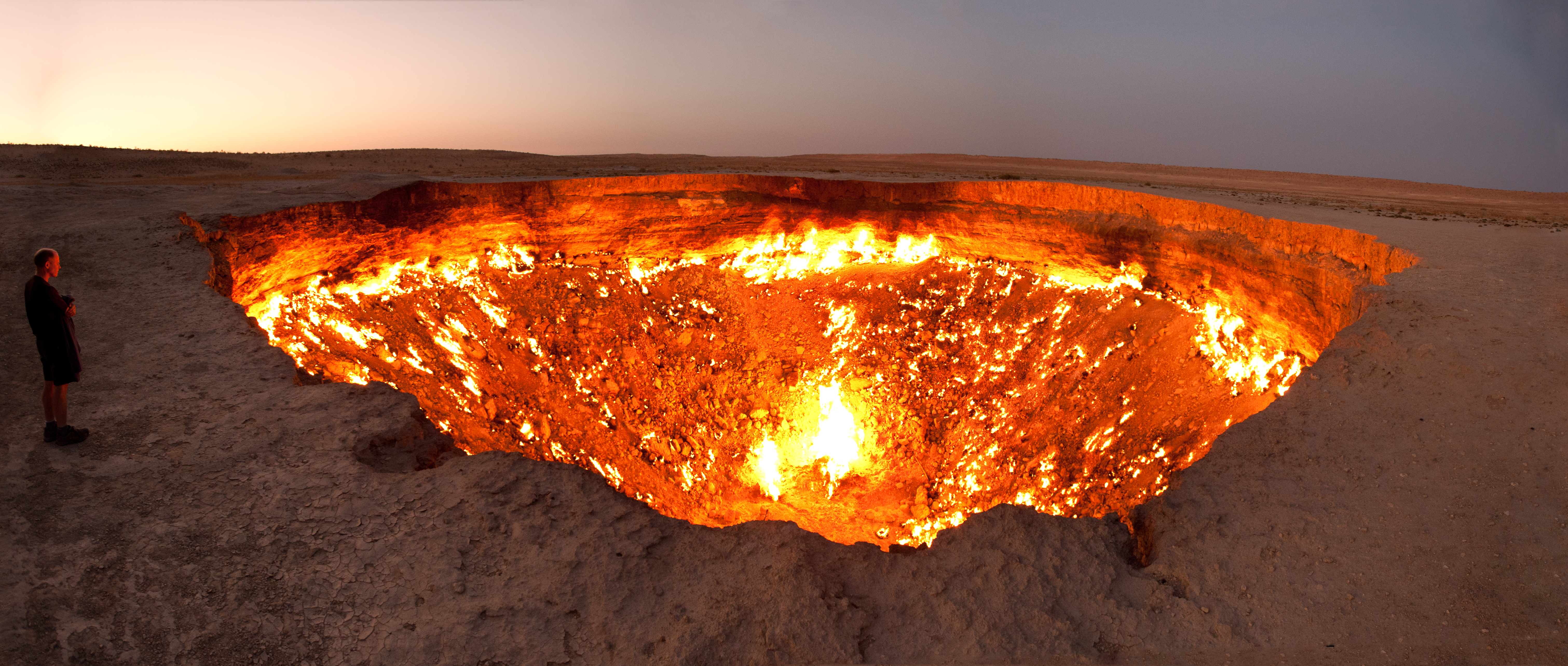
The Door to Hell: The Crater That's Been Burning for 50 Years
In 1971, Soviet geologists drilling for natural gas in the Karakum Desert of Turkmenistan hit a pocket of underground gas - and the ground collapsed beneath their equipment. A crater 230 feet wide and 65 feet deep opened in the desert. Fearing the methane would poison nearby villages, the geologists set it on fire, expecting it to burn out in a few weeks. Fifty years later, the Darvaza gas crater - nicknamed the 'Door to Hell' - is still burning. Flames lick from the crater's depths day and night. The orange glow is visible for miles. A simple engineering decision created one of the strangest sights on Earth.
The Collapse
The details of the crater's origin remain somewhat murky - Soviet-era records are incomplete, and the story has been told in conflicting versions. What's clear is that in 1971, geologists exploring for natural gas near the village of Darvaza drilled into an underground cavern filled with methane.
The ground collapsed, swallowing their drilling rig and equipment. A crater roughly 70 meters wide and 20 meters deep gaped in the desert sand. Methane began venting from the pit - a serious hazard to workers and the nearby village.
The Fire
The geologists decided to burn off the gas. Methane is dangerous - it can cause explosions and asphyxiate anyone who enters a concentrated pocket. Setting the crater on fire seemed like a reasonable short-term solution. The gas would burn out in a few weeks, and the site could be safely abandoned.
The few weeks became months. The months became years. The years became decades. The underground gas reservoir was far larger than anyone realized. Fifty years later, the flames still burn, fed by a seemingly inexhaustible supply of natural gas.
The Spectacle
The Darvaza crater has become Turkmenistan's most famous tourist attraction. By day, it's an unremarkable hole in the desert - reddish sand, some steam, nothing special. But at night, it transforms. Hundreds of flames dance across the crater floor and walls, casting an orange glow visible for miles.
The heat is intense - visitors feel it from the rim, 30 feet above. The sound is a constant low roar. At night, the crater truly looks like a gateway to the underworld. Tourists camp nearby to photograph the spectacle after dark.
The Attempts
Turkmenistan's government has periodically expressed interest in extinguishing the crater. The burning gas represents lost revenue - natural gas that could be captured and sold. President Gurbanguly Berdimuhamedow ordered the crater closed in 2010, but nothing happened. In 2022, he ordered studies on extinguishing it. The fire still burns.
Extinguishing a gas fire of this scale is technically challenging. The crater would need to be sealed or the gas supply cut off. Any attempt risks creating a larger underground fire. For now, the Door to Hell remains open.
The Future
No one knows how much gas remains beneath the Darvaza crater. The reservoir could exhaust itself next year or burn for another century. The flames have been continuous for five decades with no sign of weakening.
The Door to Hell has become a symbol of unintended consequences - a simple decision that created a permanent feature of the landscape. What was meant to be a temporary fix became a tourist attraction, a point of national embarrassment, and a reminder that when you're dealing with forces underground, you can't always predict what will happen. Some fires, once lit, refuse to go out.
From the Air
The Darvaza gas crater (40.25N, 58.44E) lies in the Karakum Desert of Turkmenistan, about 260km north of Ashgabat. Ashgabat International Airport (UTAA) is the nearest major facility. The crater is visible from the air as a dark circle in the desert, with the glow potentially visible at night. The terrain is flat sandy desert. Weather is continental desert - extremely hot summers, cold winters, very little precipitation.