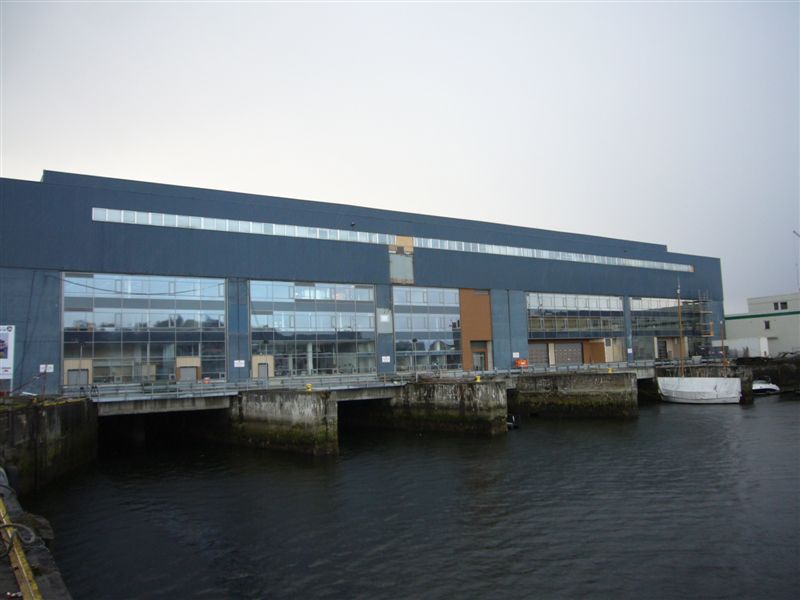
Dora I
The walls are three meters thick. The roof is three and a half meters of steel-reinforced concrete. After the war, Norwegian authorities decided to blow it up, then quietly abandoned the idea when engineers calculated the explosion would flatten the surrounding neighborhood. Dora I, the German submarine bunker on the Trondheim waterfront, was built to withstand Allied bombing raids. It succeeded. More than eighty years later, it still stands - no longer sheltering U-boats, but hosting the city archives, small businesses, and a bowling alley tucked inside what was once part of the largest German naval base in Northern Europe.
The Atlantic Gateway
Norway's occupation in 1940 gave Germany what it needed: direct access to the Atlantic and Arctic Oceans without the bottleneck of sailing from German ports. Trondheim became home to the 13th U-boat Flotilla, with 55 submarines assigned to its service during the war. But submarines in open harbors were vulnerable to air attack, and the Kriegsmarine needed protection. Construction of the bunker designated DORA I - the letter D in the German phonetic alphabet, a nod to the city's old German name, Drontheim - began in autumn 1941. The Todt Organisation's Einsatzgruppe Wiking and the Munich-based Sager and Worner construction company managed the project. The completed structure could hold 16 U-boats in hermetically sealed pens, impervious to anything the Allies could drop on it.
Built on Suffering
The Organisation Todt relied heavily on forced labor, and the construction of Dora I was no exception. Five Serbian workers died when a wall collapsed on them. A persistent rumor held that the Germans simply left the bodies entombed in the concrete. In reality, German engineers calculated that the five bodies would not compromise the fortification's strength, but the remains were ultimately removed before work continued. Beyond the human cost, the project faced relentless logistical difficulties. Norway built with timber, not concrete, so cement, sand, and aggregate were chronically scarce. Reinforcing steel had to be shipped from Germany. Snow and ice blocked roads and railways. Prefabricated housing units imported for the workers proved inadequate against the Norwegian winter. The original plan called for a second floor above the submarine pens to house workshops and accommodation, but by late 1941 that ambition was scrapped. Unstable ground - layers of clay, sand, and accumulated mud - forced engineers to build the bunker in stages, stabilizing each section before continuing.
Bombs That Barely Scratched
In July 1943, American bombers attacked the German base at Trondheim. They destroyed workshops, inflicted significant civilian damage, and set construction of the adjacent Dora II bunker back by three months. But Dora I itself suffered only light damage. The concrete held. A British raid attempted in November 1944 never reached the target at all - low cloud cover and German smoke screens forced the bombers to turn back. Construction of Dora II, started in 1942 just west of the original bunker, was only half finished when the war ended. A planned Dora III in Leangen Bay never broke ground. On 9 May 1945, German U-boats surrendered in Trondheim, and the fortress-like pens that had sheltered them passed into Norwegian hands.
Too Strong to Destroy
The Norwegian military planned to demolish Dora I with dynamite, but the sheer mass of the structure made that impossible without devastating the surrounding area. Instead, the bunker found a second life. The Norwegian submarine force, transferred from Britain in the summer of 1945, operated out of Dora I until 1954, when they relocated to Bergen. The Norwegian Defence Forces added two extra stories, painted blue, to the wartime structure. Eventually the bunker was converted into warehouse and workshop space. Today it is one of Trondheim's more unlikely civic buildings. The city and state archives occupy part of the complex, preserving Norway's documentary heritage inside walls designed to withstand thousand-pound bombs. A bowling alley operates in another section. The submarine pens themselves - the cavernous, water-filled chambers where U-boats once waited between patrols - now serve as a harbor for civilian boats, their hulls bobbing in the same dark water that once concealed weapons of war.
From the Air
Located at 63.44N, 10.42E on the Trondheim waterfront along the Trondheimsfjord. The massive concrete bunker is visible from low altitude as a large rectangular structure near the harbor. Nearest airport is Trondheim Airport Vaernes (ENVA), approximately 32 km northeast. Best viewed at 1,500-2,000 ft AGL for scale of the structure against the surrounding city.