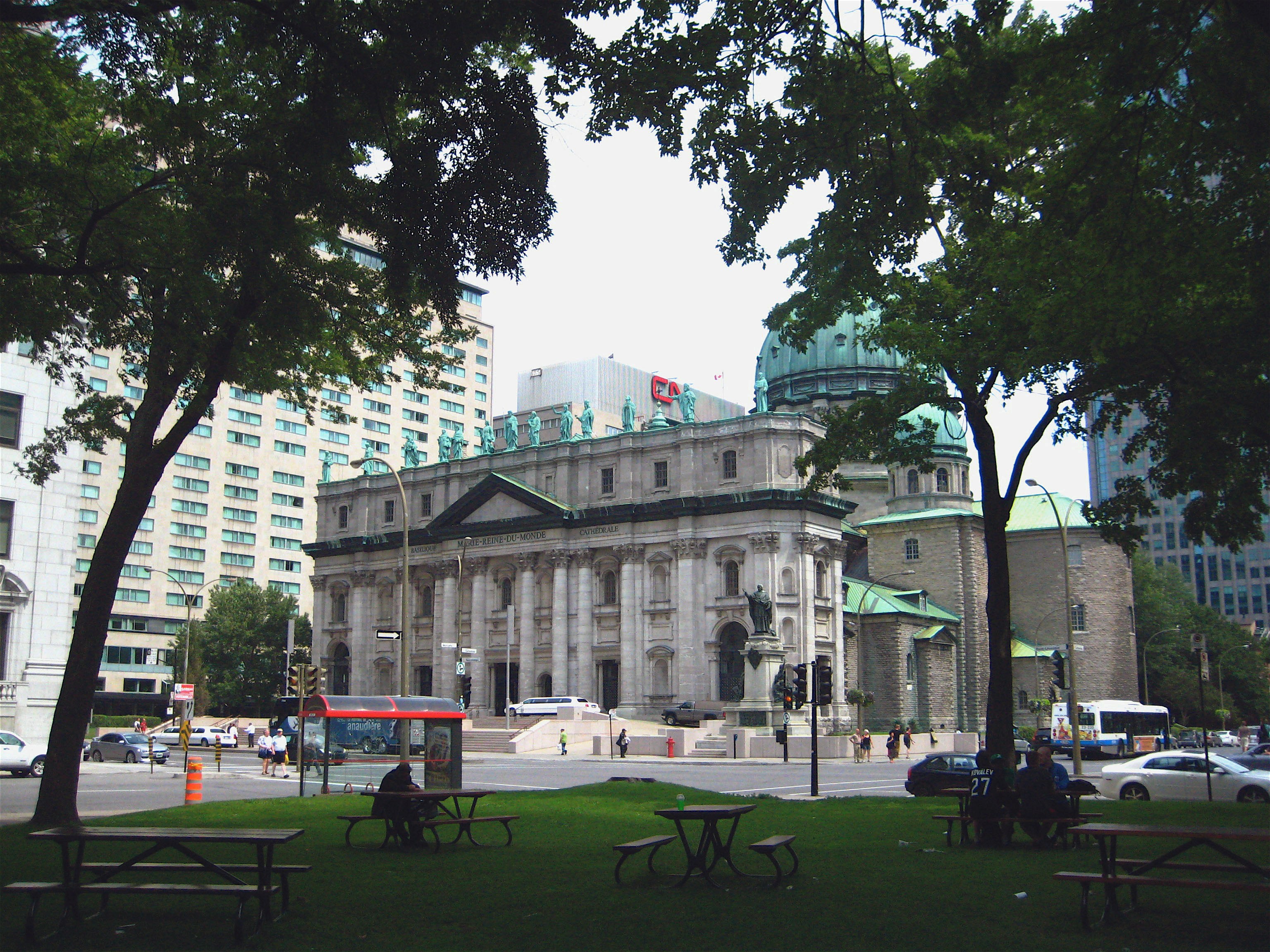
Dorchester Square: Montreal's Victorian Heart
Small crosses are embedded in the walkways of Dorchester Square, a discreet acknowledgment that thousands of Montrealers once lay buried beneath your feet. Until 1854, much of this ground served as the Catholic Sainte-Antoine Cemetery, a hastily arranged burial ground for victims of the 1851 cholera epidemic. The bodies were exhumed and moved to Notre-Dame-des-Neiges Cemetery on Mount Royal, and what had been a graveyard became the green center of a rapidly modernizing city. Today, Dorchester Square and its southern counterpart, Place du Canada, form the civic heart of downtown Montreal -- a patch of manicured parkland bordered by Rene Levesque Boulevard, Peel Street, Metcalfe Street, and a ring of landmark architecture spanning from the 1870s to the present day.
Cathedrals, Railways, and the Rise of a Square
The transformation of a cemetery into Montreal's premier public square began in the 1870s. Land acquisition started in 1872, and the park took its present form in 1878. That same year, the Catholic Archdiocese completed Mary, Queen of the World Cathedral across from the southeast corner, and the Windsor Hotel opened on the western side. In 1869, St. George's Anglican Church had already risen at Peel and De la Gauchetiere, spawning a cluster of Protestant churches and cathedrals that made the square a dividing line between the residential estates to the northwest and the commercial districts to the east. When the Canadian Pacific Railway built Windsor Station on the south side of De la Gauchetiere in 1889, the square became the transit hub of the city. The Sun Life Building consumed the entire eastern side by 1931, and the Dominion Square Building arrived in 1929 with a shopping arcade designed to funnel pedestrians between the square and St. Catherine Street.
Monuments in the Shape of a Cross
Four principal monuments were originally arranged in the shape of a Union Jack cross. At the center stands the Boer War Memorial, the only equestrian statue in Montreal, and atypically, the horse is restrained rather than mounted -- a reflection of the war's deep unpopularity in Quebec. Prime Minister Wilfrid Laurier's 1953 tribute faces south toward the United States, honoring his push for continental free trade, while his back turns toward the Boer War Memorial -- Laurier had opposed the war. The Robert Burns statue on the western side pays tribute to Montreal's Scottish industrialists and financiers, the poet gazing west toward the vastness of the Canadian territory they helped open by rail and capital. A steel fountain was added in 2015 by landscape architect Claude Cormier, who defied the city's suggestion to omit it for tourist bus parking and instead sliced off a portion, replacing it with a sculpture of a pileated woodpecker.
The Underground Crossroads
Dorchester Square sits at the junction of Montreal's most remarkable urban achievement: the Underground City. Two principal train stations -- Windsor Station and Central Station -- four metro stations, and the three densest sections of the underground pedestrian network all converge on or near the square. A parking garage lies beneath the park itself, accessed from Peel, Metcalfe, and Dominion Square streets. From here, the underground corridors reach north to the interconnected malls along McGill College Avenue -- Centre Eaton, Place Montreal Trust, Les Cours Mont-Royal -- and south through the Place Ville Marie corridor all the way to Place Bonaventure and Old Montreal. The Sun Life Building's massive central vault sits below street level, forcing underground pedestrian traffic to pass around the square, which means people must surface here -- an accident of engineering that makes the square one of the most naturally trafficked outdoor spaces in the city.
Where Montreal Gathers
The square has always been a place of assembly. On any summer day, thousands of office workers eat lunch on the grass, feet away from patches of cool temperate forest. The Camillienne kiosk at the northern end -- named for Mayor Camillien Houde, who ordered such structures built as Depression-era make-work projects -- serves as a seasonal snack bar. The Quebec Tourism bureau operates from the Dominion Square Building. But the square's most dramatic gatherings have been political. On October 27, 1995, three days before the Quebec sovereignty referendum, Canadians flooded Dorchester Square and Place du Canada for the Unity Rally, with crowd estimates ranging from 35,000 to 150,000. Prime Minister Jean Chretien, future premier Jean Charest, and a host of federal and provincial leaders rallied in support of federalism. A sovereigntist airplane trailed a banner reading 'Welcome to Our New Economic Partners!' The square held it all -- the passion, the debate, and the peaceful resolution that has defined its role for over a century.
From the Air
Located at 45.50N, 73.57W in the heart of downtown Montreal. From altitude, Dorchester Square appears as a distinctive green rectangle amid the dense cluster of skyscrapers south of Mount Royal. The Sun Life Building on its eastern flank and the Windsor Hotel to the west are recognizable landmarks. Rene Levesque Boulevard defines the southern boundary, separating the square from Place du Canada. The cross atop Mount Royal is visible to the north. Montreal-Trudeau International (CYUL) lies approximately 14 km to the west. The square sits at the core of Montreal's underground city network, though from the air it reads simply as a manicured green park surrounded by a remarkable concentration of historic and modern architecture.