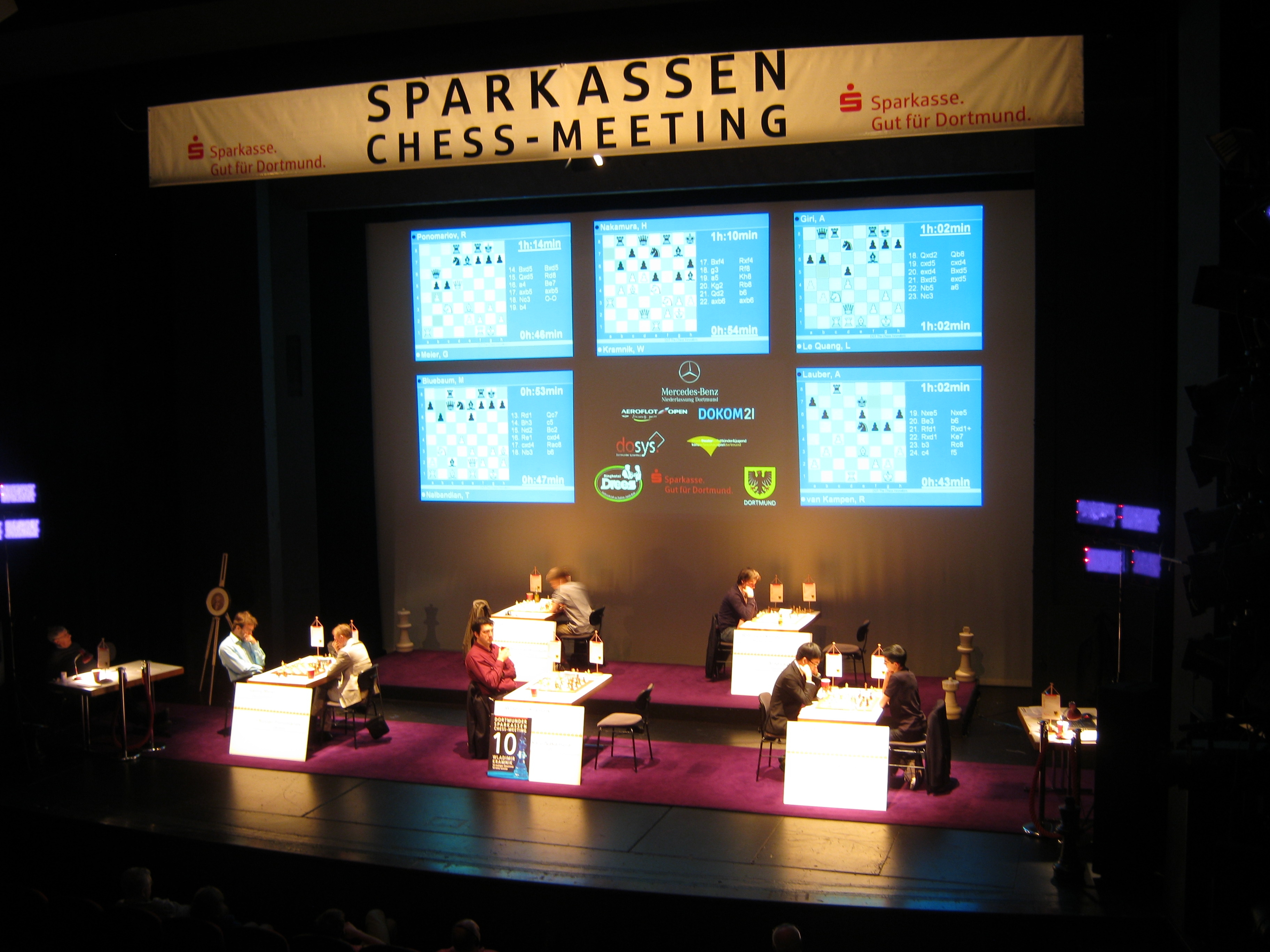
Dortmund Sparkassen Chess Meeting
In July 2002, in a quiet hall in Dortmund, the Hungarian grandmaster Peter Leko sat across from Bulgaria's Veselin Topalov and played for the right to challenge for the world championship of chess. Leko won. The tournament that produced him, the 30th Dortmund Sparkassen Chess Meeting, was technically just an invitational summer event sponsored by a North Rhine-Westphalia public savings bank. But for that one edition, the back room of a building owned by Sparkasse Dortmund decided who would play Vladimir Kramnik for the Einstein Group World Chess title. That is the kind of thing Dortmund does to chess.
A Tournament Older Than Some of Its Champions
The Dortmund Sparkassen Chess Meeting has run every summer since 1973. For most of its history it took the form of an invite-only elite round-robin or double round-robin, with a single guaranteed slot reserved for the winner of the previous winter's Aeroflot Open in Moscow. The Aeroflot is a brutal Swiss-system marathon designed precisely to surface young talent, and the prize of a Dortmund invitation was, for a generation of grandmasters, the first step into the top tier. Etienne Bacrot won it through that door in 2003. Ian Nepomniachtchi did, twice, in 2008 and 2015. Le Quang Liem of Vietnam took it in 2010 and again in 2011. The names roll on: Bologan, Rublevsky, Sutovsky, Jobava, Alekseev, Bartel, Najer, Fedoseev, Kovalev, Kulaots. Each was already strong. Dortmund was where they got to test themselves against the people at the very top.
The Year It Picked a Challenger
The 2002 edition broke pattern. Instead of the usual round-robin, the 30th Dortmund Sparkassen Chess Meeting, held from 6 to 21 July, was structured as a knockout. It served as the Candidates Tournament to determine the challenger for Vladimir Kramnik's Einstein Group World Chess title, the title Kramnik had taken from Garry Kasparov in their London match two years earlier. The format was unusual: a preliminary round followed by knockout matches, all in a single elite field. Peter Leko emerged from the brackets and defeated Veselin Topalov in the final. The match itself, the Classical World Chess Championship 2004, took two more years to organise. When Leko and Kramnik finally played in Brissago in October 2004 it ended 7-7 and Kramnik kept his title. But Leko's path to that match started, and could only have started, in Dortmund.
Kramnik's House
If Dortmund had a player, it was Kramnik. He won the tournament so many times that it became a kind of running gag in the chess press: the meeting itself was sometimes called Kramnik's birthday party. He led the 42nd edition in 2014, headlining a field that also included Fabiano Caruana and Michael Adams. He was back in 2015 alongside Caruana and the American Wesley So. He was back again in 2016 with Caruana and Maxime Vachier-Lagrave, the Frenchman who finally won the tournament on 16 July with a game to spare, his first Dortmund title. The events were held at the Orchesterzentrum NRW, a music academy whose hall doubles as a tournament venue, with the players given the classical time control of 100 minutes for the first 40 moves, then an additional 50 minutes for 20 more moves, then 15 minutes for the rest of the game with a 30-second increment from move one. The watching public sat just metres from boards on which world-championship-level moves were being calculated.
The Strangest Side Events
Dortmund has always made room for the strange and the experimental alongside the main draw. In 2001 the meeting hosted a Man-Machine Match between Robert Hubner, the German grandmaster, and the chess engine Deep Fritz. Every game was drawn, six in a row, final score 3-3, a peculiar kind of stalemate between human and machine. In 2002 a side match between David Baramidze and Alisa Maric, the Serbian women's grandmaster, ended 4.5 to 3.5 for Baramidze. In 2019 the Sparkassen Chess Meeting Open A, a Swiss tournament running alongside the main event, was won by Thomas Michalczak with a performance rating of 2533. In its newer incarnation, after a COVID-19-forced reset, the meeting added a flagship format called the No Castling Masters, a variant invented by Vladimir Kramnik himself, in which neither player may castle. The new rule strips one of the oldest defensive resources from the game and forces players to invent fresh ideas every move.
A Bank, a Bank Hall, and a Quiet Tradition
The title sponsor is Sparkasse Dortmund, the city's public savings bank, and the staying power of the tournament owes everything to that institution's willingness to keep funding chess year after year, in good seasons and bad, through three different formats and one pandemic. The latest incarnation, branded the Sparkassen Chess Trophy International Dortmund Chess Days, blends the elite invitational with large open events and an invite-only cup competition. In 2024 the event featured a six-game match between Germany's top two women, GM Elisabeth Pahtz and IM Dinara Wagner, with the Open A counting toward the FIDE Circuit. In 2025 the women's component grew to a double round-robin between Pahtz, Wagner, Deimante Cornette of France, and Lu Miaoyi of China, again with the open included in the FIDE Circuit. The buildings change. The format changes. The savings bank keeps writing the cheque, and the strongest players in the world keep boarding trains to a Ruhr city in July.
From the Air
The Dortmund Sparkassen Chess Meeting in its modern era has been held primarily at the Orchesterzentrum NRW in central Dortmund, near 51.5139 degrees north, 7.4653 degrees east, a few minutes from Dortmund Hauptbahnhof. From the air the venue is part of the city's culture mile, alongside the Theater Dortmund complex and the German Football Museum. Dortmund Airport (EDLW / DTM) is 13 km east; Dusseldorf International (EDDL / DUS) is 60 km southwest. Recommended viewing altitude 800 to 1,500 metres.