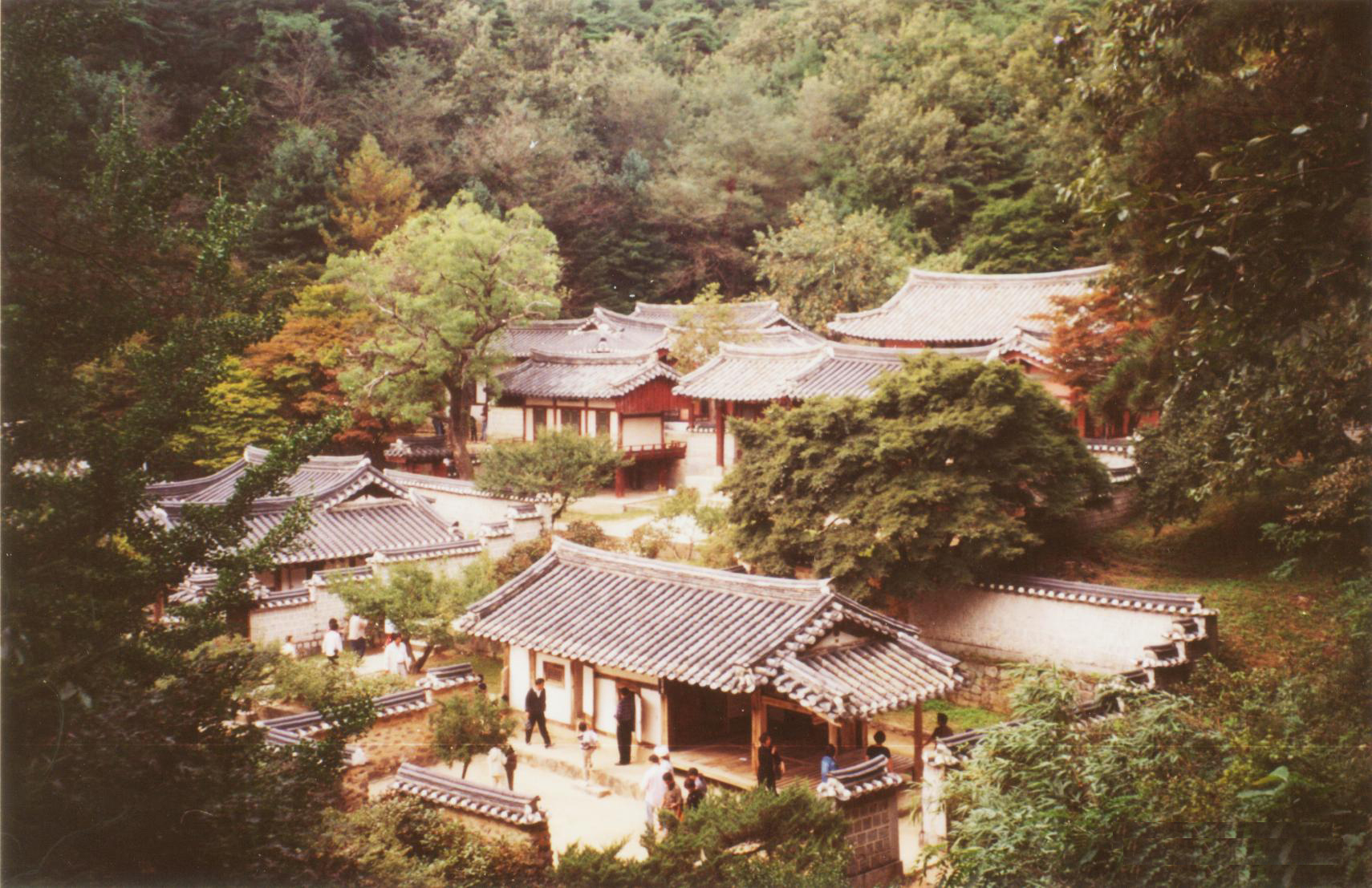
Dosan Seowon
Look at the floor of the lecture hall carefully and you will notice something odd: a section of wooden planks, crudely attached, breaking the otherwise measured elegance of the building. The story goes that the scholar Yi Hwang -- known by his pen name Toegye -- refused his students' suggestion to extend the hall to accommodate more learners. So while Toegye was out, his students attached the planks themselves. The master returned, saw the rough addition, and let it stand. Nearly five hundred years later, those hasty boards remain, a quiet testament to the relationship between teacher and students that defined this place.
A Scholar's Retreat
Yi Hwang retired to this hillside in Andong in 1549, seeking a place to study, teach, and live according to Confucian principles. He was not wealthy, and it took him four years to complete the modest lecture hall called Dosan Seodang. The building's three rooms -- an exposed floor, a large room, and a kitchen -- reflected both his means and his philosophy: learning required discipline, not luxury. He dug a small square pond called Jeongudang in the eastern garden where he raised lotus flowers, and planted apricot trees in the western part. Toegye called apricots, bamboos, chrysanthemums, and pine trees his "friends," but he loved the apricot trees most. A small signboard in his own calligraphy still hangs on one of the pillars.
The Academy Takes Shape
Toegye died in 1570, and four years later his disciples and other Confucian authorities established Dosan Seowon as a formal academy in his memory. Like other Korean seowon, it served two purposes: education in the Confucian classics and commemoration of the sages through regular memorial rites. The complex grew to include Nongun Jeongsa, a dormitory for students, and Jangpangak, a publishing center where woodblock prints of important texts were produced. The library was raised off the ground to protect its contents from humidity. In 1575, King Seonjo granted the academy a royal charter, elevating its status and ensuring its influence. For over 400 years, Dosan Seowon was home to the Toegye School of Thought, one of the most important intellectual traditions in Korean Confucianism.
On the Thousand-Won Note
The reach of Dosan Seowon extended well beyond its hillside. Yi Hwang's portrait appeared on the front of the South Korean 1,000 won bill, and the academy's lecture hall was featured on the reverse -- an honor it held from 1975 to 2007. Few educational institutions anywhere in the world have been considered important enough to grace a nation's currency. The recognition speaks to what Toegye represented: a model of the scholar-official whose intellectual rigor and personal modesty shaped Korean culture at its deepest levels. His philosophical work on the nature of principle and material force influenced not just Korea but also Confucian thought in Japan and beyond.
Ceremonies in the Quiet
The educational function of Dosan Seowon ceased long ago -- Korea's modern university system displaced the seowon centuries back. But the commemorative ceremonies have never stopped. Twice a year, descendants and scholars gather to perform the memorial rites that honor Yi Hwang and the tradition he built. The compound is designated South Korean Historic Site No. 170. A modern museum building stands within the grounds, but it is the old structures that draw visitors: the lecture hall with its mismatched floor planks, the lotus pond, the apricot trees that still bloom each spring. The setting itself is instructive -- a hillside above a river in a landscape of forested ridges, the kind of place where a scholar might convince himself that the world's noise could be kept at a distance, at least for a while.
From the Air
Located at 36.73N, 128.84E near Andong in North Gyeongsang Province. The academy sits on a hillside overlooking the Nakdong River valley, surrounded by forested ridges. Andong is inland, roughly 200 km southeast of Seoul. Nearest airports include Yecheon Airfield and Daegu International Airport (RKTN) to the south. The compound appears as traditional Korean architecture amid wooded terrain. The surrounding landscape is characterized by river valleys and mountainous terrain typical of Korea's interior.