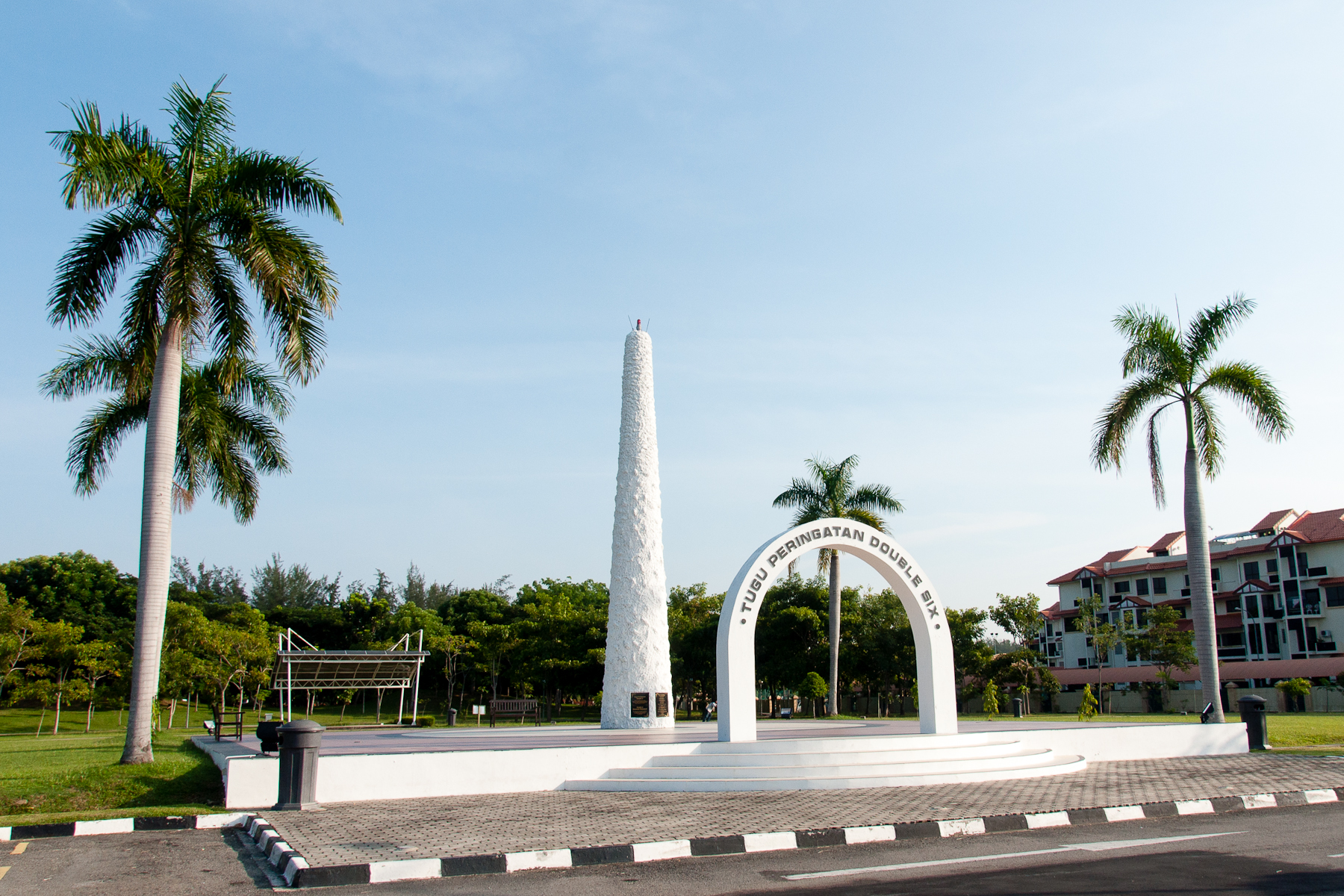
Double Six Monument
Eleven names are inscribed on the monument. Chief minister, state ministers, a finance secretary, an economic planning director, a private secretary, a bodyguard, a pilot, a father's eldest son. They died together on 6 June 1976 when a GAF Nomad aircraft crashed in the Sembulan neighborhood of Kota Kinabalu, and together their names are carved into the Double Six Monument that now occupies the ground where the wreckage came to rest. The date gives the tragedy its name: the sixth day of the sixth month. Double Six.
The Names on the Stone
The monument lists every soul lost in the crash, each name paired with a title that reveals how much of Sabah's government was aboard a single ten-seat aircraft. Fuad Stephens, Chief Minister. Peter Mojuntin, State Minister of Housing and Local Government. Chong Thien Vun, State Minister of Communications and Public Works. Salleh Sulong, State Finance Minister. Darius Binion, State Assistant Minister to the Chief Minister. Wahid Andu, Permanent Secretary of the State Ministry of Finance. Syed Hussein Wafa, Director of the State Economic Planning Unit. Ishak Atan, Private Secretary to Tengku Razaleigh Hamzah. Corporal Mohd Said, the chief minister's bodyguard. Captain Ghani Nathan, the pilot. Johari Stephens, Fuad Stephens' eldest son. Reading the list is to understand the scale of the loss: this was not merely an accident but the near-total destruction of a newly elected state government.
A Monument on the Crash Site
The Double Six Monument stands in the Sembulan neighborhood of Kota Kinabalu, directly on the site where the aircraft went down. The memorial features an arch that frames the inscription listing the victims, along with an exhibition hall that documents the tragedy and its aftermath. The design is solemn without being grandiose -- appropriate for a site that functions simultaneously as a memorial, a museum, and a place of mourning. Visitors walk through the exhibition to learn the circumstances of the crash, the political context of 1976 Sabah, and the lives of the eleven people who died. For many Sabahans, this is personal history. The people named on the monument were not distant figures but local leaders -- neighbors, family friends, the chief minister who had been in office for barely two months.
The Weight of Double Six
In Sabah's collective memory, the Double Six Tragedy occupies a space comparable to political assassinations in other nations -- an event that altered the trajectory of the state and left questions that festered for decades. The crash investigation report was classified for nearly fifty years, and its eventual declassification in 2023 found no evidence of sabotage. But the damage done by secrecy was its own kind of wound. Conspiracy theories attached themselves to the unresolved oil royalty dispute between Sabah and the federal government, to the political transitions that followed, and to the simple question of why so many leaders were on one small aircraft. The monument does not attempt to resolve these questions. It stands where the plane fell, bearing the names of the people who were inside it, and leaves the visitor to reckon with the rest.
Remembrance in Sembulan
The Sembulan neighborhood has grown up around the monument in the decades since the crash. What was once a crash site at the edge of a small city is now embedded in the urban fabric of a state capital with a metro population approaching 630,000. Every 6 June, Sabahans return to the site to pay their respects. The monument serves as both a civic landmark and a reminder that political history in Sabah is not abstract -- it is located, physical, and close enough to touch. The arch, the exhibition hall, the inscribed names: these are the state's way of insisting that eleven lives and the government they represented will not be forgotten, even as the city builds itself higher and denser around the place where they were lost.
From the Air
Coordinates: 5.96N, 116.06E. The Double Six Monument is in the Sembulan neighborhood of Kota Kinabalu, near Kota Kinabalu International Airport (ICAO: WBKK). The monument site is a ground-level structure in an urban area. From altitude, the Sembulan neighborhood is identifiable between the airport and the city center. The South China Sea lies to the west, and the islands of Tunku Abdul Rahman National Park are visible offshore.