Dougga
A wealthy citizen named P. Marcius Quadratus built his city a theater with his own money and celebrated the dedication with games, festivals, and food for the populace. That was in 168 AD, and the theater he paid for still hosts performances during the annual festival of Dougga. Few places in the ancient world offer this kind of continuity. UNESCO designated Dougga a World Heritage Site in 1997, calling it "the best-preserved Roman small town in North Africa." The 75-hectare site escaped the fate of Carthage -- repeatedly pillaged and overbuilt -- because it sat in the countryside, too remote for modern urbanization to consume it.
Before Rome, Before Carthage
Dougga's name preserves its origins. The Numidian toponym TBGG, recorded in the Libyco-Berber alphabet, likely derives from a root meaning "to protect" -- a reference to the site's position atop a defensible plateau overlooking the Oued Khalled valley. The settlement dates to at least the 6th century BC, and dolmens on the site suggest occupation stretching back perhaps 4,000 years. Punic influence arrived through Carthage, and inscriptions show that Punic-style shofets still governed alongside Roman magistrates well into the imperial period. For two centuries after Rome's conquest, Dougga was governed by a dual system: a city (civitas) of indigenous inhabitants and a community (pagus) of Roman colonists, each with its own magistrates and council. At one point, the city had three magistrates serving simultaneously -- a rarity in the entire Mediterranean.
The Capitol and Its Companions
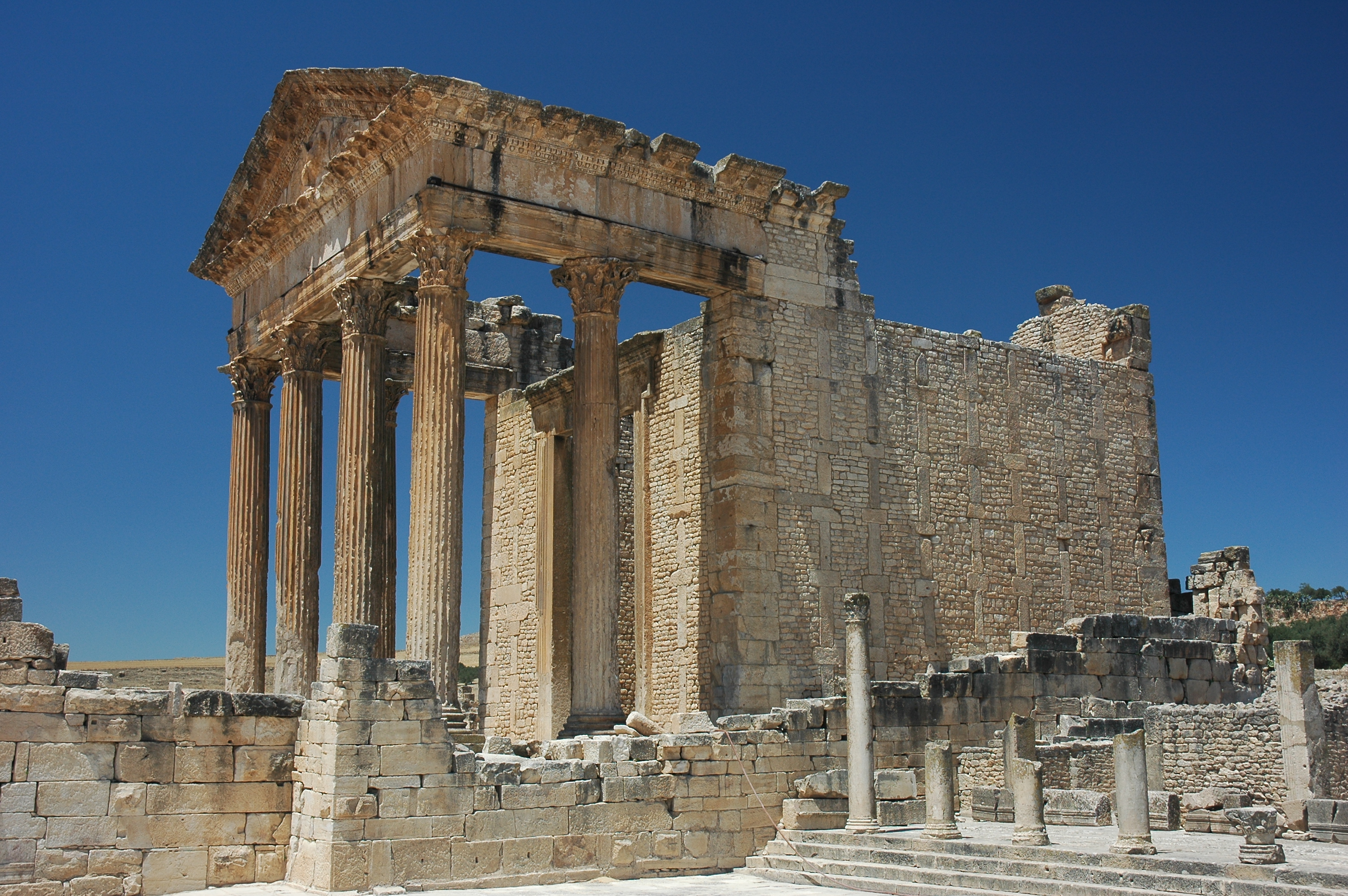
The Capitol dominates the forum as it was meant to, its Corinthian columns rising eight meters to support a perfectly preserved pediment. Carved into that pediment is a scene of Emperor Antoninus Pius being carried to godhood by an eagle. Completed around 166-167 AD with a dedication to Jupiter, Juno, and Minerva, the Capitol owes its exceptional preservation to an ironic twist: the Byzantines incorporated it into their fort, and the military structure shielded the temple from further damage. Nearby stands the Temple of Juno Caelestis, successor to the Punic goddess Tanit, its semi-circular temenos still intact. The Temple of Saturn occupies a promontory overlooking the cereal valley, built over an older sanctuary of Baal Hammon where ritual ditches full of ex-votos were found beneath the Roman foundations.
A City Built for Spectacle
For a town of perhaps 5,000 inhabitants, Dougga accumulated an extraordinary concentration of public buildings. The theater seats 3,500 -- meaning the entire population could attend a performance simultaneously and still leave room for visitors. A circus 393 meters long hosted chariot races; a wealthy woman named Gabinia Hermiona donated the land "for the pleasure of the people" and bequeathed funds for an annual banquet for the city council after her death. The Licinian Baths, donated by the Licinii family in the 3rd century, retain much of their original walls and include a tunnel used by the enslaved workers who maintained the heating systems. From above, the city resembles what scholar Hedi Slim described as "a compact mass" cascading down the hillside, its streets winding rather than following the standard Roman grid -- the builders adapted to the terrain rather than imposing geometry upon it.
The Mausoleum's Stolen Voice
The Libyco-Punic Mausoleum, 21 meters tall and capped with a pyramid, is one of only three surviving examples of royal Numidian architecture. In 1842, the British consul in Tunis, Thomas Reade, damaged the monument severely while removing its bilingual inscription -- a Punic-Libyan text that enabled scholars to decipher the Numidian alphabet. That inscription now sits in the British Museum. The mausoleum was reconstructed between 1908 and 1910 by French archaeologist Louis Poinssot from pieces scattered across the ground. Recent scholarship suggests the names in the inscription are not those of the tomb's occupant but of its builders: the architect and head artisans who constructed it for the citizens of Dougga. Some researchers believe the monument was intended for Massinissa himself -- the Numidian king whose temple, dated to 139 BC, stands on the western flank of the Capitol.
From the Air
Located at 36.42°N, 9.22°E, approximately 5 km southwest of the modern town of Teboursouk in northern Tunisia. The 75-hectare site is clearly visible from altitude as extensive ruins on a hillside plateau. The Capitol and theater are the most recognizable structures. Recommended viewing altitude: 4,000-6,000 feet AGL. Nearest major airport: Tunis-Carthage International (DTTA) approximately 110 km northeast. The terrain is hilly with olive groves surrounding the site.