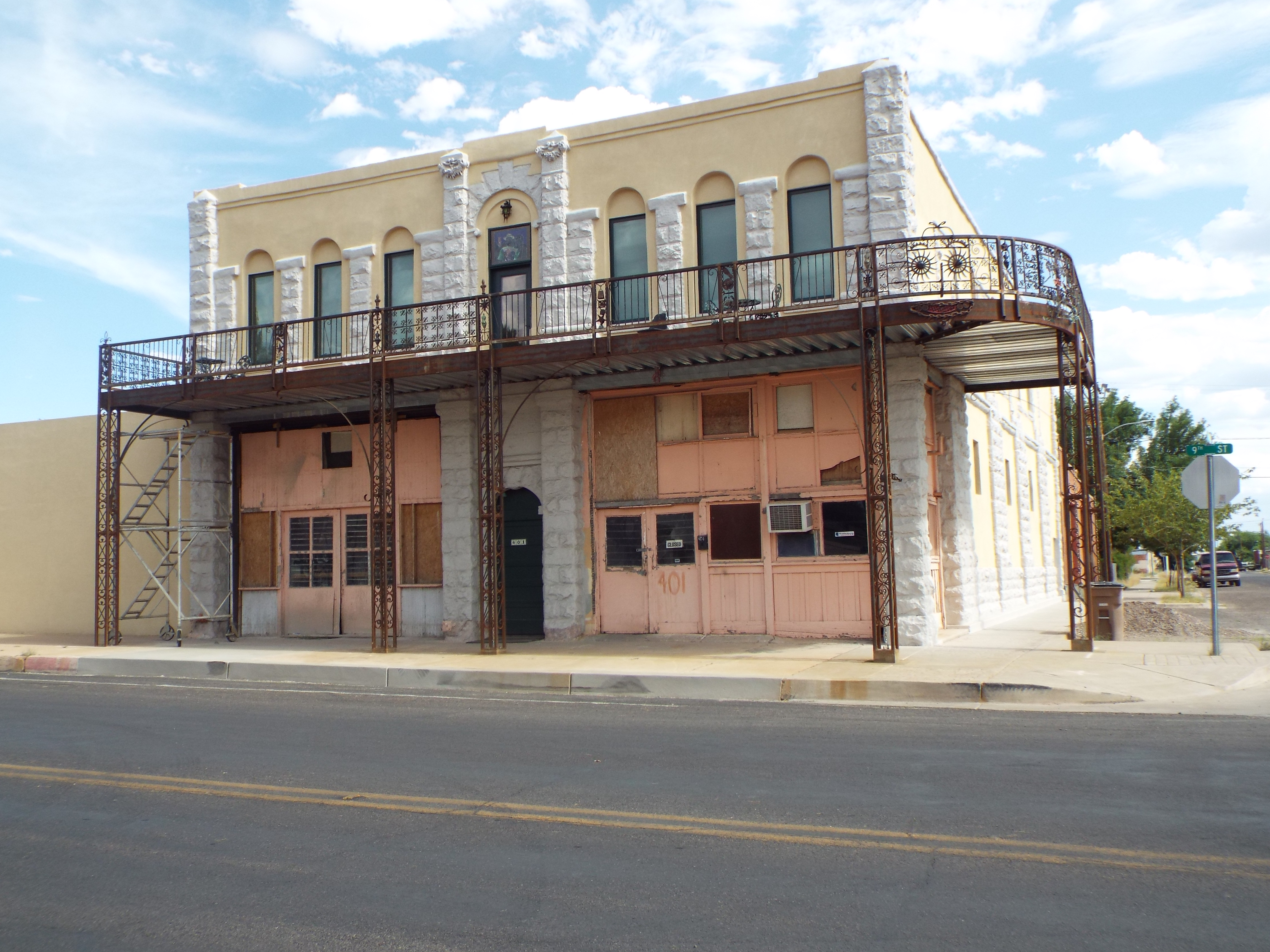
Douglas Historic District
In 1930, Robert Ripley declared it impossible, then printed it anyway: four churches standing shoulder to shoulder on a single city block. Grace Methodist, St. Stephen's Episcopal, First Baptist, and First Presbyterian had grown up together in this copper-boom town just eight blocks from the Mexican border, their congregations arriving by rail and staying to build something extraordinary. Church Square still anchors Douglas, Arizona, a testament to the unlikely community that rose from the Sonoran Desert in 1901 when Phelps Dodge needed somewhere to smelt its copper. The historic district that surrounds it preserves one of the most complete collections of early commercial architecture in the American Southwest.
Copper's Legacy in Stone and Terra Cotta
Douglas owes its existence to the smelters. When Phelps Dodge established its reduction works here at the turn of the twentieth century, the company needed a town, and the town needed buildings. What emerged along G Avenue between 1901 and 1935 was remarkable not for its uniformity but for its ambition. The Spanish Colonial Revival Gadsden Hotel anchors the 1100 block with its ornate facade, individually listed on the National Register of Historic Places. Across the street, the Grand Theatre displays an early and extensive use of sculpted terra cotta that predates the material's widespread adoption in the Southwest. The Art Deco Airdome Theatre and the Neo-Classic Revival Post Office round out a streetscape that reads like a catalog of American architectural styles transplanted to the Arizona desert.
Building Blocks of a Border Town
The district's construction tells the story of a town learning to build itself. Early structures like the Samson Hotel rose from adobe, the traditional material of the region. As Douglas prospered, solid brick and brick veneer over reinforced concrete became the standard. Cast stone appears on the Watts Hotel and the Irene Building. Luxfer Prisms, those ingenious glass tiles that bent daylight into windowless interiors, still gleam in the transoms of older storefronts. The Phelps Dodge Mercantile, built in 1902-1903, hides behind a modern shell, but step inside and the past reasserts itself: pressed tin ceilings, stained wood wainscoting, polished wooden floors worn smooth by generations of miners and merchants. The building encapsulates Douglas itself, a century of history visible to anyone willing to look beyond the surface.
The Architects Who Shaped the Desert
The firm of Trost and Trost left their mark throughout the district. Henry Trost and his brother Gustavus designed the Neo-Classic Brophy Building and the terra-cotta-clad Airdome Theatre around 1925, bringing El Paso sophistication to this Arizona border town. Their work joined structures ranging from one-story frame buildings to the imposing Masonic Temple and the Hotel Douglas-Arizona Club. Marlin's Saddle Shop, built in 1905, served the cowboys and ranchers who still drove cattle through the San Bernardino Valley. The Irene Building and the Bank of Commerce added Neo-Classic elegance to G Avenue's commercial corridor. Together, these buildings document Douglas's transformation from mining camp to established community during the district's most significant growth period.
A Street That Tells Time
Walk the blocks of the Douglas Historic District and you walk through decades. The smaller, older buildings cluster at the south end, in the 800 and 900 blocks, where the town first took root. The 1100 block marks the commercial peak, dominated by the Gadsden Hotel and Grand Theatre. To the north, in the 1200s through 1400s, the buildings grow modest again as the district reaches its edges. This organic growth happened without master planning, without concern for compatible land uses or visual cohesiveness, yet the resulting streetscape possesses a unity that formal planning rarely achieves. The brick, stucco, and frame buildings retain most of their original architectural characteristics, contributing structures that remain essential to the district's character even when they lack the grandeur of the major landmarks.
The View from Above
From the air, Douglas presents itself as a geometric grid pressed against the international boundary, the copper smelter smokestacks that once defined its skyline now silent. The historic district forms a dense commercial core along G Avenue, distinguishable by the uniform building heights and the shadows cast by decorative cornices and parapets. Church Square is visible as a concentration of ecclesiastical architecture unlike anything else in the region. The town sits in the broad San Bernardino Valley, with the Peloncillo Mountains to the east and the border fence stretching toward the horizon. The land here is flat cattle country, crossed by the old smuggling routes that once brought silver and trouble through Guadalupe Canyon. Douglas endures as a border town, its architecture a permanent record of the boom years when copper was king.
From the Air
Douglas Historic District is located at 31.345N, 109.554W in extreme southeastern Arizona, just 8 blocks from the U.S.-Mexico border. The town is visible from cruising altitude as a grid pattern against the desert floor. Nearest airport is Bisbee Douglas International (KDUG), 8 nm to the northwest. Best viewed at 3,000-5,000 ft AGL for architectural detail. The Peloncillo Mountains rise to the east; the Sierra San Jose in Mexico lies to the south. Visibility typically excellent in this high desert environment.