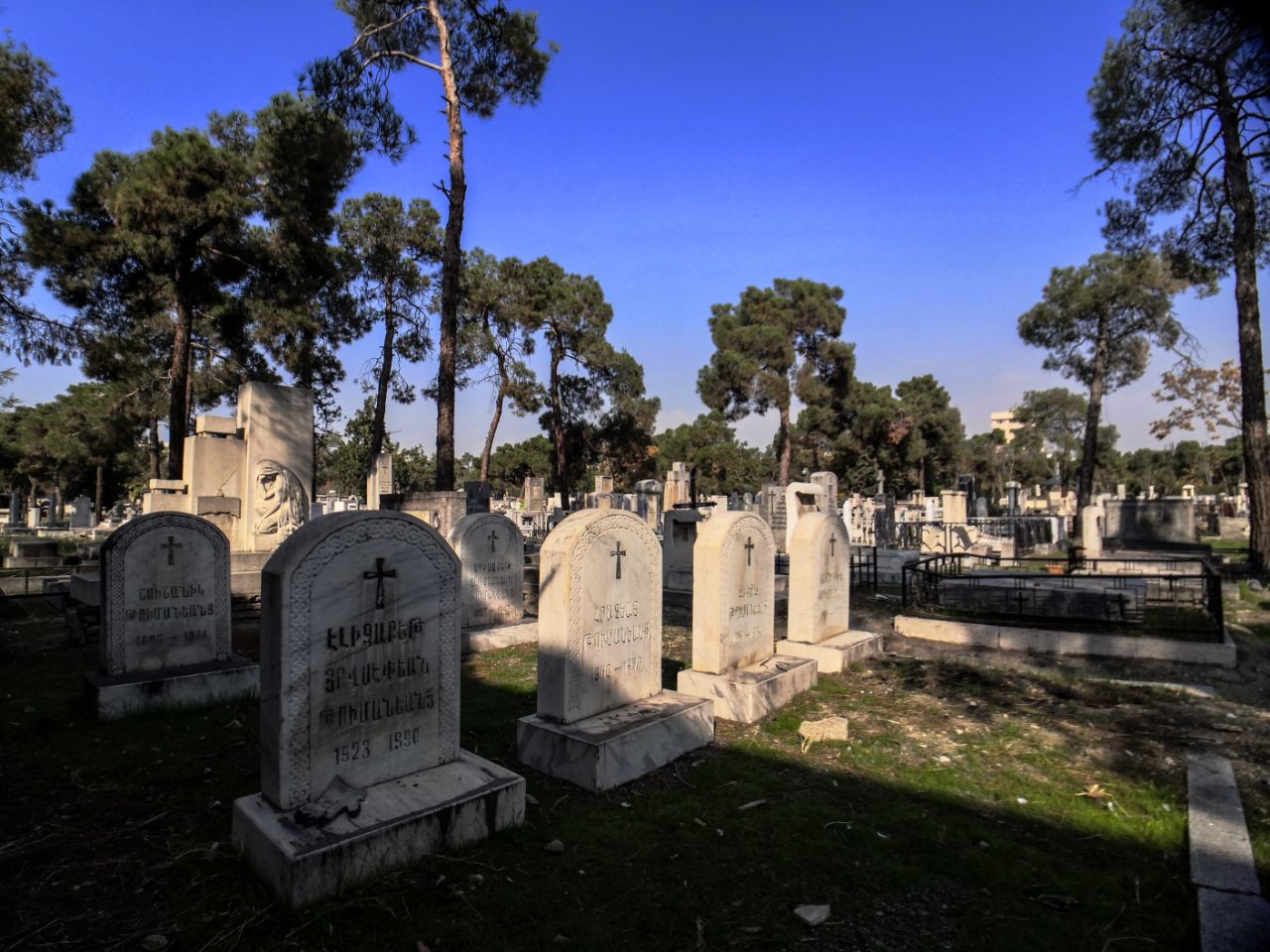
Doulab Cemetery
In 1855, a young French doctor named Louis Andre Ernest Cloquet died in Tehran. He had served as personal physician to Naser al-Din Shah Qajar, and his colleagues buried him in an open field in the Doulab district, near an existing Armenian cemetery. That modest grave, still visible beneath a small brick cupola, became the seed of something unexpected: a sprawling 76,000-square-meter cemetery complex that would eventually hold the dead of more than thirty nations, from Germany to Japan, from Latvia to the Philippines.
The Doctor's Field
When the Lazarist priests arrived in Tehran in 1862, they found a Catholic community of exactly 87 souls, all foreigners or Chaldean Catholics. They took charge of the cemetery surrounding Dr. Cloquet's tomb, and in 1886 Joseph Desire Tholozan, a French officer of the Legion d'honneur serving as physician for the French mission, purchased the land outright. From that point forward, the cemetery belonged to Tehran's Catholic community, which grew steadily more international with each passing decade. The site expanded in distinct sections: Armenian Apostolic, Eastern Orthodox for Russians and Georgians and Greeks, Roman Catholic, Armenian Catholic, and Assyrian. Five faiths, five sections, one shared ground.
The Polish Exodus
The most dramatic chapter in Doulab's history arrived in 1942, when an estimated 120,000 Polish soldiers and civilians washed up on Iran's Caspian shore at Bandar Anzali. They had been released from Soviet captivity and were bound to form the Polish Army of the East under General Wladyslaw Anders. Many never recovered from the journey. Weakened by years of forced labor in Siberian camps, they died upon reaching Iran or shortly after. The Polish Embassy purchased half the Catholic cemetery's terrain to give these refugees a final resting place. Their graves lie in Tehran soil, thousands of kilometers from the homeland they were trying to reach.
Lives Written in Stone
Walk through Doulab's sections and you encounter an improbable cross-section of people who made Tehran home. Antoin Sevruguin, the Armenian-Iranian photographer who documented Qajar-era Persia, rests here. So does Ovanes Ohanian, the film director who created Iran's first feature film. Alfred Jean Baptiste Lemaire, a French military musician and composer, shares the grounds with Nikolai Markov, a Russian architect, and Wladyslaw Horodecki, a Polish architect known for his work in Kyiv. Anna Borkowska, a Polish-Iranian actress, lies near Helena Stelmach, a Polish-Iranian war veteran who survived the 1942 exodus as a child and lived in Tehran until 2017. The headstones read like a catalog of the world's displaced, ambitious, and adventurous.
A Heritage Under Threat
In 2000, the Iranian Cultural Heritage Organization listed Doulab as a national cultural heritage item. But that protection came with an asterisk. During the 1990s, Tehran's city administration had revoked permission to use the ground for new burials, reasoning that after forty years, the graves could be demolished and the land repurposed for development. A new cemetery location was identified for the Catholic community, and Doulab seemed destined for oblivion. The complex persists, though its future remains uncertain. About five burials per year had sustained it through the second half of the twentieth century, a trickle that kept the grounds alive but could not insulate them from the pressures of a city of nine million expanding around them.
From the Air
Doulab Cemetery is located at 35.676N, 51.471E in eastern Tehran. From the air, look for the green patches of cemetery grounds amid dense urban fabric southeast of Tehran's center. Mehrabad International Airport (OIII) lies approximately 8 km to the west. Imam Khomeini International Airport (OIIE) is about 50 km to the south. Best viewed at altitudes between 3,000 and 5,000 feet AGL for context within Tehran's eastern suburbs.