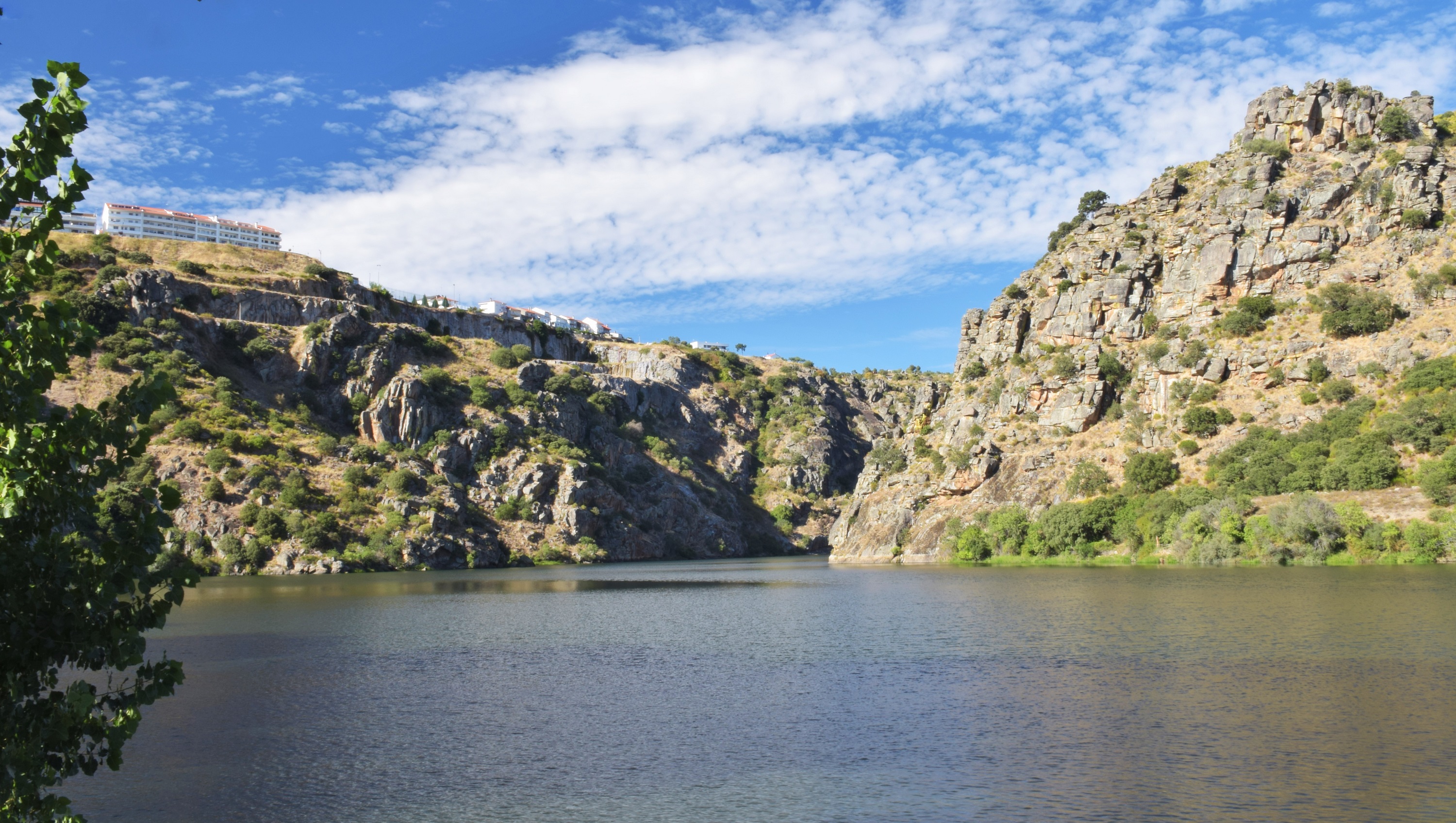
Douro International Natural Park
The Egyptian vulture arrives each summer from Africa, crossing the Strait of Gibraltar and following the Iberian interior northward until it reaches the Douro River canyon. Here, where the river has spent millions of years cutting a deep trench through granite to mark the border between Portugal and Spain, the cliffs provide exactly what the vulture needs: vertical rock faces with ledges for nesting, updrafts for soaring, and a landscape too rugged for most human activity. The Egyptian vulture is the symbol of the Douro International Natural Park, and the choice is fitting. This 868-square-kilometer protected area exists because of those cliffs.
The River as Sculptor
The Douro River has been carving this canyon for millennia, and the result is a landscape of vertiginous drama. Steep cliffs drop hundreds of meters to the water, while rocky outcrops and narrow side valleys create a fractured, layered terrain. The park stretches along the Portuguese side of the river through the municipalities of Miranda do Douro, Mogadouro, Freixo de Espada a Cinta, and Figueira de Castelo Rodrigo, with the Spanish Arribes del Duero Natural Park protecting the opposite bank. Together, they form one of the largest transboundary protected areas in Western Europe. The park also encompasses the border area of the Agueda River, another tributary that has carved its own dramatic valley through the same ancient rock.
A Cliff-Face Kingdom
Established in 1998, the park protects what may be the most important cliff-breeding bird community in Portugal. Griffon vultures nest on the canyon walls, their numbers recovering from fewer than ten pairs in the 1990s to more than seventy by 2015. Bonelli's eagles and golden eagles patrol the thermals. Black storks, rare across most of Europe, nest in the more sheltered sections of the gorge. Peregrine falcons, choughs, alpine swifts, and blue rock thrushes complete a community of cliff-dwellers that has few parallels on the continent. The Egyptian vulture, smaller than its griffon cousin and identifiable by its contrasting underwing pattern and wedge-shaped tail, migrates here each summer to breed, making the park a critical link in the species' survival chain.
Beyond the Cliffs
The park is not only vertical. Above the canyon rim, the cold Mirandese plateau extends across northeast Portugal, a landscape of open fields, stone-walled villages, and a continental climate harsher than anything on the coast. The contrast between the sheltered river valley and the exposed plateau above creates diverse habitats within a compact area. Iberian wolves still roam the remoter sections. Wild cats hunt in the scrubland. Roe deer move through the holm oak and cork oak woodlands that cling to the less precipitous slopes. The flora shifts with altitude and exposure, from Mediterranean species in the warmer, south-facing gorge bottoms to hardier Atlantic vegetation on the plateau.
A Border Written in Stone
The word "International" in the park's name is not decorative. The Douro River has served as the border between Portugal and Spain for centuries, and this section of frontier was always one of the most remote and least accessible. Villages on both sides of the canyon developed in relative isolation, connected more to their own river than to each other or to their distant capitals. Miranda do Douro, the largest town on the Portuguese side, still preserves its own language, Mirandese, one of the few recognized minority languages in Portugal. The landscape itself enforced separateness. The same cliffs that shelter vultures made crossing the river difficult, turning a natural boundary into a political one that has endured since the Middle Ages.
From the Air
Located at 41.21N, 6.73W in northeast Portugal along the Spanish border. The park is dramatically visible from the air as a deep canyon system carved by the Douro River, with cliffs dropping hundreds of meters. The contrast between the flat Mirandese plateau and the incised river gorge is striking from altitude. Nearest airports include LPBG (Braganca) approximately 80 km north and LESA (Salamanca, Spain) approximately 150 km south. Best viewed from 4,000-6,000 ft AGL to appreciate the canyon depth. Watch for soaring raptors in thermal columns, especially in summer months.