Dover Air Force Base
On a June evening in 1989, a C-5 Galaxy from Dover's 436th Military Airlift Wing dropped 190,346 pounds of cargo and 73 paratroopers from its cavernous belly, setting a world record that captured what this base does better than anywhere else on Earth: move massive loads through the sky. Dover Air Force Base, tucked into the flat Delaware coastal plain southeast of the state capital, runs the busiest and largest air freight terminal in the entire Department of Defense. But the numbers only tell half the story. Dover is also the place where America's fallen come home, a dual identity that makes it one of the most operationally vital and emotionally charged military installations in the country.
Born Ten Days After Pearl Harbor
Construction on the Municipal Airport at Dover Airdrome began in March 1941, but the facility had barely opened on December 17 when the world changed. Just ten days after the attack on Pearl Harbor, the fledgling airfield was pressed into military service. The 112th Observation Squadron of the Ohio National Guard arrived on December 20 to fly anti-submarine patrols off the Delaware Coast, and by early 1942 B-25 Mitchell bombers were hunting German U-boats in the Atlantic. Buildings went up fast, most clad in little more than plywood and tarpaper over concrete foundations. In 1944, the Air Technical Service Command chose Dover for classified air-launched rocket tests, experiments that shaped the deployment of air-to-surface rockets across both the European and Pacific theaters. When the war ended, the base fell quiet, placed on inactive status in September 1946 with only a small caretaker squad left behind.
The Galaxy's First Home
The Korean War and Cold War tensions brought Dover roaring back to life in 1950. P-51 Mustangs from the Pennsylvania Air National Guard arrived first, but the base's true destiny emerged in 1952 when it transferred to the Military Air Transport Service. Dover became an airlift powerhouse. In 1971, the 436th Military Airlift Wing began receiving the enormous C-5 Galaxy, and by 1973 Dover was the first all-C-5 wing in the Air Force. The Galaxy's ability to swallow tanks, helicopters, and bridge sections whole made Dover the go-to base for every major operation: a 32-day airlift delivering 22,305 tons of equipment to Israel during the 1973 Yom Kippur War, 131,275 tons of cargo during Desert Shield, and missions supporting operations in Grenada, Panama, the Balkans, and Somalia. In 2009, Dover became the first base to receive the upgraded C-5M Super Galaxy, christened 'The Spirit of Global Reach.'
Where America Brings Its Fallen Home
Dover carries a weight that no tonnage figure can express. The Charles C. Carson Center for Mortuary Affairs is the largest military mortuary in the Department of Defense, the place where service members killed overseas are received, identified, and prepared for transfer to their families. During Vietnam, more than 20,000 American war dead passed through Dover, accounting for over 90 percent of all remains processed at the base before 1988. The mortuary has also served in extraordinary civilian circumstances: identifying victims of the Jonestown mass murder-suicide in 1978, the crew of Space Shuttle Challenger in 1986, and the crew of Columbia in 2003. On the night of October 28, 2009, President Barack Obama visited Dover to receive the bodies of soldiers killed in Afghanistan, a moment that underscored the base's role as a place where the cost of war is measured not in cargo tonnage but in human sacrifice.
The Freight Capital of National Defense
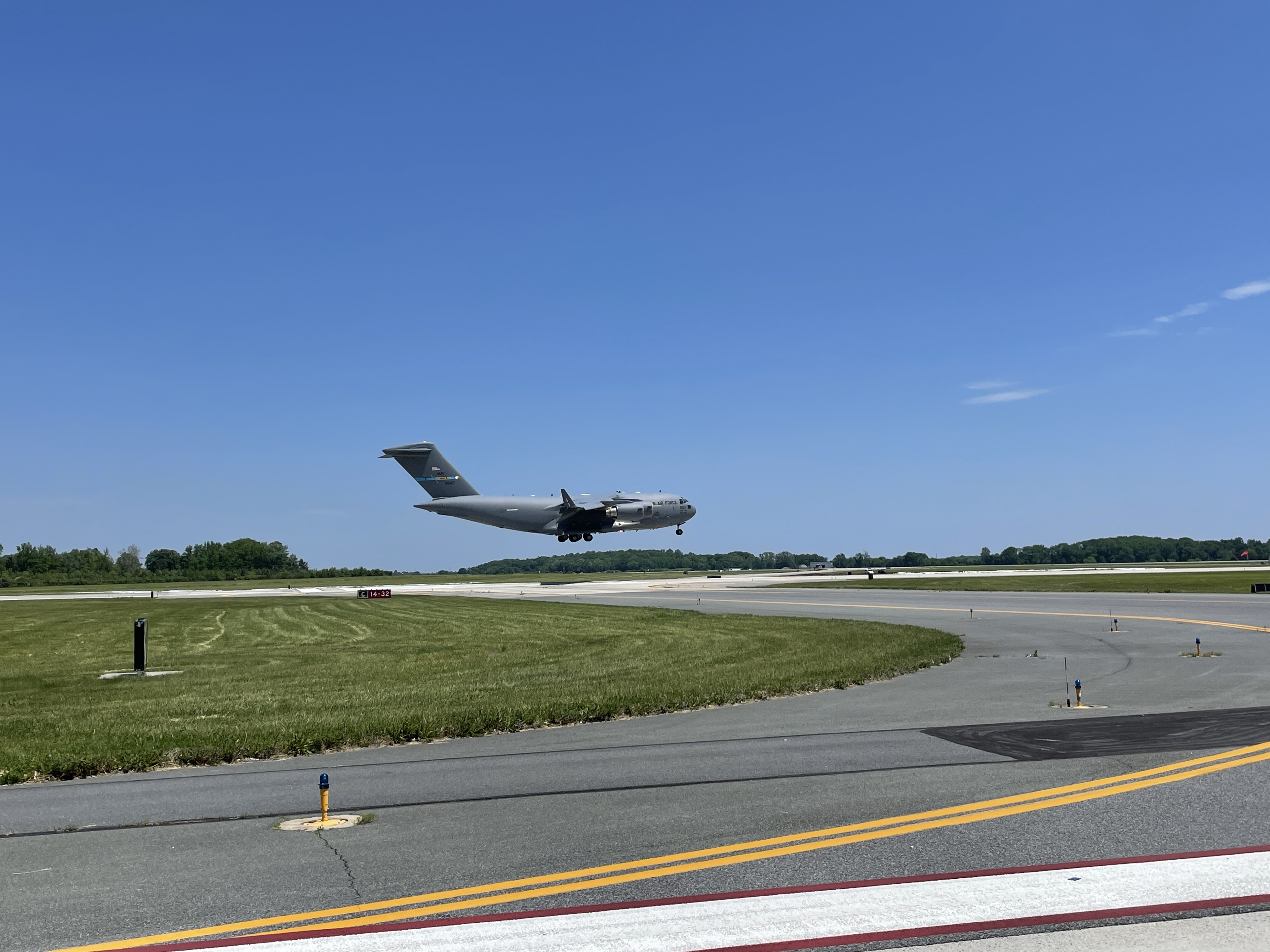
Today Dover operates two massive runways: Runway 14/32 stretching 12,903 feet and Runway 1/19 at 9,602 feet. The base averages 339 aircraft operations per day, all of them military. The 436th Airlift Wing, known as the Eagle Wing, and the Air Force Reserve's 512th Airlift Wing, the Liberty Wing, fly C-17 Globemaster IIIs and C-5M Super Galaxies from their four flying squadrons. Dover's reach extends beyond its flight line. The base provides almost $470 million in annual revenue to the city of Dover, making it the third largest industry in Delaware. The Air Mobility Command Museum in historic Hangar 1301, listed on the National Register of Historic Places since 1994, houses a collection of restored cargo and tanker aircraft. Retired pilots and flight engineers lead tours, sharing first-person accounts from missions that shaped modern military airlift.
An Unexpected Space Connection
Few people realize that Dover was one of only seven airports in the United States designated as a Space Shuttle launch abort facility. That connection became tragically personal in January 1986 when the remains of the seven Challenger astronauts were transferred to Dover's mortuary for identification. The base has also played roles that seem almost implausible for a Delaware airfield: in March 1989, C-5s from Dover delivered specialized equipment to clean up the Exxon Valdez oil spill in Alaska's Prince William Sound. During the Cold War, a Dover crew delivered a 40-ton superconducting magnet to Moscow, earning the prestigious Mackay Trophy. From airdropping a Minuteman intercontinental ballistic missile to landing the first C-5 at Baghdad International Airport in 2003, Dover has been where the Air Force sends its biggest aircraft to do its most critical work.
From the Air
Dover AFB (KDOV) sits at 39.128N, 75.465W on the flat Delaware coastal plain. Two prominent runways oriented 14/32 (12,903 ft) and 01/19 (9,602 ft) are visible from altitude, along with large ramp areas and distinctive hangars. The base is entirely military; civilian pilots should note the restricted airspace. Nearest civilian airports include Delaware Airpark (33N) and Summit Airport (EVY). Look for the massive C-5M Super Galaxy aircraft on the ramp, among the largest military aircraft in the world. Dover is approximately 50 nm south of Philadelphia International (KPHL) and 85 nm east of Baltimore-Washington International (KBWI).