Dover Strait coastal guns
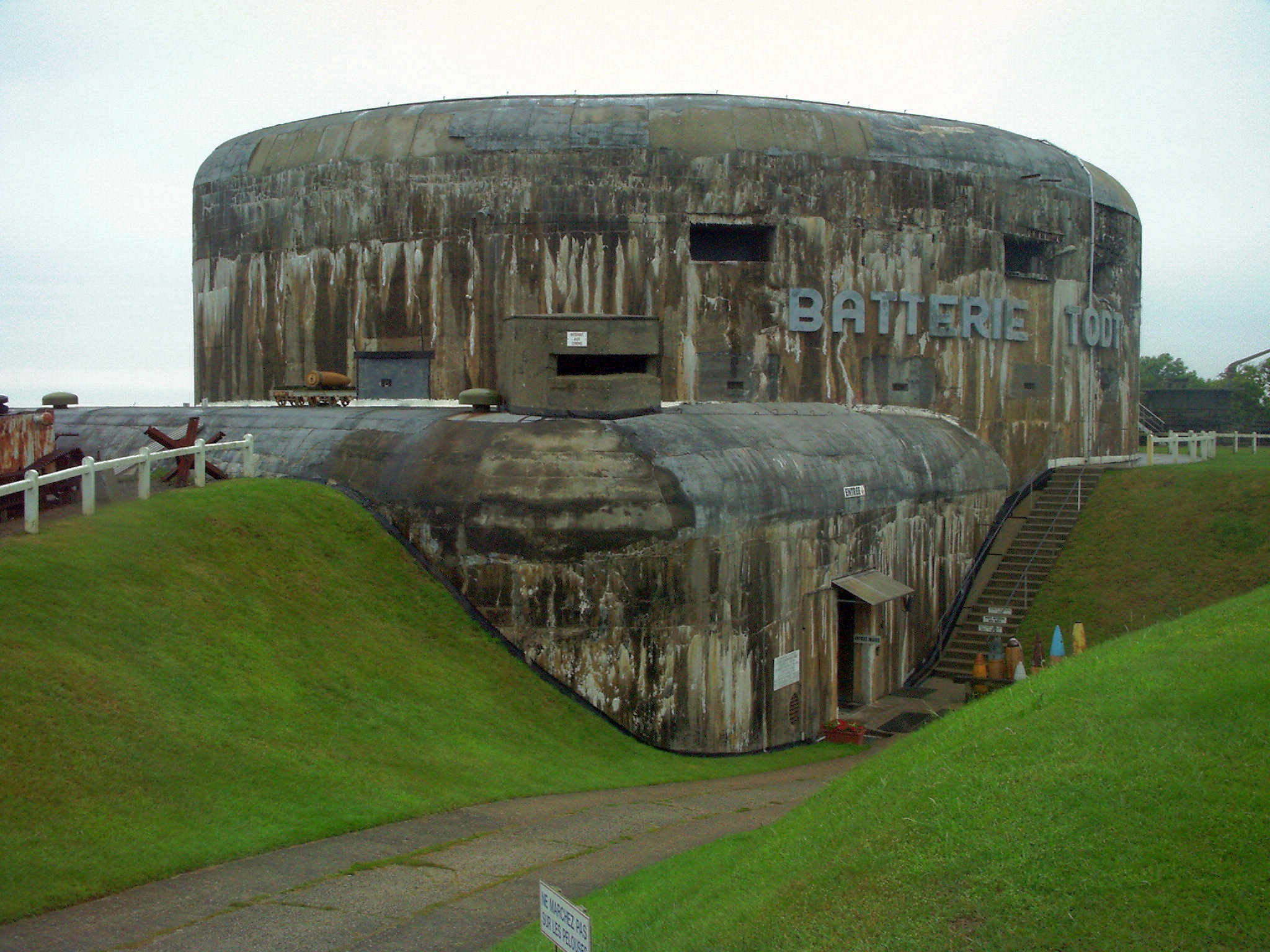
On the evening of 12 August 1940, the first German shells from the Pas-de-Calais arrived in Dover. They had been fired from the Grosser Kurfurst Battery at Cap Gris-Nez, traveled roughly 33 kilometers across open water in under two minutes, and landed in a town that for nine hundred years had imagined itself shielded by twenty-one miles of water from anything an enemy could throw across the Channel. For the next four years, Dover would learn what it meant to be in artillery range. Hitler's batteries on the French coast - Lindemann, Todt, Grosser Kurfurst, Friedrich August, Oldenburg, Prinz Heinrich - would fire more than a thousand rounds at the town and the convoys passing the strait. Winston Churchill, watching from the chalk cliffs, ordered his own monsters into the ground: two 14-inch naval guns named Winnie and Pooh, and beyond them Wanstone Battery's Clem and Jane.
Why Here
Hitler personally walked Erich Raeder, his Grand Admiral, through the plan on 21 May 1940 - the same week the Wehrmacht broke through at Sedan. By 25 June, three weeks after Dunkirk, he had ordered preparation studies for the invasion of Britain. Fuhrer Directive 16 of 16 July ordered guns into the Pas-de-Calais to support Operation Sea Lion, the planned cross-Channel invasion. Organisation Todt began the concrete bunkers on 22 July. The Strait of Dover was chosen because at 33 kilometers it was the only stretch of water on the entire Western Front where coastal artillery could simultaneously command the busiest shipping lane in the world and shell a foreign country. The geometry was inescapable: anything the Germans built at Cap Gris-Nez could reach Dover, and anything the British built at Dover could reach Cap Gris-Nez.
The German Batteries
The first German guns - one 38 cm naval gun at Siegfried Battery near Audinghen - went into service at the end of July 1940. Within weeks the line of fortifications had taken shape along a thirty-kilometer arc from north of Boulogne up past Cap Gris-Nez to Sangatte. Three 30.5 cm guns at Friedrich August. Four 28 cm guns at Grosser Kurfurst. Two 21 cm guns at Prinz Heinrich; two more at Oldenburg. And at Lindemann Battery, between Calais and Cap Blanc-Nez, three of the so-called Adolf guns: 40.6 cm naval guns, sixteen-inch calibre. The battery itself was named for Kapitän Ernst Lindemann, captain of the Bismarck, killed when the ship sank in May 1941; the guns carried the "Adolf" designation as a Krupp type name. Total firepower across the four heavy naval batteries: eleven guns roughly equivalent to a battlecruiser, with two radar sites providing target data to forty kilometers out. The army added railway guns - K5s and a pair of K12s with a theoretical range of 115 kilometers, descended from the World War I Paris Gun. Shell fragments from those Krupp railway guns were eventually found at Chatham, 88 kilometers from the French coast.
Winnie and Pooh
Churchill, who had visited Dover personally to see the situation, ordered British guns into the cliffs in response. The first two were already there: two BL 14-inch Mk VII naval guns - spares originally intended for a battleship - dug in at St Margaret's at Cliffe and named Winnie (for the Prime Minister) and Pooh (for the bear in A.A. Milne's stories). On 22 August 1940 Winnie fired the first British shell onto continental Europe of the war, a morale victory at least. But the 14-inchers were slow to reload and inaccurate against shipping. So Churchill ordered new batteries: three 6-inch guns at Fan Bay, four 9.2-inch at South Foreland, and at Wanstone, two 15-inch guns named Clem - for Clement Attlee - and Jane, for the wartime newspaper pin-up. Three more 13.5-inch guns pulled out of First World War retirement, mounted on railway chassis, were christened Gladiator, Scene Shifter, and Piece Maker. Together with the rounds the German guns sent back, they made the most heavily shelled patch of British ground in the war.
Hellfire Corner
Dover's nickname for what it was living through was Hellfire Corner. The numbers tell only the cold part of it: 3,059 air-raid alerts, 216 civilians killed, 10,056 buildings damaged. The colder part is the human one. Civilian crews of British coal coasters, forced to thread the strait because Britain's road and rail network couldn't carry the load, sometimes refused to sail from Southend-on-Sea because the shelling was more terrifying than the air raids or the E-boat attacks they also faced. From 1940 to 1944 - with a quiet interlude in 1943 - one of every five Channel convoys was fired upon, an average of 29 rounds per attack. Yet for all that ironmongery, the German guns sank only one convoy ship up to D-Day, hitting the troop transport Sambut in June 1944 with the loss of 130 of the soldiers aboard her. The British counter-batteries did somewhat better, sinking five vessels including the German blockade runner Munsterland in January 1944.
Last Shots
On 11 February 1942, when the German battleships Scharnhorst and Gneisenau and the cruiser Prinz Eugen ran north through the Channel in Operation Cerberus - the so-called Channel Dash - South Foreland Battery's radar-directed 9.2-inch guns fired 33 shells in the fog and missed every one. The Germans were two kilometers off in radar bearing. The last day of cross-Channel shelling came on 26 September 1944, during the Anglo-Canadian liberation of Calais. The Lindemann Battery fired one final salvo into Dover, killing five people including 63-year-old Patience Ransley, who was sheltering in the 900-foot Barwick's Cave tunnel beneath the cliffs. Hours later, British heavy guns silenced the Grosser Kurfurst Battery at Floringzelle. Dover was free. The town's mayor was sent a captured German flag from the batteries as a trophy. Some of the British guns stayed in place until the coastal artillery was finally retired in 1956; the 15-inchers at Wanstone Farm were not removed until 1959. The German concrete remains - massive and largely undamaged - between Calais and Boulogne, much of it inside the Atlantic Wall Museum at Audinghen. A piece of armour plate from a Lindemann turret, taken as a war trophy in 1944, still sits on the Dover seafront.
From the Air
The German battery line runs along the Pas-de-Calais coast from Boulogne (50.73°N, 1.61°E) north past Cap Gris-Nez (50.87°N, 1.58°E) to Sangatte and Cap Blanc-Nez (50.92°N, 1.71°E). The British battery line runs along the Dover-St Margaret's coast from South Foreland (51.14°N, 1.37°E) to Wanstone Farm (51.15°N, 1.40°E) and Fan Bay. The view from FL250 captures both batteries' arcs of fire and the entire 33-km Hellfire Corner in a single frame; on a clear day the geometry of the artillery duel - the line of Kent emplacements firing across at the Cap Gris-Nez bunkers - is immediately legible. Nearby airfields: Manston (EGMH), Lydd (EGMD), and the now-closed Hawkinge on the English side; Calais-Dunkerque (LFAC) and Saint-Inglevert on the French side. The Todt Battery casemate at Audinghen is now a museum - visible from the air as the largest concrete bunker complex on the Cap Gris-Nez headland.