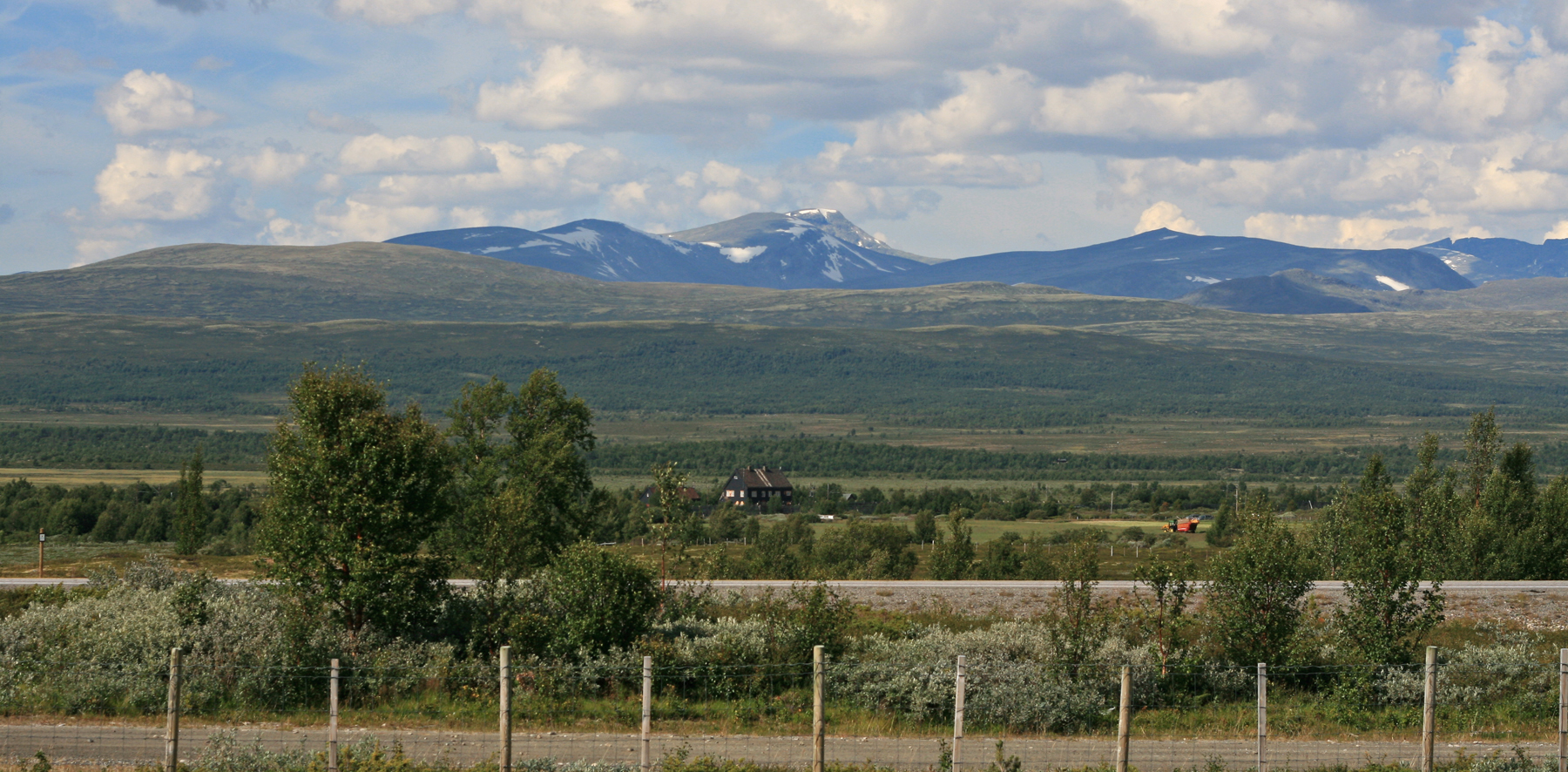
Dovrefjell
"United and true until the mountains of Dovrefjell do crumble." When Norway's founding fathers signed their constitution in 1814, they chose these mountains for their oath -- not Jotunheimen's taller peaks, not the northern fjords, but Dovrefjell. The choice was deliberate. This mountain range had been the border between northern and southern Norway since before recorded history, so fundamental to the national geography that northern Norwegians simply called their half of the country det Nordenfjeldske -- "north of the mountains" -- without needing to specify which mountains. Everyone knew.
The Hall of the Mountain King
Dovrefjell's grip on the Norwegian imagination runs deeper than politics. In the old sagas, King Harald I -- the king who unified Norway -- was raised by the giant Dovre inside these mountains. Henrik Ibsen placed his Mountain King's court here in Peer Gynt, and Edvard Grieg composed In the Hall of the Mountain King for the production -- a piece of music so embedded in global culture that it has turned up everywhere from Fritz Lang's M to jazz clubs to progressive rock albums. The peak of Snohetta, rising to 2,286 meters in the center of the range, was long assumed to be Norway's highest mountain until surveyors measured Jotunheimen's peaks in the 19th century and found them taller. Snohetta's demotion did nothing to diminish Dovrefjell's stature in the national consciousness. Height, Norwegians seem to have decided, is not the only measure of a mountain.
Where Ice Age Plants Still Grow
Dovrefjell's dry, cool continental climate -- some stations at Hjerkinn record among the lowest precipitation figures in all of Europe -- has preserved a botanical record that astonishes scientists. Some plant species here predate the last ice age. The three Knutshoene peaks harbor rare alpine plants that were given legal protection as early as 1905, with further protections added in 1911. The Drivdalen valley, floored with loose slate and limestone, supports its own community of rare species. At the Fokstumyrene moorland, overcollection by European botanists in the 1800s had reduced nesting bird species to fewer than 20 by 1917. Full protection came in 1923, with stricter rules in 1969, and the marshes have recovered into one of Norway's premier birding sites. The alpine botanical garden at Kongsvoll offers a concentrated introduction to the range's extraordinary plant diversity.
Musk Oxen and Ancient Reindeer
Two large protected areas -- Dovrefjell-Sunndalsfjella National Park, established in 2002, and Dovre National Park, established in 2003 -- cover most of the range. Together with surrounding protected zones, they shelter one of Europe's most remarkable collections of large wildlife. The wild reindeer here are Fennoscandian animals of possible Beringia origin, genetically distinct from the semi-domesticated reindeer found elsewhere in Norway. Wolverines hunt the valleys. Golden eagles and gyrfalcons patrol the skies. And then there are the musk oxen, introduced from Greenland in 1947, shaggy Ice Age holdovers that have established a thriving population on the plateau. They do not flee when approached -- they form defensive circles and charge. Park rules require a minimum distance of 200 meters, and hikers who ignore that warning occasionally learn why it exists.
Pilgrims and Railroads
People have crossed Dovrefjell for as long as there have been people in Norway. Medieval pilgrims heading to Trondheim's cathedral established mountain inns along the route, and two of those inns -- at Kongsvoll and Fokstua -- still operate today, making them among the oldest continuously running guest houses in Scandinavia. The old pilgrim paths remain walkable and are maintained for modern hikers. In the industrial age, the Dovre Line railway and the E6 highway followed the same ancient corridor, threading between Dombas in the south and Oppdal in the north. The railway stations at Hjerkinn and Kongsvoll serve as starting points for backcountry treks, though hikers are warned that the distances between huts are long, the weather is volatile, and mobile phone coverage is patchy at best. This is terrain for the experienced and well-equipped -- or for those willing to stay in the valleys, where gentler day trips offer views of golden eagles overhead and, if fortune favors, a distant line of reindeer crossing the plateau.
From the Air
Located at 62.10N, 9.42E in central Norway. Dovrefjell stretches between Dombas to the south and Oppdal to the north, bisected by the E6 highway and Dovre Line railway, both clearly visible from altitude. Snohetta (2,286 m) is the prominent peak in the western sector. Nearest airports: Trondheim Airport Vaernes (ENVA) approximately 100 nm north, Oslo Airport Gardermoen (ENGM) approximately 150 nm south. The plateau is characteristically bare and windswept, with snow cover much of the year. Look for the railway line threading through the mountain pass -- it marks the historic crossing route.