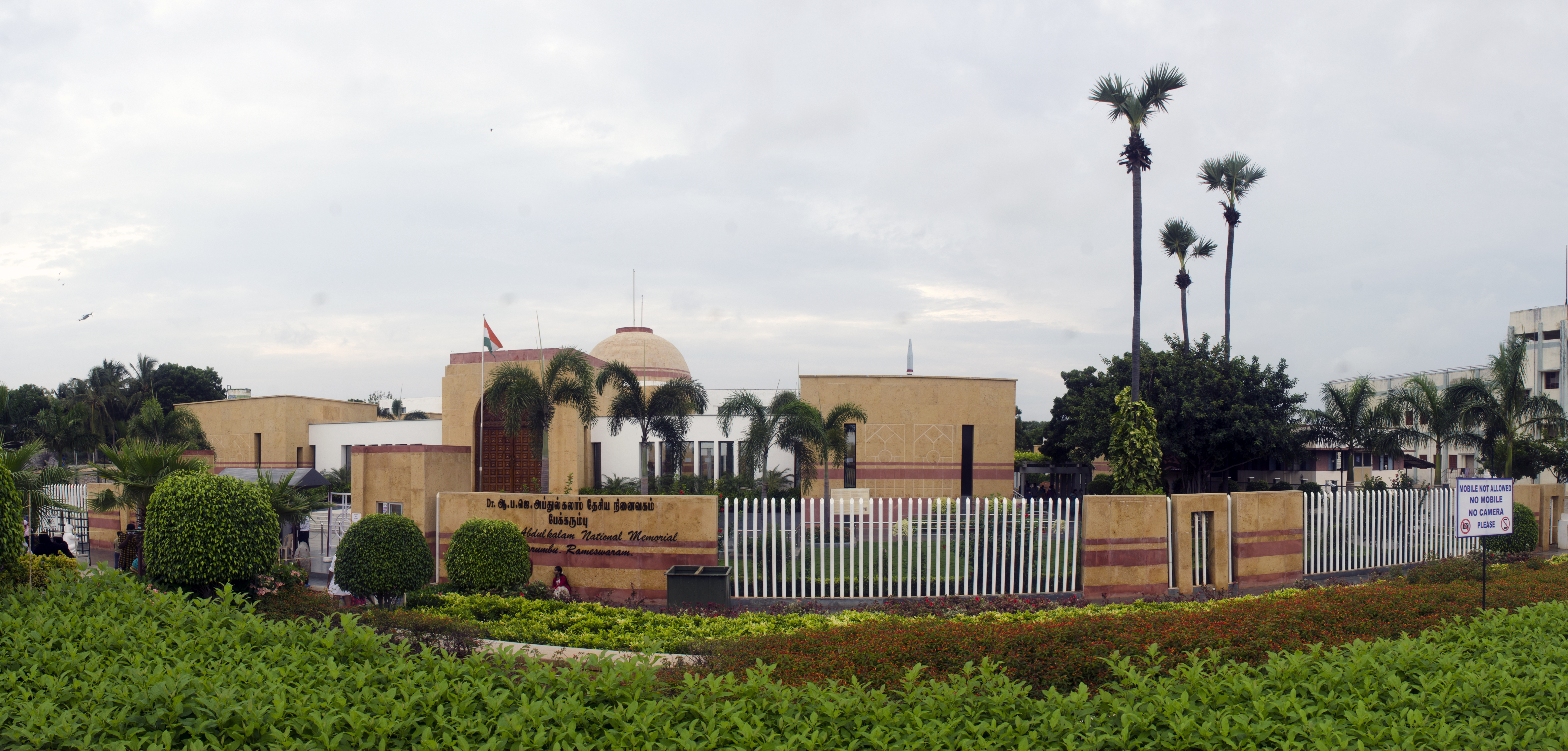
Dr. A. P. J. Abdul Kalam Memorial
He was two sentences into a lecture when his heart stopped. On 27 July 2015, A. P. J. Abdul Kalam stood before students at the Indian Institute of Management in Shillong, preparing to deliver a 4,000-word address titled "Creating a Livable Planet Earth." He collapsed after speaking only the opening lines and was confirmed dead of cardiac arrest at a nearby hospital. The Indian government proposed a state funeral at Raj Ghat in New Delhi, alongside the memorials of Mahatma Gandhi and Jawaharlal Nehru. But Kalam's family refused. He had wanted to be buried in his hometown, the small island town of Rameswaram at the tip of the Indian peninsula, where he was born the son of a boat owner in 1931. Two years later, a memorial designed by India's Defence Research and Development Organisation opened on that same island.
From Boat Owner's Son to Missile Man
Abdul Kalam grew up in modest circumstances near the Ramanathaswamy Temple, one of Hinduism's holiest shrines. A Muslim in a predominantly Hindu town, he would later describe his childhood as shaped by the coexistence of faiths that Rameswaram embodied. He studied aerospace engineering and spent decades at the Defence Research and Development Organisation and the Indian Space Research Organisation, becoming the driving force behind India's Integrated Guided Missile Development Programme. The Agni and Prithvi missiles were his signature achievements, earning him the title "Missile Man of India." In 2002, he was elected the 11th President of India, a Muslim scientist leading a Hindu-majority democracy. He served until 2007 and spent his remaining years teaching and lecturing, insisting that his greatest legacy would be in the classrooms, not the laboratories.
A Memorial Built at Full Speed
On 15 October 2015, Kalam's birth date, Prime Minister Narendra Modi announced construction of the memorial in Rameswaram. The DRDO, the organisation Kalam had devoted his career to, took charge of design and construction. In July 2016, Defence Minister Manohar Parrikar laid the foundation stone on the first anniversary of Kalam's death. The work was completed in roughly a year, sometimes running around the clock, supervised by DRDO colonels B. Choubey and B. K. Singh. The mausoleum was built of granite, marble, and reinforced concrete. On 27 July 2017, the second anniversary of Kalam's death, Modi inaugurated the finished memorial in Peikarumbu, a village within Rameswaram.
Mughal Domes and Missile Replicas
The memorial's architecture is deliberately eclectic, blending Mughal and Indian design traditions to reflect the cultural diversity that defined Kalam's life. A central dome connects to four display halls of approximately 2,500 square feet each, organized around the phases of Kalam's journey: children's square, scientist square, motivation square, and lecture square. Murals sourced from artists in Hyderabad, Shantiniketan, Kolkata, and Chennai line the walls, alongside Shekhawati paintings and a collection of 200 photographs documenting Kalam's work with DRDO, ISRO, and India's civilian space program. Life-sized sculptures depict him at different ages. At the forefront of the structure stands a 45-foot replica of the Agni missile, the weapon he helped create, bearing the theme "unity in diversity." Mughal-style gardens surround the mausoleum, with pergola pathways lined by models of the missiles Kalam designed.
Resting Where He Began
There is something fitting about the memorial's location. Kalam was born on this island, surrounded by the same waters that carry pilgrims to the Ramanathaswamy Temple and fisherfolk to their daily catch. He left Rameswaram as a young man, built rockets and missiles, served as head of state, and then came home. The memorial sits within walking distance of the ancient temple, a modern structure of marble and missile replicas alongside corridors of thousand-year-old sculpted pillars. Visitors who come for the temple often stop at the memorial; visitors who come for Kalam often walk to the temple afterward. The island holds both comfortably. In a country where religion and science are sometimes cast as opponents, Rameswaram offers the quiet counter-argument that they can share a shoreline.
From the Air
The Dr. A. P. J. Abdul Kalam Memorial is located at approximately 9.29N, 79.27E in Peikarumbu, Rameswaram, on Pamban Island. The 45-foot Agni missile replica at the memorial's entrance is a distinctive visual marker from lower altitudes. Located near the Ramanathaswamy Temple complex in central Rameswaram. Best viewed at 2,000-5,000 feet. Nearest airport is Madurai (VOMD), approximately 165 km northwest. The Pamban Bridge connecting to the mainland is visible to the west.