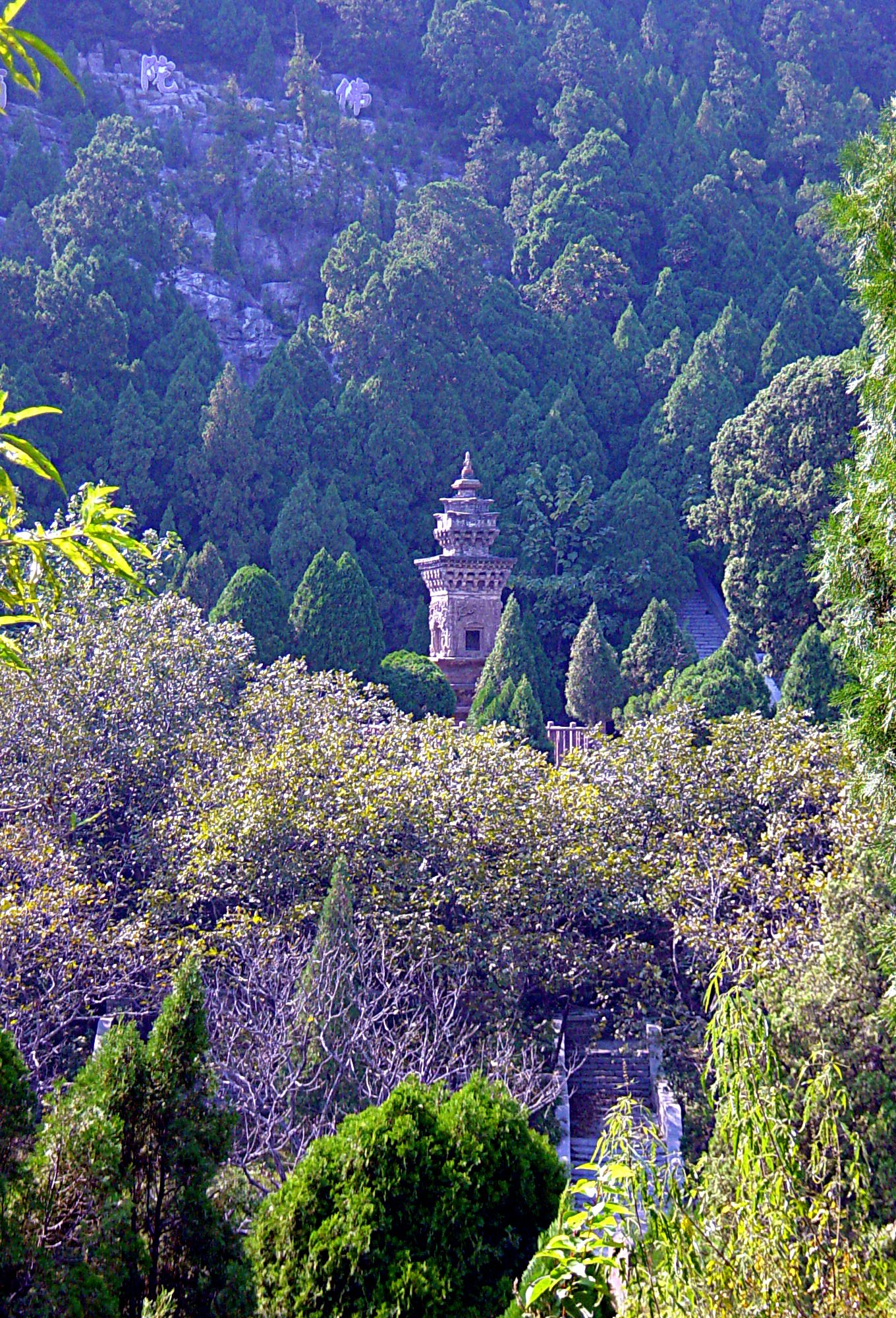
Dragon-and-Tiger Pagoda
The central pillar of the Dragon-and-Tiger Pagoda is a single cube of stone, four meters on each side, carved with figures that have been staring out at visitors for over a thousand years. Dragons and tigers writhe across the surface in high relief, flanked by Buddhas, bodhisattvas, celestial guards, and flying apsaras -- the heavenly dancers of Buddhist mythology. The carvings are so vivid, so densely populated with figures, that the stone seems to move. This is Tang dynasty sculpture at its most confident, and it stands 33 kilometers southeast of Jinan in the hills of Shandong Province, near the ruins of the Shentong Temple -- the "Supernatural Power" Temple -- that gave this valley its sacred character.
A Monk's Resting Place
The Dragon-and-Tiger Pagoda was built as a burial monument for a monk. No records survive to date its construction precisely, but its style places it firmly in the Tang dynasty, roughly 618 to 907 AD. It stands near Liubu Village in Licheng County, in a landscape that once belonged to the Shentong Temple, one of the most important Buddhist centers in northern China during its era. The temple is now in ruins, but the pagoda endures -- a testament to the durability of stone over wood. At 10.8 meters tall, it is modest compared to the multi-story pagodas of later dynasties. But its purpose was never to impress with height. Everything about this structure directs attention inward, toward the carvings on the central pillar.
Stone That Breathes
The pagoda is designed as a single-story pavilion with a square cross-section. Its base consists of a three-tier Sumeru pedestal -- named for the mythical mountain at the center of the Buddhist universe -- decorated with relief sculptures of lions and lotus flowers. The central pillar, that remarkable carved stone cube, has rectangular doors on each side, and behind each door sits a carved Buddha. Above the doors, flying apsaras spread their scarves in perpetual motion. The dragons and tigers that give the pagoda its name occupy the pillar's surfaces with a coiled energy that suggests the Tang sculptors were competing with the medium itself, trying to make stone do what only living muscle should. The brick roof above is richly decorated but shows signs of later reconstruction, probably during the Song dynasty.
A Valley of Sacred Stone
The Dragon-and-Tiger Pagoda does not stand alone. Two companion structures share this valley: the Four-Gates Pagoda, which dates to the Sui dynasty and is thought to be the oldest surviving pavilion-style stone pagoda in China, and the Minor Dragon-and-Tiger Pagoda, a smaller Tang dynasty structure that echoes the larger pagoda's design. Immediately nearby is the Thousand Buddha Cliff, where over 200 religious statues and sculptures of noble figures were carved into a 63-meter cliff face during the Tang dynasty. Together, these sites form a concentration of early Chinese Buddhist art that is remarkable for its density and preservation. Walking among them, with the Shentong Temple ruins providing a haunting backdrop, the valley feels like an open-air museum where the Tang dynasty never quite ended.
From the Air
The Dragon-and-Tiger Pagoda is located at 36.45°N, 117.13°E in the hills near Liubu Village, Licheng County, about 33 km southeast of Jinan, Shandong Province. The pagoda complex sits in a valley surrounded by forested hills. At 10.8 meters tall, the individual pagoda is not easily visible from altitude, but the cluster of historical sites (including the Four-Gates Pagoda and Thousand Buddha Cliff) marks the area. Nearest major airport: Jinan Yaoqiang International (ZSJN), approximately 45 km to the northwest. The terrain is hilly with moderate elevation.