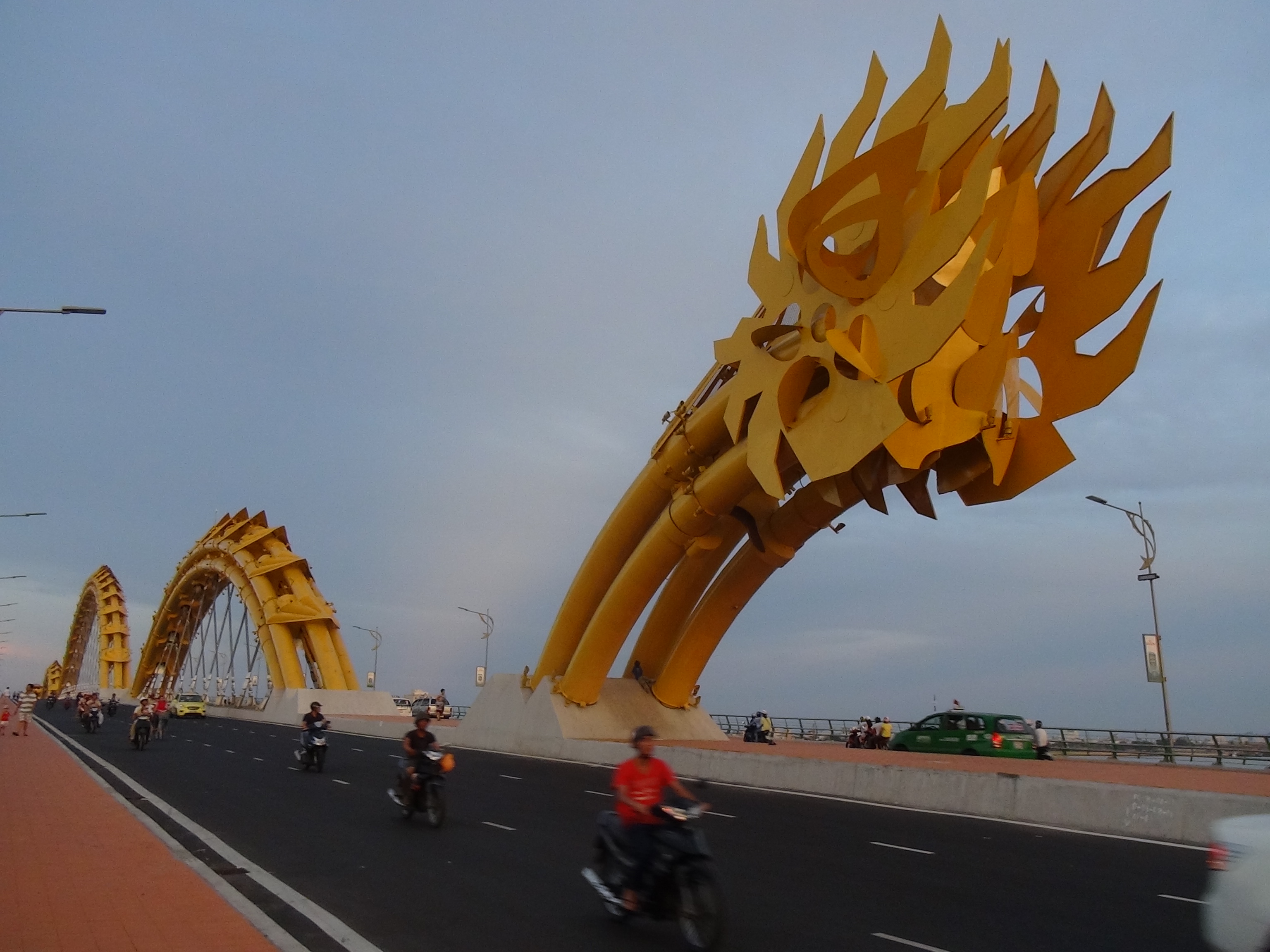
Dragon Bridge (Da Nang)
Every Saturday and Sunday at nine in the evening, a dragon breathes fire over the Han River. This is not myth or metaphor. The Dragon Bridge in Da Nang is 666 meters of curved steel that literally shoots flames and jets of water from a massive dragon head, drawing thousands of spectators to the riverbanks while traffic halts on the six-lane roadway below. It is the world's largest dragon-shaped steel bridge, and it belongs to a city that has reinvented itself with a boldness that the bridge's designers made physical.
Born on Liberation Day
The bridge opened to traffic on March 29, 2013 -- a date chosen with deliberate precision. It was the 38th anniversary of the day North Vietnamese forces captured Da Nang during the final push of the Vietnam War, an event known in Vietnam as the Liberation of Da Nang. Where American military trucks once rolled through the city, a dragon now carries six lanes of traffic from the international airport toward the beaches of the eastern coast. The symbolism is layered and intentional: the dragon is Vietnam's most potent cultural emblem, representing power, nobility, and good fortune. Da Nang chose to stamp that symbol across its river at a cost of nearly 1.5 trillion dong, roughly 88 million US dollars, and to open it on the anniversary of the day the city considers its rebirth.
Engineering the Beast
Designing a bridge in the shape of a dragon that actually functions as a major urban artery required collaboration between continents. The US-based Ammann & Whitney Consulting Engineers, working with the Louis Berger Group, developed the arch-beam-wire combination structure that gives the bridge its sinuous dragon form while supporting heavy vehicle traffic. Construction began on July 19, 2009, with former Prime Minister Nguyen Tan Dung attending the groundbreaking. The main span was completed on October 26, 2012, and the bridge stretches 37.5 meters wide -- generous enough for those six traffic lanes. Company No. 508, an affiliate of Civil Construction Engineering Corporation No. 5, and Bridge Company No. 75 undertook the construction, threading structural steel into curves that mimic scales, claws, and a tail tapering toward the eastern bank.
A City's Ambition, Cast in Steel
Da Nang's investment in the Dragon Bridge was not vanity. The city needed a direct route from its international airport to the coastal tourism corridor along My Khe Beach and Non Nuoc Beach. Before the bridge, traffic funneled through congested city streets to cross the Han River. Now the Dragon Bridge provides the shortest road link from the airport, crossing the river at the Le Dinh Duong and Bach Dang traffic circle and opening the eastern districts to development. Da Nang has grown rapidly in the decades since reunification, and the bridge functions as both infrastructure and declaration -- a statement that a city once defined by its wartime airbase now defines itself by ambition, tourism, and spectacle.
Fire on the Water
The bridge's weekend fire-and-water show has become one of the most recognizable attractions in central Vietnam. At nine o'clock, the dragon head erupts with streams of fire, then switches to water, misting spectators who crowd the promenades along both riverbanks. The performance lasts several minutes, and the effect is surreal -- an infrastructure project that doubles as public theater. Along the Han River, the Dragon Bridge joins a family of architecturally ambitious crossings, including the Han River Bridge, which rotates 90 degrees to allow ship traffic, and the Tran Thi Ly Bridge with its sail-inspired cable stays. Together they form a sequence of engineering statements that Da Nang has used to reshape its skyline and its identity. The dragon, though, is the one tourists remember. It breathes fire. That tends to make an impression.
From the Air
Located at 16.061N, 108.227E, the Dragon Bridge crosses the Han River in central Da Nang. Best viewed from 2,000-3,000 feet AGL where its distinctive S-curve dragon shape is clearly visible against the river. Da Nang International Airport (VVDN) is immediately west, less than 2 km from the bridge. The bridge connects the airport area to the beachfront district on the eastern bank. Other notable bridges visible along the Han River include the rotating Han River Bridge to the north and the cable-stayed Tran Thi Ly Bridge to the south.