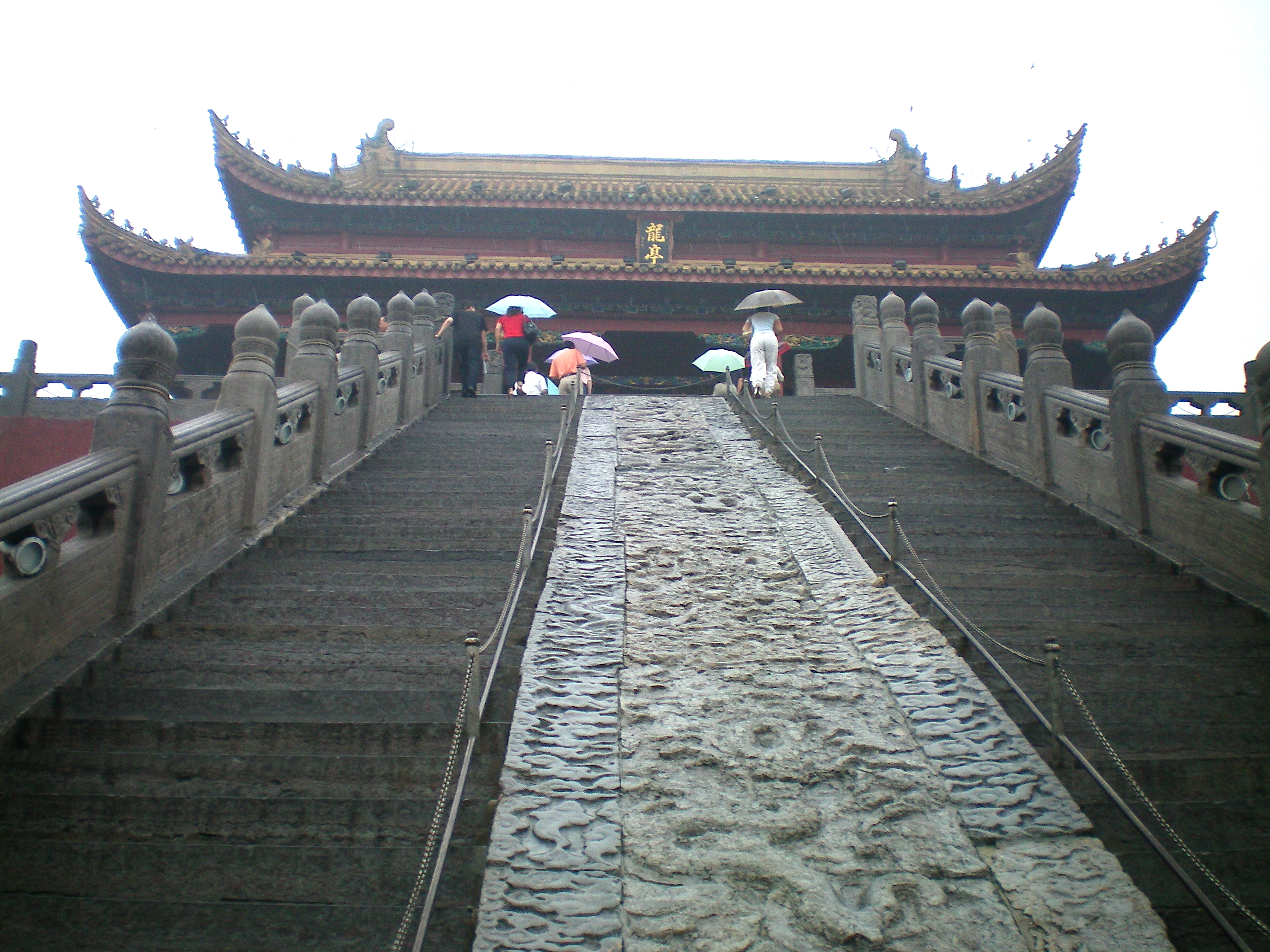
Dragon Pavilion
Seventy-two stone steps climb a thirteen-meter terrace of blue brick. At the top, a wooden pavilion stands where the Song dynasty emperors once held court -- or rather, where a series of pavilions have stood, each one rising from the wreckage of its predecessor. The Dragon Pavilion has been burned in wartime, toppled by storms, and struck by lightning. Each time, Kaifeng rebuilds it. The structure is less a historical artifact than a declaration of stubbornness, the city's refusal to let its imperial past disappear entirely beneath the silt of the Yellow River.
When Kaifeng Was the World
In 960, Kaifeng became the capital of the Northern Song dynasty and was renamed Dongjing -- the Eastern Capital. The city may have reached a population of 400,000, making it one of the largest urban centers on Earth. The imperial palace complex, of which the Dragon Pavilion was a part, anchored a city whose daily life is believed to be captured in Zhang Zeduan's famous painting Along the River During Qingming Festival, one of the most celebrated works in Chinese art history. The literary companion to that painting, Dongjing Meng Hua Lu -- Dreams of Splendor of the Eastern Capital -- records the city's markets, festivals, and street life with a vividness that still reads as modern. For a century and a half, Kaifeng was not merely a capital but a cultural phenomenon.
Conquered, Flooded, Rebuilt
The Jurchen-led Jin dynasty captured Kaifeng in 1127, ending the Northern Song. They made the city their southern capital between 1157 and 1161, then moved their full imperial court there in 1214 while fleeing the Mongol advance from the north. Under the subsequent Yuan and Ming dynasties, Kaifeng was demoted from imperial capital to provincial seat. The Dragon Pavilion was destroyed and rebuilt multiple times through these centuries. The structure visitors see today traces its design to the reign of the Kangxi Emperor during the Qing dynasty, built atop the foundations of the original Song palace. But even this version has not survived continuously -- it was burned during the Chinese Civil War around 1948, and collapsed after a lightning strike during heavy rainstorms in 1994.
A Palace in Miniature
What remains today is a single grand hall -- a wooden structure measuring 19.10 meters east to west, 11.90 meters north to south, and standing 26.7 meters tall atop its brick terrace. It sits within Longting Park, surrounded by the lakes and gardens that have replaced the vast palace complex of the Song era. Most of the original imperial structures have been lost to floods, wars, and the simple accumulation of centuries. But archaeological excavations beneath the modern Song Capital Street, a 400-meter restored road running south from the park entrance, have revealed remains of the actual Song dynasty imperial way. The restored street is lined with two-story wooden buildings designed to evoke the scenes depicted in the Qingming scroll -- a reconstruction of a reconstruction, layers of aspiration reaching back toward a golden age that Kaifeng has never stopped remembering.
From the Air
Located at 34.81N, 114.35E in the northern part of Kaifeng's old city, Henan province. The pavilion sits atop its blue-brick terrace within Longting Park, adjacent to Yang Family Lake and Pan Family Lake. From low altitude, the park's water features and the pavilion's elevated position make it identifiable. Nearest major airport is Zhengzhou Xinzheng International (ZHCC/CGO), approximately 75 km west.