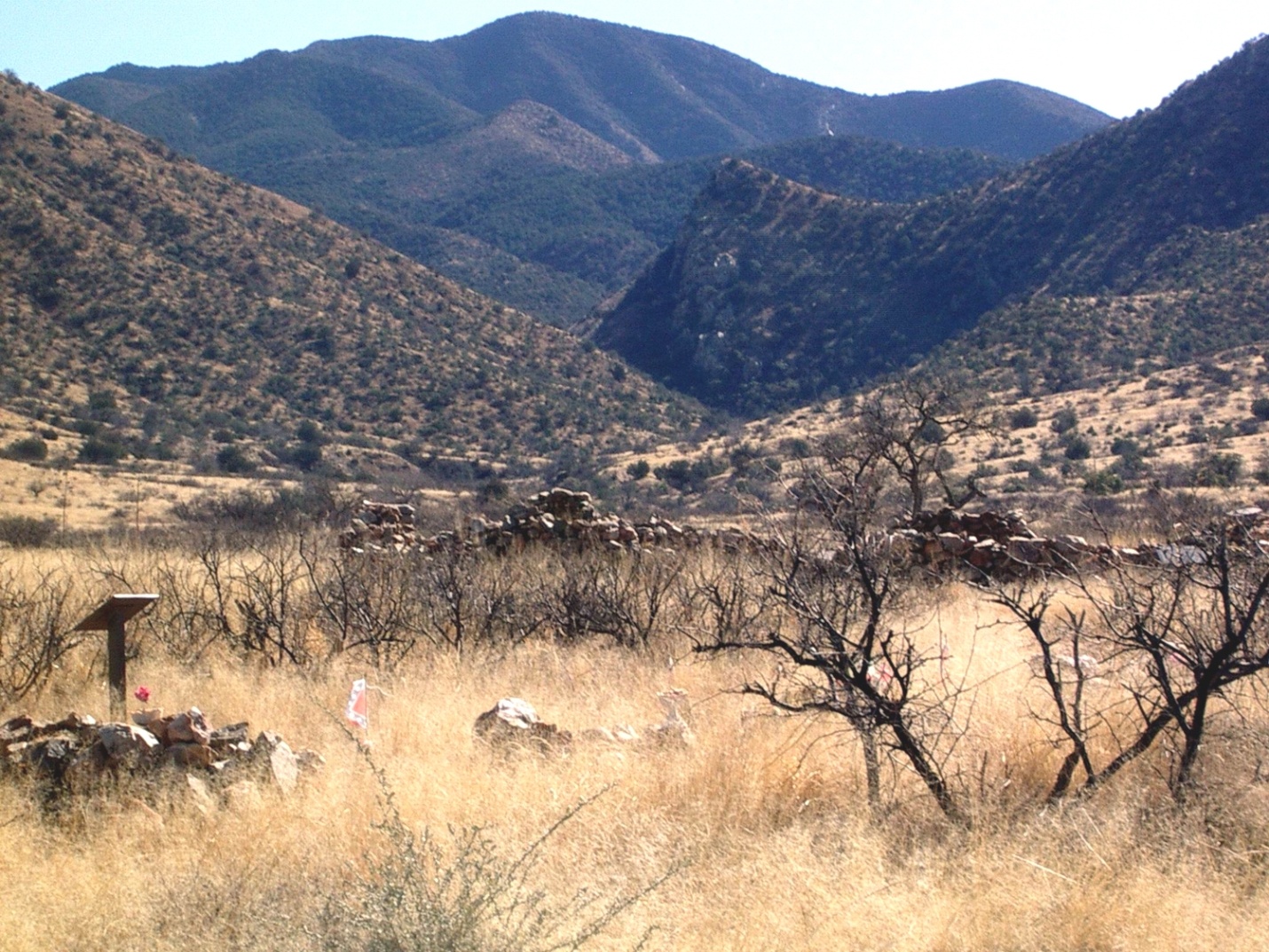
Dragoon Springs Stage Station Site
Six rock cairns stand silent in the Arizona sun, their occupants dead for more than 160 years. The graves at Dragoon Springs Stage Station tell a story that defies simple telling: a midnight massacre by trusted workers, a Civil War battle between Confederate soldiers and Apache warriors led by Cochise himself, and the remarkable survival of a man who waited four days with a shattered arm before help arrived. This remote outpost in the Dragoon Mountains witnessed some of the most dramatic moments in the American Southwest, events that echo across the decades in carved stone markers and weathered graves.
Fortress in the Desert
In August 1858, workers under Superintendent William Buckley of Watertown, New York, constructed one of the most important stops on the 2,700-mile Butterfield Overland Mail route. The stone fortress featured walls eight feet high, thatched-roof storehouses, a station master's sleeping quarters, and a heavy wooden gate. The mules waited inside, ready for the next relay. Dragoon Springs Stage Station was the last fortified stop heading west before San Francisco, and one of only two stone-walled stations in all of Arizona. The spring itself, about a mile up the canyon, had long served travelers on the Southern Emigrant Trail, including the San Antonio-San Diego Mail Line, nicknamed the 'Jackass Mail,' which began operating in July 1857. After the Gadsden Purchase made this territory American soil, the 3rd U.S. Cavalry Dragoons established posts here around 1856 to battle the Chiricahua Apache, giving both the spring and the mountains their name.
The Midnight Massacre
A few minutes after midnight on September 9, 1858, betrayal came from within. Three Mexican laborers, trusted members of the station construction crew, attacked their sleeping coworkers to steal the valuable mules and property. They killed James Burr with a stone hammer as he slept in his blankets, crushing his skull with two blows. William Cunningham died as well. James Laing was mortally wounded but clung to life for days. Silas St. John suffered horrific injuries, including wounds that would cost him his arm, but survived. For four days, St. John lay unable to move or call out, his wounds crawling with maggots, his throat too parched to respond when a journalist approached the silent station with his gun cocked. When Colonel James B. Leach's road party finally arrived that Sunday morning, they found a scene of carnage. Assistant Surgeon B. J. D. Irwin reached the station nine days after the attack and amputated St. John's arm at the shoulder socket. Remarkably, just 21 days after the operation, St. John could mount a horse and ride to Tucson. His severed arm remains buried between the graves of his fallen comrades.
Cochise Strikes the Confederacy
The station's most famous engagement came on May 5, 1862, when the Civil War reached Arizona in unexpected form. A small band of Confederate soldiers under Sergeant Samuel B. Ford was escorting Union prisoners to Texas when they camped at the abandoned station. Around 100 Chiricahua Apache warriors, led by the legendary war chiefs Cochise and Francisco, ambushed the camp. Three Confederate soldiers fell, along with a young Mexican stock herder named Ricardo, pressed into service by the Texans at Tucson. The Apaches captured 30 mules, 25 horses, and cattle. This minor skirmish holds an outsized place in history: it caused the Confederacy's westernmost battle deaths and remains the only known engagement where Confederate soldiers were killed within modern Arizona's borders. One of the Union prisoners, pressed into service against the Apache, carved the grave markers that still exist today: 'S. Ford, May 5th, 1862' and 'Ricardo.'
Graves That Tell Stories
Walk the station grounds today and you will find six graves arranged in two distinct groups. Four rock cairns north of the station gate mark the Confederate dead and Ricardo. To the west of the ruined structure lie two more graves holding three of the Butterfield employees massacred in 1858, with Silas St. John's amputated arm buried between them. The site has not escaped the ravages of time and treasure hunters. In 1967, grave robbers desecrated Sergeant Ford's grave and removed his remains, a violation of the American Antiquities Act of 1906 that the Forest Service documented with grim precision. Photographs from 1929 show the stone marker for Ford atop one cairn; today it sits cemented at the base. The identification of individual Confederate graves remains uncertain, but the overall picture is clear: this small patch of Arizona earth holds the remains of men who died in two separate eras of American violence, united only by their final resting place.
Where War Ended
On October 12, 1872, this same station witnessed an event that bookended its violent history. Chiricahua Apache chief Cochise, the same war leader who had commanded the attack ten years earlier, met with General O. O. Howard to negotiate an end to eleven years of brutal warfare. The treaty granted the Apache a reservation covering much of what is now Cochise County, named for the chief himself. The stone walls that had sheltered mail carriers, massacre survivors, and Confederate soldiers became the site of peace. The station operated under various stage lines until around 1880, when the railroads made the old overland routes obsolete. Today the ruins stand within Coronado National Forest, their rock cairns and carved stones a memorial to the overlapping conflicts that shaped the American Southwest.
From the Air
Located at 31.9975N, 110.0222W in the Dragoon Mountains of southeastern Arizona, approximately 16 miles from Benson. The site sits within Coronado National Forest at the mouth of a canyon. Nearest airports: Benson Municipal (E95), Tucson International (KTUS) 75 miles west. Best viewed from 3,000-5,000 feet AGL. The rugged Dragoon Mountains provide distinctive visual reference, with the station site at the edge of the plain where mountains meet desert floor.