Draining and Development of the Everglades
In 1897, explorer Hugh Willoughby canoed through the Everglades and described a tract of land 130 miles long and 70 miles wide that was "as much unknown to the white man as the heart of Africa." Within a generation, governors were promising to drain it, developers were selling it by the acre to buyers who had never seen it, and an engineer's flawed report was being touted as a blueprint for paradise. The Everglades -- a river of grass flowing imperceptibly from Lake Okeechobee to Florida Bay -- became the arena for one of America's most ambitious and catastrophic experiments in reshaping the natural world.
Sawgrass, Soldiers, and Seminoles
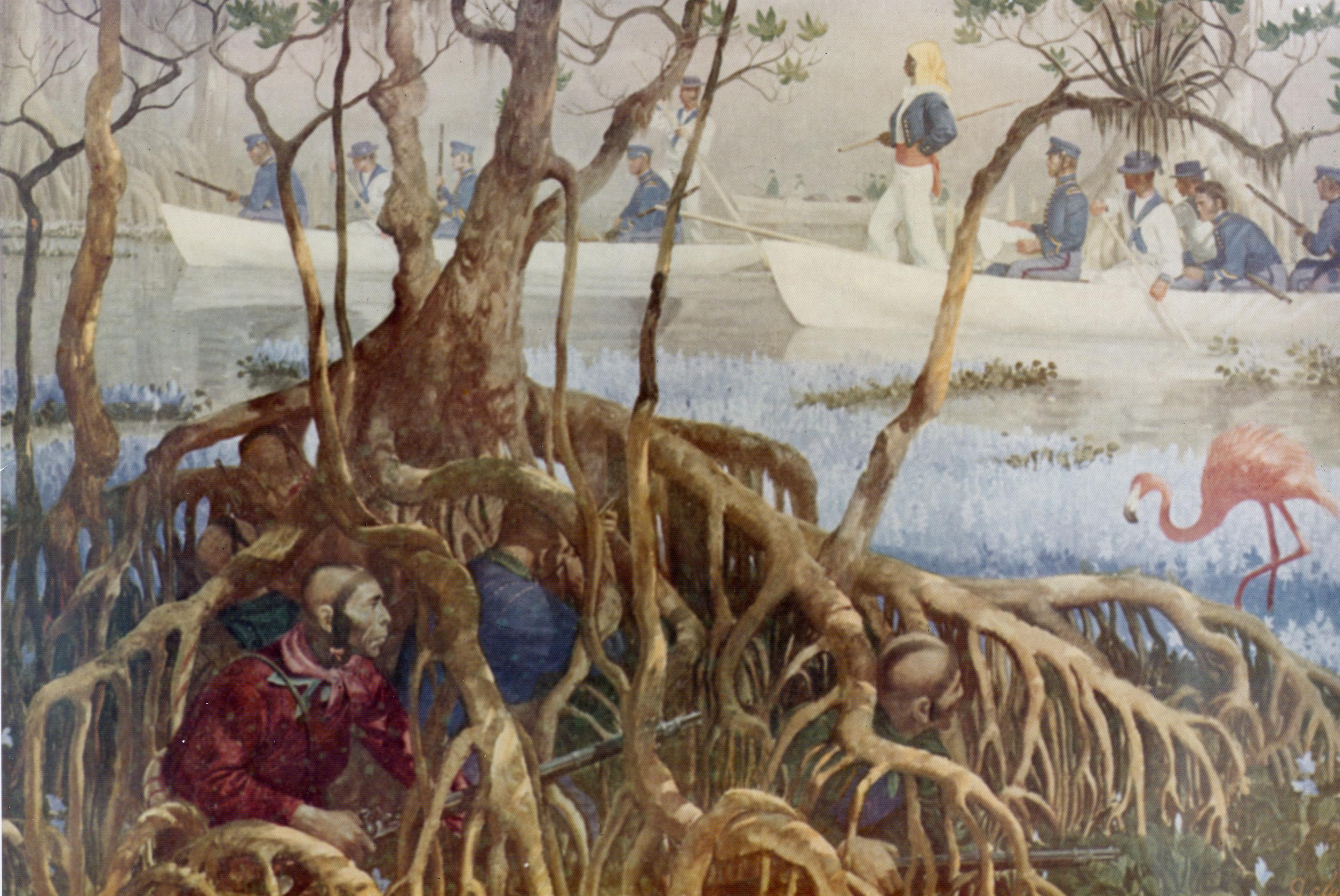
American knowledge of the Everglades was carved out during the Second Seminole War from 1836 to 1842. Soldiers tore their clothes on sawgrass, ruined their boots on uneven limestone, and watched gangrene set in from countless cuts. Mosquito-borne illness killed many; one private died of exhaustion in his tracks in 1842. Colonel William Harney led 90 soldiers in 16 canoes into the interior in 1840, hunting a chief named Chekika. One soldier's account in the St. Augustine News became the first printed description of the Everglades, portraying "a vast sea filled with grass and green trees." An army surgeon wrote that it was "a most hideous region to live in, a perfect paradise for Indians, alligators, serpents, frogs, and every other kind of loathsome reptile." The terrain inspired either wonder or hatred -- rarely anything in between.
Promises Built on Muck
Real estate developer Hamilton Disston made the first drainage attempt in 1881, purchasing a vast tract and digging canals near St. Cloud. His canals failed to drain the wetlands, but his purchase primed Florida's economy -- property values doubled within four years. In 1904, gubernatorial candidate Napoleon Bonaparte Broward made draining the Everglades his signature promise, calling it "so simple an engineering feat" and envisioning an "Empire of the Everglades." An engineer named Wright designed canals based on flawed rainfall data, underestimating the volume of torrential downpours. Real estate developers misrepresented Wright as the world's foremost authority on wetlands drainage. Buyers who spent their life savings arrived to find their land completely underwater. When muck dried, it turned to fine black powder and created dust storms. Crops sprouted lushly, then wilted and died -- the peat lacked copper and other trace elements. The USDA declared the land too costly to drain; residents of Fort Lauderdale collected every copy of the pamphlet and burned them.
Plumes Worth Their Weight in Gold
The growing population brought hunters who operated without restraint. In 1886, an estimated five million birds were killed for their feathers. Aigrettes -- the plumes prized by the millinery trade -- sold in 1915 for $32 an ounce, the same price as gold. Hunters lay in wait at nests during breeding season, shot parent birds with small-bore rifles, and left the chicks to starve. Plumes from Everglades wading birds turned up in Havana, New York City, London, and Paris. One New York dealer employed at least 60 hunters. The Audubon Society hired warden Guy Bradley to watch the rookeries around Cuthbert Lake. Bradley was murdered in 1905 by a neighbor he tried to stop from hunting. President Theodore Roosevelt established Pelican Island as the first federal wildlife refuge in 1903, partly in response to the slaughter. Harriet Beecher Stowe had already sounded the alarm in 1877: "The decks of boats are crowded with men, whose only feeling amid our magnificent forests, seems to be a wild desire to shoot something."
Walls of Water
On September 18, 1926, a hurricane struck Miami with winds powerful enough to destroy Henry Flagler's opulent Royal Palm Hotel. Residents who ventured outside during the eye's calm were caught when the wind returned from the opposite direction -- 115 died in Miami alone, though racial segregation of death counts may have hidden the true toll. Two years later, the 1928 Okeechobee Hurricane breached the lake's levees and drowned between 1,770 and 3,000 people, most of them Black migrant workers near Belle Glade. President Herbert Hoover, himself an engineer, ordered the Army Corps of Engineers to build a dike around the lake. Completed in 1938, the Herbert Hoover Dike stopped flooding but severed the Everglades from its water source. Peat turned to dust, saltwater invaded Miami's wells, and in 1939 massive fires hung black clouds over the city. Scientists discovered too late that draining the organic soil exposed it to oxygen, causing bacteria to decompose it. Feet of topsoil simply vanished.
River of Grass, River of Change
In 1947, two events reshaped the Everglades story. On December 6, President Truman dedicated Everglades National Park. One month earlier, Marjory Stoneman Douglas published The Everglades: River of Grass, redefining the landscape as a living river rather than a stagnant swamp. Its first printing sold out within a month. Yet that same year, devastating floods prompted Congress to approve the Central and Southern Florida Flood Control Project, which carved the Everglades into basins separated by levees and pumping stations. Between 1940 and 1965, six million people moved to South Florida. The turning point came in 1969 when a jetport was proposed beside the national park. The New York Times called it a "blueprint for disaster." Senator Gaylord Nelson wrote to President Nixon: "It is a test of whether or not we are really committed in this country to protecting our environment." The Everglades were subsequently named an International Biosphere Reserve, a World Heritage Site, and a Wetland of International Importance -- one of only three places on Earth to earn all three designations.
From the Air
The Everglades drainage area is centered around 26.00N, 80.70W, spanning from Lake Okeechobee southward to Florida Bay. From altitude, the grid of canals, levees, and the Everglades Agricultural Area are clearly visible as geometric patterns cutting through the natural wetland. The Herbert Hoover Dike encircles Lake Okeechobee to the north. The Tamiami Trail (US-41) traces a straight east-west line across the landscape. Nearest airports: Miami International (KMIA), Fort Lauderdale-Hollywood International (KFLL), and Palm Beach International (KPBI). Best viewed at 5,000-10,000 feet AGL to appreciate the massive scale of both the natural and engineered landscape.