Draper's Meadow Massacre
On a summer day in July 1755, about twenty settlers were going about their lives on a 7,500-acre tract in southwest Virginia when Shawnee warriors emerged from the forest. Within minutes, Colonel James Patton lay dead. An infant had been killed. Five colonists were marched away as captives into the wilderness. The place was called Draper's Meadow, and it sat on what is now the campus of Virginia Tech in Blacksburg. What happened next, the captivity and astonishing escape of Mary Draper Ingles, would become one of the most remarkable survival stories on the American frontier.
An Irish Sea Captain's Gamble
The land that became Draper's Meadow was awarded on June 20, 1753, to Colonel James Patton, an Irish-born sea captain turned land speculator, by Virginia Governor Robert Dinwiddie. Patton had recruited settlers from Pennsylvania, a mix of Irish and Germanic migrants willing to push west beyond the Blue Ridge into territory the Shawnee considered their own. By mid-1755, roughly twenty people were scattered across the meadow in a handful of cabins. They had no stockade, no militia garrison, and no illusions about the dangers. The French and Indian War was already underway along the frontier. But the harvest needed tending, and the settlement pressed on.
The Day the Frontier Shattered
The exact date remains disputed. The Virginia Gazette recorded the last day of July; Preston's Register gives July 30. What is certain is the violence. Colonel Patton was killed. Eleanor Draper, Mary's mother, was slain. Caspar Barger fell. Bettie Robertson Draper's infant daughter was killed when raiders dashed the child's head against a cabin wall. The elderly Phillip Barger was decapitated, and the Shawnee delivered his head in a bag to a neighboring homestead at Sinking Creek, telling the woman who opened it to "look in the bag and she would see an old friend." Bettie Draper was shot through the arm. Five captives, including Mary Draper Ingles and her two young sons, were forced to march westward toward the Shawnee village of Lower Shawneetown in present-day Kentucky.
Mary's Walk to Freedom
At Lower Shawneetown, Mary Draper Ingles was separated from her sons and put to work making salt and shirts. Weeks passed. Then, seizing an opportunity, she escaped with another captive woman and began walking home. The journey covered hundreds of miles through unmapped Appalachian wilderness, following the New River and other waterways, foraging for roots and nuts, enduring cold and near-starvation. The ordeal tested the limits of human endurance. Mary made it back. She and her husband William later established Ingles Ferry across the New River in 1762, along with a tavern and blacksmith shop. Mary Draper Ingles lived until 1815, six decades after the raid that shattered her world.
A Frontier Abandoned
Draper's Meadow did not recover. In September 1756, Governor Dinwiddie authorized funds for a stockade fort on the site, but no evidence suggests it was ever built. The settlement was abandoned for the duration of the French and Indian War, along with much of Virginia's western frontier. Of the original settlers who survived, only the Barger family eventually returned to reclaim their land. William Preston, who had been at Draper's Meadow the morning of the attack but was sent to help with the harvest at Sinking Creek and so narrowly escaped, purchased the property on May 24, 1773. The place where blood had soaked the meadow grass became, in time, farmland again.
Memory Carved in Stone
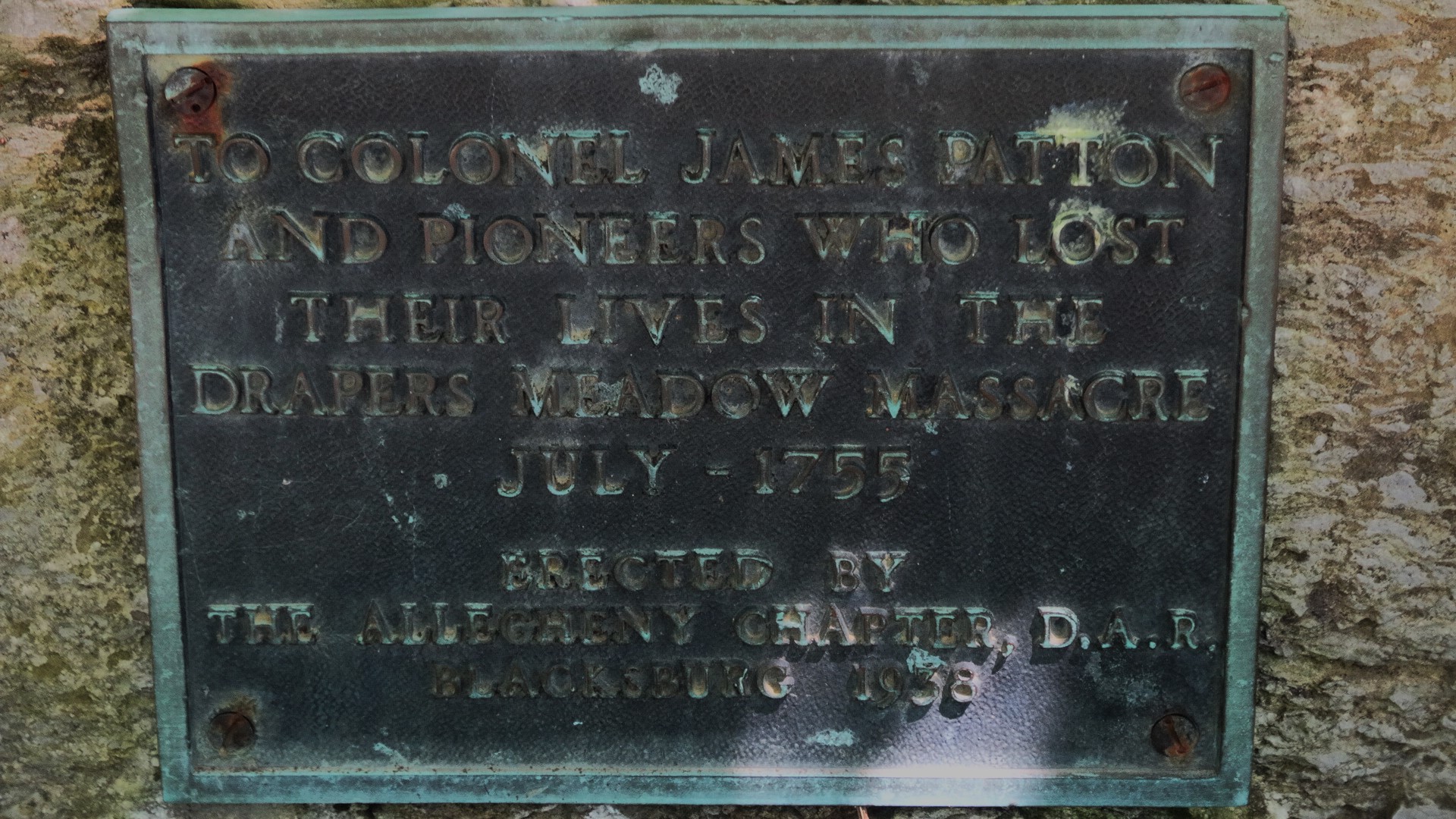
Today, a memorial wall on the Virginia Tech campus, between the golf course clubhouse and the duck pond, marks the massacre site with the inscription "July 8, 1755," though historians debate the precise date. In 1938, the Alleghany Chapter of the Daughters of the American Revolution placed a brass plaque at nearby Smithfield Plantation reading: "To Colonel James Patton and pioneers who lost their lives in the Draper's Meadow Massacre, July 1755." A play dramatizing Mary Ingles' escape, "The Long Way Home," ran from 1971 to 1999 and was revived in 2017. The story endures because it distills the frontier experience into its rawest form: ordinary people caught between empires and cultures, surviving through sheer will in a landscape that offered no quarter.
From the Air
Located at 37.38°N, 80.72°W on the campus of Virginia Tech in Blacksburg, Virginia. The massacre site lies near the university's duck pond and golf course. Virginia Tech/Montgomery Executive Airport (KBCB) is about 6 miles to the southeast. Roanoke-Blacksburg Regional Airport (KROA) is approximately 30 miles northeast. The New River, which Mary Draper Ingles followed during her escape, is visible winding through the valley to the south. Recommended viewing altitude: 3,000-5,000 feet AGL. The Appalachian ridgelines surrounding the New River Valley provide dramatic context for the frontier isolation these settlers experienced.