Drayton Hall
Drayton Hall has never been restored. That is the first thing the guides will tell you, and it is the most important thing to understand about this place. While other plantation houses along the Ashley River were burned, blown down, or rebuilt beyond recognition, Drayton Hall endured -- through the Revolution, the Civil War, an earthquake in 1886, a hurricane in 1893, and seven generations of a single family. It stands today exactly as time left it: no furniture, no period reproductions, no decorative concessions to the tourist trade. The bare plaster walls and exposed architectural bones reveal something that a furnished house never could -- the extraordinary ambition of a colonial planter who imported Renaissance ideals to the swampy Lowcountry of South Carolina.
A Villa on the Ashley
John Drayton Sr. purchased the property in 1738 and began building a house that would have been remarkable in London, let alone the Carolina frontier. The mansion's double projecting portico is modeled on Andrea Palladio's Villa Cornaro, designed near Venice in 1551. The floor plan likely derives from Plate 38 of James Gibbs's "A Book of Architecture," the influential pattern book published in London in 1728. Inside, pedimented chimney-pieces echo the designs of Inigo Jones, the architect who brought Palladian ideals to England a century earlier. For decades, scholars believed construction began in 1738 and finished around 1752. But a 2014 dendrochronology study -- the analysis of tree-ring patterns in the attic timbers -- revealed the wood was cut from trees felled in the winter of 1747-48. The house was likely occupied by the early 1750s, its seven bays and symmetrical stair hall representing the most sophisticated architectural statement in colonial America.
Rice, Indigo, and Human Bondage
Drayton Hall was not merely a grand house. It was the administrative center of a plantation built on the forced labor of enslaved people. The property produced rice and indigo, two crops that made the Carolina Lowcountry one of the wealthiest regions in British North America. Thirteen slave cabins once stood on the grounds, housing approximately 78 enslaved men, women, and children whose labor sustained the Drayton family's wealth and made the architectural splendor of the main house possible. Those cabins are gone now. But their archaeological footprints remain, and Drayton Hall's interpreters make a deliberate effort to tell the full story of the plantation -- not just the elegance of the big house but the human cost that built and maintained it. The contrast between the Palladian refinement of the mansion and the brutal reality of the labor system that supported it is central to understanding what Drayton Hall represents.
Surviving Everything
The Ashley River corridor was once lined with plantation houses. Most did not survive. Drayton Hall's longevity is part luck, part stubbornness. During the Revolutionary War, British forces occupied many Charleston-area plantations. During the Civil War, Union troops burned plantation houses along the Ashley as they advanced on Charleston. Drayton Hall was spared both times -- the exact reasons are debated, but family stewardship clearly played a role. Nature proved harder to dodge. The Charleston earthquake of 1886 destroyed the flanking laundry house. A hurricane in 1893 took out the kitchen. The main house endured both, its massive walls absorbing shocks that flattened lesser structures. Seven generations of Draytons held onto the property through war, natural disaster, and the economic upheavals of Reconstruction and the twentieth century, resisting the temptation to modernize or sell.
The Architecture Speaks
What makes Drayton Hall exceptional among historic house museums is the decision to preserve rather than restore. The National Trust for Historic Preservation acquired the property and maintains it in a state of "arrested decay" -- stabilized against further deterioration but not furnished or redecorated. Walk through the central entrance hall and you see the symmetrical divided staircase exactly as the Drayton family left it. The plaster walls show their age. The floorboards creak. Light falls through windows onto bare rooms where you can study the proportions, the joinery, the architectural ambitions of a colonial builder without the distraction of reproduction furniture. The approach is radical in the world of historic preservation. Most house museums recreate a specific period, filling rooms with appropriate antiques. Drayton Hall lets the building itself be the exhibit. Declared a National Historic Landmark in 1960, it stands within the Ashley River Historic District as the finest surviving example of Georgian Palladian architecture in North America.
The View from the River
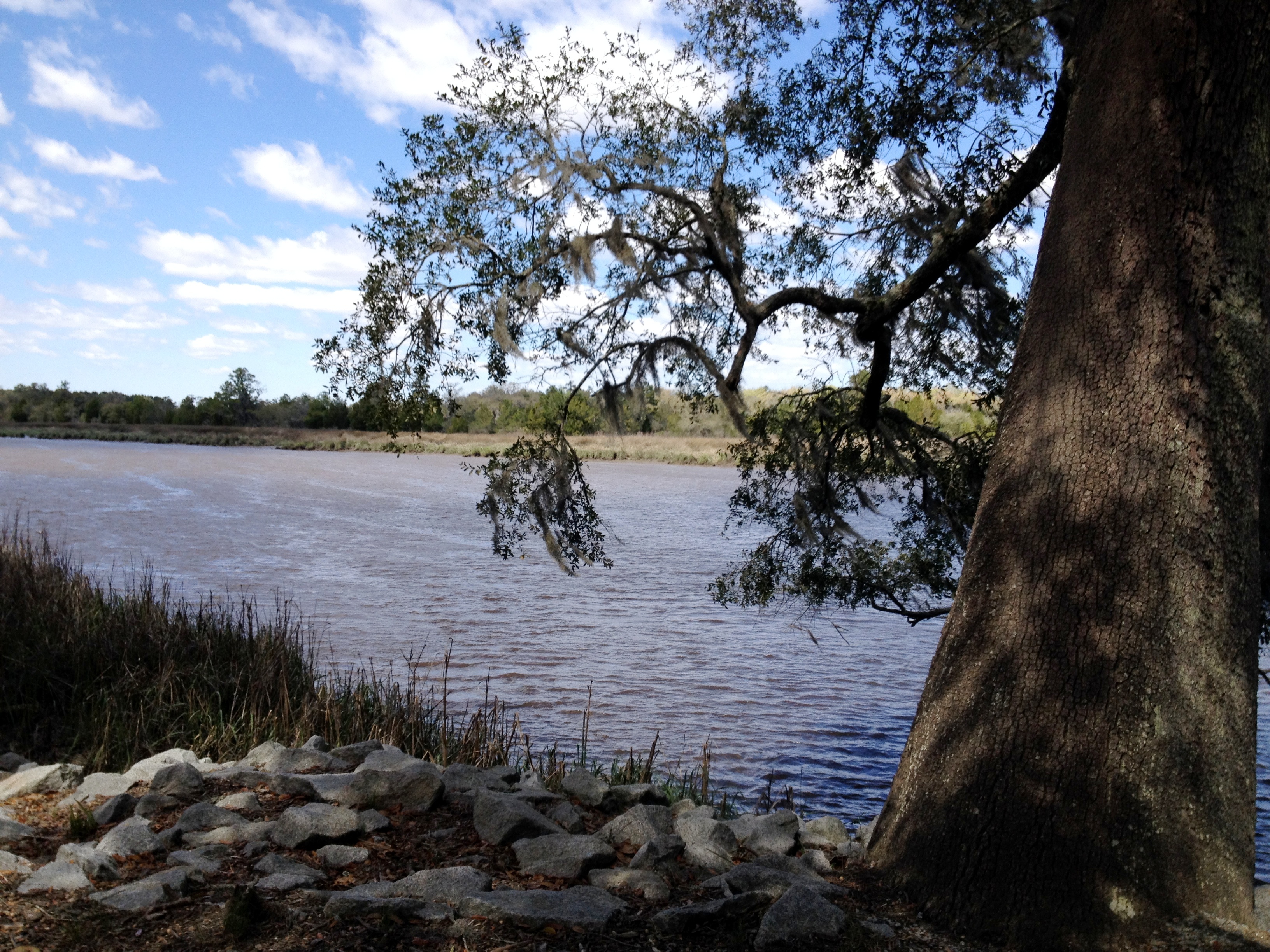
From the Ashley River, Drayton Hall presents the facade its builder intended visitors to see first -- the river side, formal and commanding, framed by live oaks draped in Spanish moss. In the 18th century, the river was the highway; guests arrived by boat and approached the house from the water. That perspective survives today, and from the air, the relationship between house, river, and landscape is even clearer. The property sits about 15 miles northwest of downtown Charleston, on the west bank of the Ashley where the river curves through the Lowcountry marshes. The surrounding landscape of tidal creeks, ancient oaks, and flat terrain is much as it was when John Drayton first saw it in 1738, recognized its potential, and began building his impossible villa.
From the Air
Located at 32.87°N, 80.08°W on the west bank of the Ashley River, about 15 miles northwest of downtown Charleston, SC. From the air, look for the distinctive Palladian plantation house set among live oak allees along the river. The Ashley River corridor is visible as a winding waterway through Lowcountry marshland. Charleston International Airport (KCHS) is approximately 8 miles to the east. Best viewed at 1,500-2,500 feet AGL to appreciate the relationship between the house, the river approach, and the surrounding plantation landscape.