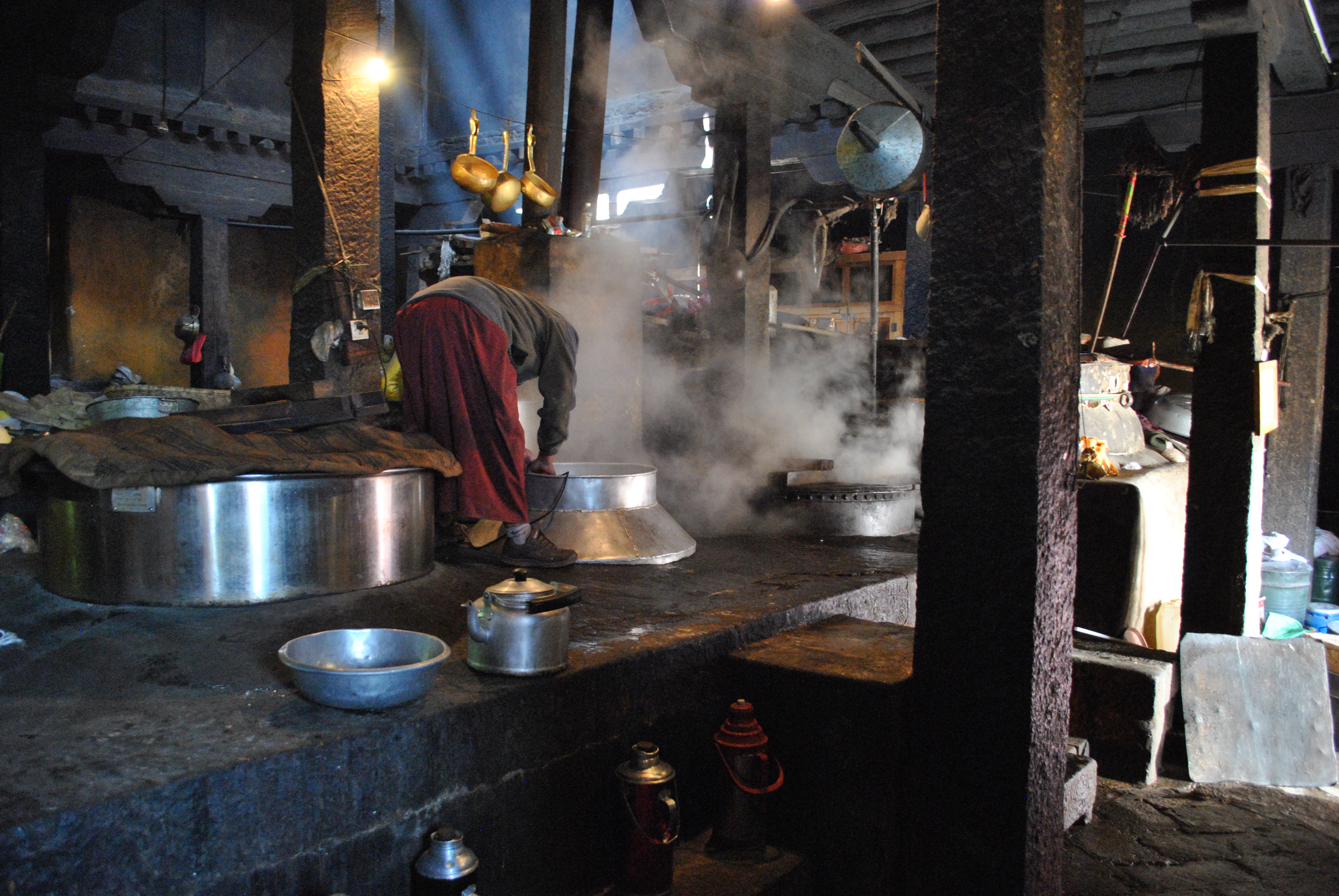
Drepung Monastery
In the late 1930s, the British explorer Freddie Spencer Chapman reported that Drepung was the largest monastery in the world: 7,700 monks in residence, sometimes as many as 10,000. Its name means "Rice Heap" -- an image that captures the visual impression of white buildings tumbling down the slopes of Mount Gephel, five kilometers from western Lhasa, like grain spilling from an overturned sack. This was not merely a monastery. Drepung was a university, a government seat, and for centuries the most powerful religious institution in Tibet.
The Nalanda of Tibet
Jamyang Choge Tashi Palden, one of Tsongkhapa's principal disciples, founded Drepung in 1416 and named it after Shridhanyakataka, a sacred site in South India. The monastery became the principal seat of the Gelugpa school and earned a comparison that carried real weight: it was called the Nalanda of Tibet, after the legendary Buddhist university of ancient India. The comparison was not casual. Drepung's academic standards were famously rigorous, and its seven colleges -- Gomang, Loseling, Deyang, Shagkor, Gyelwa, Dulwa, and Ngagpa -- functioned much like the colleges of medieval Oxford or the Sorbonne, each with its own teaching lineages, emphases, and traditional geographic affiliations. Monks from Kham filled one college; Mongolians another. The system produced scholars whose influence reached far beyond Tibet's borders.
Where the Dalai Lamas Lived
Before the Potala Palace existed, the Dalai Lamas lived here. In 1518, Gendun Gyatso -- later recognized as the 2nd Dalai Lama -- constructed the Ganden Phodrang within Drepung's walls. This estate became the Dalai Lamas' chief residence and governmental seat, and when the 5th Dalai Lama eventually established the Tibetan government, he named it after this very building. The Ganden Phodrang government ruled Tibet from the mid-17th century until the Chinese takeover in the 1950s, but the name originated here, on a mountainside in western Lhasa. Two centers of power coexisted within the monastery: the lower chamber, associated with the Dalai Lamas-to-be, and the upper chamber, tied to the lineage of Penchen Sonam Drakpa, the renowned Geluk master who held the Throne of Drepung in 1535.
What Survived and What Did Not
Almost half the older monastic buildings were destroyed after Chinese forces arrived in Lhasa in 1951. The chief structures survived -- the four colleges, the great assembly hall known as the Tsokchen, and the Ganden Phodrang -- but much of the complex was reduced to rubble. Photographs from 1993 show destroyed buildings alongside functioning ones, a jagged architectural timeline of loss. The monastery was shut entirely for five years, reopening only in 2013 according to reports in the International Herald Tribune. Monks were arrested; others disappeared after speaking to reporters. The Chinese government imposed a population cap, limiting Drepung in Lhasa to roughly 300 monks -- a fraction of the thousands who once filled its colleges and debating courtyards.
A Monastery in Two Countries
Drepung's story did not end at the Tibetan border. In exile, the institution rebuilt itself on land in Karnataka, South India, donated by Prime Minister Jawaharlal Nehru to the Tibetan community. The Indian campus today houses over 5,000 celibate monks: around 3,000 at Drepung Loseling and some 2,000 at Drepung Gomang. Hundreds of new monks are admitted each year, many of them refugees who crossed the Himalayas from Tibet. The debating tradition continues -- young monks sharpening their logic in the same rapid-fire exchanges that once echoed off the walls of Mount Gephel. The monastery now exists simultaneously in two locations and two political realities: constrained in Lhasa, flourishing in Mundgod.
The Weight of the Name
To understand Drepung is to understand why monasteries mattered in Tibet. They were not retreats from the world but centers of it -- educational, political, economic, and spiritual all at once. Drepung held the Throne of the Gelugpa school. It housed the Dalai Lamas. Its colleges trained the administrators and philosophers who shaped Tibetan civilization for centuries. When the Ganden Phodrang government took its name from a building inside Drepung's walls, it was not a coincidence but a statement of where authority resided. The rice heap on the mountainside was the seed from which Tibetan governance grew, and its partial destruction was, for Tibetans, the loss of far more than architecture.
From the Air
Drepung Monastery is located at 29.68°N, 91.05°E on the slopes of Mount Gephel (Gambo Utse), approximately 5 km west of central Lhasa. Elevation roughly 3,800 m (12,500 ft). The nearest airport is Lhasa Gonggar Airport (ZULS), about 65 km to the south-southwest. The monastery complex is visible as a large cluster of white buildings spreading across the mountainside west of Lhasa. Look for it on the north side of the Lhasa River valley, distinct from the city proper.