Dresden Cathedral
When Augustus III commissioned a Catholic cathedral for the most stubbornly Protestant city in Germany, he had to build a covered walkway so he could attend Mass without crossing the street. Dresden in the 1730s was overwhelmingly Lutheran. Its citizens had built the Frauenkirche down the road as a monumental statement of Protestant identity. But the elector of Saxony was Catholic - he had converted to qualify for the Polish throne - and his church needed somewhere to pray. The result, designed by Italian architect Gaetano Chiaveri between 1738 and 1751, became the Hofkirche, the Catholic Court Church, the largest church in Saxony, and the only one in Dresden where the heart of a king is buried in a separate vessel from his body.
A Religion for a Crown
The story behind the Hofkirche is the strangest political conversion in early modern German history. Saxony was the cradle of the Reformation - Wittenberg, where Luther nailed his theses, lay just north of Dresden. Yet in 1697 Frederick Augustus I, Elector of Saxony, formally converted to Catholicism so the Polish nobility would elect him their king. He became Augustus II the Strong, ruling both Saxony and Poland, and his son Augustus III continued the dual reign and the dual faith. The court was Catholic; the country remained Protestant. The Hofkirche was the architectural compromise. Built for the king and his entourage rather than for ordinary worshippers, it was connected to Dresden Castle by an enclosed elevated bridge so the royal family could move between palace and altar without ever stepping onto a public street. The ornate walkway is still there today, restored after wartime destruction.
Statues on the Skyline
Chiaveri's design is unmistakable from across the Elbe. The 86-meter bell tower rises beside a long elliptical nave, and the entire roofline bristles with 78 oversized statues of saints - Italian sculptor Lorenzo Mattielli's work, carved in Pirna sandstone, that gives the cathedral its almost theatrical silhouette. Inside, the most precious object is the organ: the last work of Gottfried Silbermann, completed by his apprentice Zacharias Hildebrandt in 1755 after the master's death. Bach knew Silbermann's instruments and admired them. The Rococo pulpit, carved by Balthasar Permoser - the same sculptor who decorated the Zwinger across the square - is one of the finest in Germany. Free entry during the day means visitors can wander in to hear the organ practice or simply sit in a building where the kings of two countries once knelt.
The Crypts Below
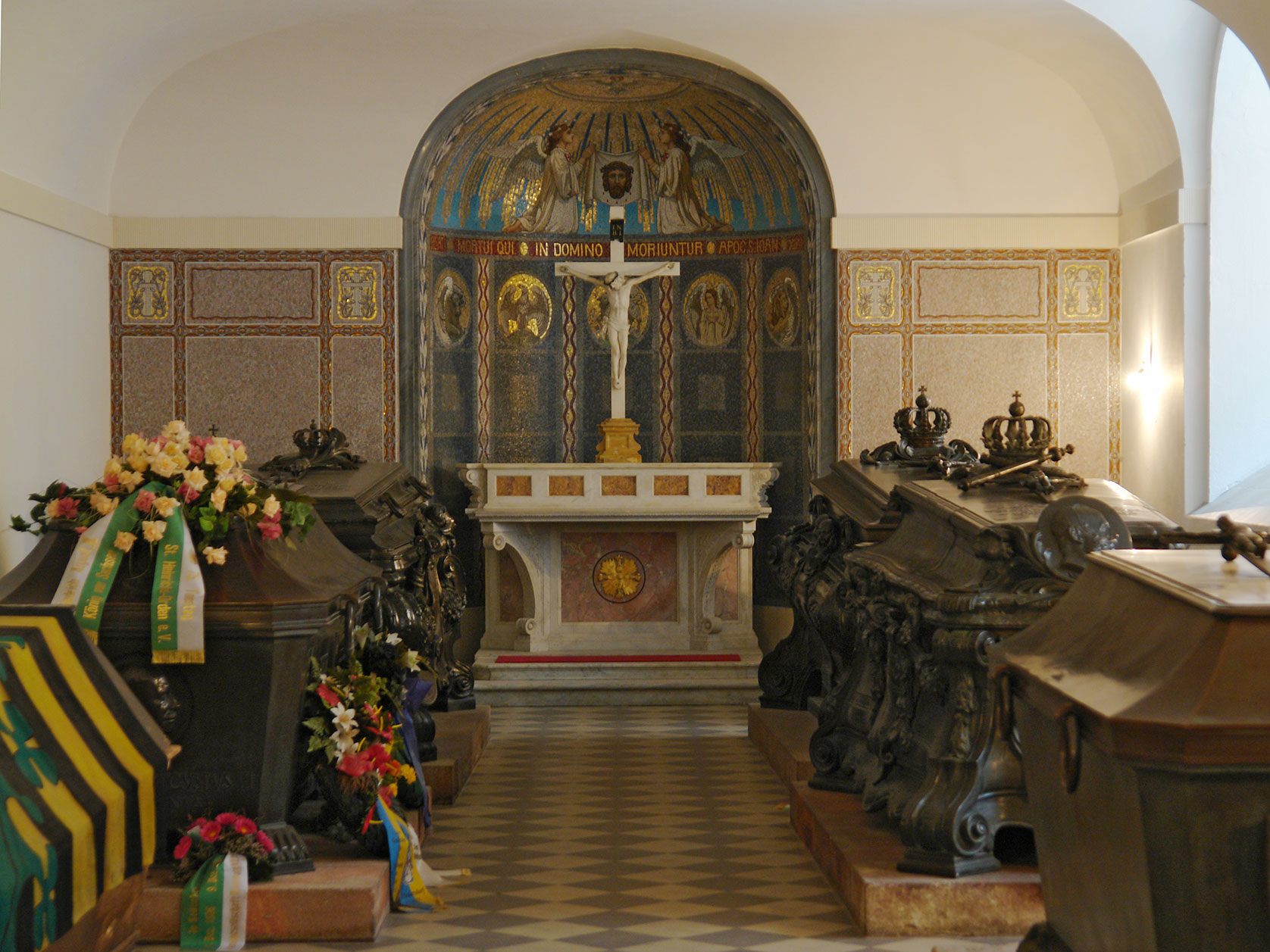
Beneath the floor lie four crypts holding 49 members of the House of Wettin, including the heart of Augustus the Strong - a literal heart, preserved in a copper capsule, separated from his body in keeping with a Saxon royal tradition. The body itself is buried in the Wawel Cathedral in Krakow, the traditional resting place of Polish monarchs. So one king lies in two countries: bones in Poland, heart in Saxony, neither location complete without the other. The Founders' Crypt holds Augustus III of Poland and his wife Maria Josepha of Austria - one of the very few Polish monarchs buried outside Wawel. Polish princes and princesses lie in adjoining vaults, and the cathedral facade still bears the coat of arms of the Polish-Lithuanian Commonwealth, a quiet reminder that this German baroque church was once a piece of Polish royal infrastructure.
Burned and Rebuilt
On the night of February 13, 1945, RAF and USAAF bombers struck Dresden in one of the most destructive raids of the European war. The Hofkirche burned. Its roof collapsed, the Silbermann organ was severely damaged, and the upper walls were reduced to scorched stumps. The East German government, despite its official atheism, restored the building by 1962 - the Catholic Church's continuity in the GDR was tolerated more than encouraged, but the cathedral's symbolic weight was too great to leave in ruins. In 1980 the Vatican elevated the Hofkirche to cathedral status of the Diocese of Dresden-Meissen, and after reunification a second wave of restoration rebuilt the covered walkway to the castle. Today the cathedral functions both as an active Catholic parish and as a monument to a city that was nearly erased and chose, stone by stone, to put itself back together.
From the Air
Dresden Cathedral sits at 51.05 N, 13.74 E on the south bank of the Elbe, directly adjacent to Dresden Castle in the historic Altstadt. The 86-meter bell tower and saint-lined roofline make the Hofkirche one of the most recognizable silhouettes on the Elbe terrace, particularly when paired with the dome of the nearby Frauenkirche. Best viewed from the north bank or from approach paths into Dresden International (EDDC), 9 km to the north. Watch for restricted Class D airspace over the Altstadt during major events.