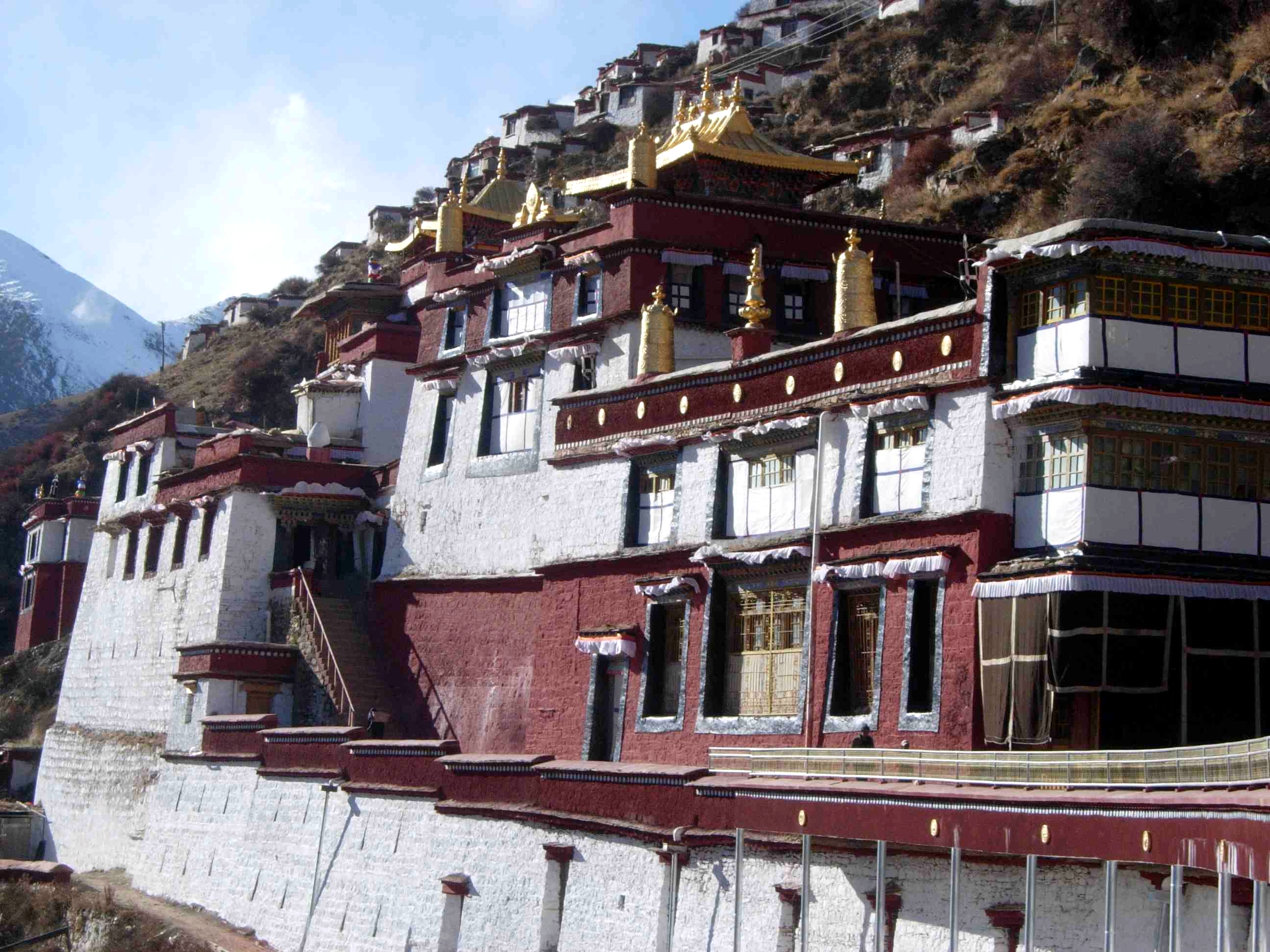
Drigung Monastery
Legend says a female yak chose this place. She wandered up the south slope of a long mountain ridge northeast of Lhasa, lay down, and refused to move. Jigten Sumgon, the monk following her, took it as a sign and founded his monastery on the spot in 1179. The horns of that yak are still preserved inside Drigung Thil, eight and a half centuries later. Whether or not you believe the story, the location speaks for itself: 4,465 meters above sea level, 180 meters above the Shorong valley floor, with a panoramic view that stretches across central Tibet in every direction. The monastery clings to the ridge as if it grew there, its more than fifty buildings scattered along slopes so steep that some can only be reached by wooden ladders.
A Lineage Born in the Caves
Drigung Thil did not begin as a grand institution. It grew beside a hermitage erected in 1167 by Minyak Gomring, an illiterate ascetic who had studied under Phagmo Drupa Dorje Gyalpo. When Jigten Sumgon established his monastery twelve years later, he was founding the seat of the Drikung Kagyu, one of eight minor lineages within the broader Kagyu tradition of Tibetan Buddhism. Meditation, not scholarship, defined the place from the start. Jigten Sumgon initiated a tradition of twice-yearly courses on sutra and tantra, but the monastery's deepest practice unfolded in nearby caves, where meditators lived in seclusion for years at a time. In the 13th century, the monastery dispatched lamas to establish meditation colonies at some of Tibet's most sacred sites, including Mount Kailash and the Lapchi caves. Until the 19th century, faith and ritual took precedence over formal scholarship, and a teaching college was not established until the 34th abbot, Kyabjey Zhiway-lodro, introduced one where monks spent five years studying thirteen scriptural texts through logic and debate.
Mongol Fire and Slow Rebuilding
The monastery's early growth was remarkable. Within decades of Jigten Sumgon's death in 1217, Drigung Thil rivaled the powerful Sakya sect in both political and religious influence. That rivalry proved dangerous. In 1240, Mongol armies under Dorta Nagpo sacked nearby monasteries and turned toward Drigung, but the monks managed to defend their walls. Their luck ran out fifty years later. In 1290, a Mongol army directed by the Sakya general Aklen destroyed the monastery entirely, a deliberate strike against Drikung's political power. The 9th lineage holder, Chunyi Dorje Rinchen, rebuilt with help from the Sakya and the Mongol emperor, but the monastery's ambitions were now scaled back to contemplative studies. It regained some strength by the mid-14th century, played a role in Sino-Tibetan relations through the Ming dynasty, but was gradually eclipsed after the 15th century by the rising Gelug sect.
Destruction and What Survived
In 1959, four hundred monks lived at Drigung Thil, sixty people sat in meditation retreats, and eight Incarnate Lamas presided over the community. Then came the Cultural Revolution. Red Guards looted nearly everything: statues, stupas, thangkas, manuscripts. The monks managed to hide a few small statues, but the buildings were severely damaged and the collection accumulated over centuries was gone. Reconstruction began in 1983. Seven of the original fifteen temples were rebuilt, though the monastery never returned to its former scale. By 2015, about 250 monks were in residence. The traditions found a second home in 1989, when the Jangchubling Drikung Kagyu Institute was established in Dehradun, India, ensuring continuity of the lineage in exile.
The Ridge Between Earth and Sky
The Tsuglakhang, the main shrine hall, stands on a rampart of solid stone twenty meters high, its facade fronted by a terrace where lessons were once given in the open air. Inside, a central statue of Jigten Sumgon made of gold and copper and filled with relics sits beside a figure of Guru Rinpoche. A chorten in the hall holds Jigten Sumgon's remains. Above the assembly hall, a small shrine is dedicated to Achi, the monastery's protector, depicted in both peaceful and wrathful forms. A pilgrimage trail loops from below the chanting hall up to the crest of the ridge at nearly 15,000 feet, where it reaches the sky burial site before skirting various chortens and shrines on its descent. The monastery has closed sky burials to uninvited visitors, but during Tibetan New Year, thousands of pilgrims still arrive, many traveling from Kham in eastern Tibet to walk the kora and feel the wind on the ridge where a yak once lay down.
From the Air
Located at 30.11N, 92.20E in the Drikung region of central Tibet, approximately 120 km northeast of Lhasa. The monastery sits at 4,465 m (14,650 ft) on a south-facing mountain ridge overlooking the Shorong valley. From altitude, look for a cluster of buildings on a long ridge with the valley below. Nearest major airport is Lhasa Gonggar Airport (ZULS), about 150 km to the southwest. Expect high-altitude conditions with thin air and potential turbulence along the ridgeline.