Drommedaris
Every quarter of an hour, in the harbour town of Enkhuizen on the northern shore of the Markermeer, a seventeenth-century iron drum turns inside a domed tower, lifts a sequence of hammers, and lets them fall. Forty-four bronze bells - some cast by Geert van Wou around 1524, some by Pieter Hemony in 1675, some by Eijsbouts in 1982 - sound the time. The drum has been doing this since 1659. Through plague, occupation, two world wars, the collapse of the herring trade, the closure of the Zuiderzee, and the entire history of recorded music, the bells have not stopped. They are not a tourist gesture. They are a public utility, and the building that holds them has been earning its keep for almost five centuries, in jobs that keep changing.
Built for War, 1540
The original building was a defence work at the entrance to Enkhuizen's old harbour - a stout stone rondel from 1540, two storeys tall, with an artillery cellar and a ground-floor gun room where cannons fired through niches cut in the walls. The vaulted upper room had ribbed Gothic groins and a stone Imperial coat of arms over the gate carved with an inscription that translates roughly: 'Blessed is the city, and highly praised, that prays for war in time of peace.' The old name for the gate was the Zuiderpoort, the Southern Gate, or the Ketenpoort, the Salt-Pan Gate, because behind it lay the salt-evaporation pans where seawater was reduced to the white grit that preserved Enkhuizen's herring catch. The bell in the wooden chair on the roof rang every evening to announce that the gate was closing for the night. If you were outside the wall when it rang, you slept outside the wall.
Raised for Music, 1649-1657
After the Eighty Years' War with Spain ended in 1648, Enkhuizen was rich. The town was one of the six VOC chambers, and the merchants who returned from Batavia decided their defensive gate should also be a civic monument. Between 1649 and 1657 the building was raised by two storeys, given a pointed copper-domed tower, and equipped first with a chime of ten old bells from the city's St. Pancras tower, then with a full carillon by Pieter Hemony - one of the last instruments the great Amsterdam bell-founder ever built, and the lightest set of bells he ever cast. The carillon's largest Hemony bell carries a Latin inscription bragging that it sounds louder than psalms and Apollo's lyre. The building's job changed in those years from keeping enemies out to telling the town what time it was, and warning ships in fog when they were approaching the harbour mouth. The fog warning, the historian Peter Bakker argued, was the real reason the tower was built up. The music was the dividend.
All the Other Jobs
A building this useful does not stay one thing for long. Over four centuries the Drommedaris served as a gunpowder magazine, a debtors' prison, a guardhouse, a tax collector's office, a spinning and weaving mill, and - under the gate itself, by the late nineteenth century - the town's telegraph office. There was a cell above the gate for those condemned to death, and the prisoners scratched the dates and occasionally short poems into the oak panelling, which is still visible if you climb the stairs. Near the end of the Second World War, an Allied bombing raid hit the city side of the gate; the photographs from 1945 show the stone face pocked with shrapnel scars. After the war the building hosted the first temporary exhibition of what became the Zuiderzee Museum in 1949. By 1960 it had become a student centre, with a bar on the ground floor and the death cells above repurposed as bedrooms - Princess Beatrix, before she was queen, reportedly slept up there at least once. Today the Drommedaris is a cultural centre and concert venue, with an elevator added for accessibility during the 2012-2015 restoration.
The Anchors and the Story They Tell
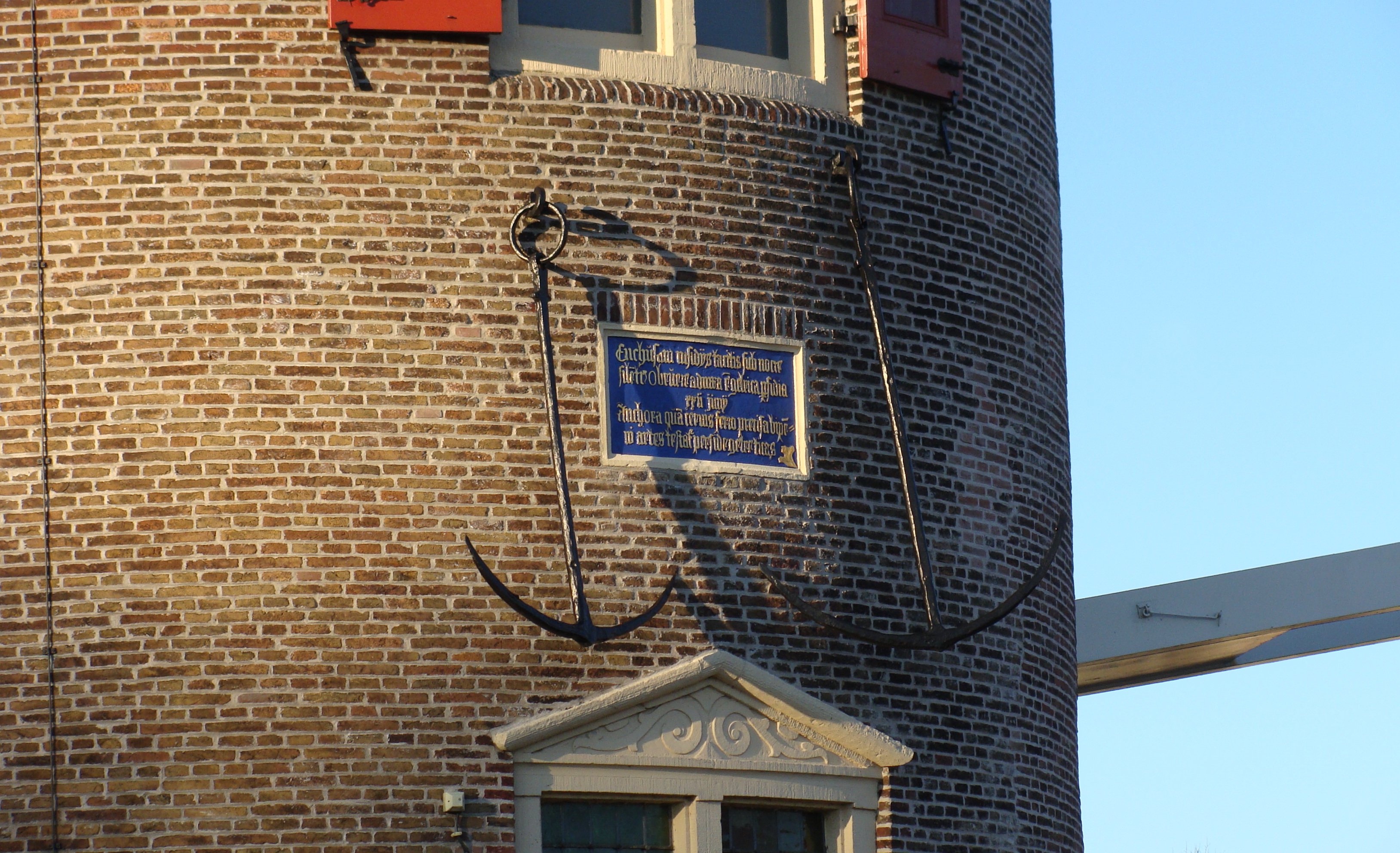
Two large iron anchors hang on the harbour-side wall of the Drommedaris. The legend - and the town has always called it a legend, with the modesty of a place that has learned to qualify its stories - says they were captured from five Gelderland ships in 1537, during the Gelderse Wars, when an attempted raid on Enkhuizen failed. The Enkhuizers spotted the ships at anchor, attacked, and the Gelderlanders cut their cables to escape, leaving the anchors behind. The trophies were originally hung on the English Tower (also called the East Indian Tower), which was demolished in 1829, and the anchors were moved to the Drommedaris along with the memorial stone. Whether the legend is precisely true is uncertain; the anchors are old, the wars were real, and the practice of hanging captured tackle as civic trophies is well documented. What matters is that Enkhuizen has been telling the story for almost five centuries, and the anchors are where the story is kept.
The Bells Keep Time
The carillon today has 44 bells across three and a half octaves, with the most recent expansion completed during the 2012-2015 restoration. The city carillonneur plays a live recital every Thursday at noon. Twice a year he climbs into the dome and changes the melodies pinned on the seventeenth-century drum, so that the quarter-hour tunes rotate with the seasons. The hour bell strikes louder than the rest. The ferryman bell, cast in 1775 by Jan Verbruggen with the Latin inscription Labor Vincit Omnia - 'work overcomes all things' - hangs outside the dome above the eastern dial, where it has been ringing for ferries for two hundred and fifty years. Walking the harbour wall at dusk, with the bells coming down through the cold air over the Markermeer water, it is hard not to feel that this small building has done more honest work than most. The dromedary it is named for, incidentally, was never here. The nineteenth-century townspeople just liked the sound of the word.
From the Air
The Drommedaris stands at 52.70 N, 5.29 E, at the southern entrance to the old harbour of Enkhuizen, North Holland, on the inland shore of the IJsselmeer/Markermeer. Visible from the air as the squat round tower with copper dome at the tip of the historic harbour mole. The town is at the eastern terminus of the rail line from Hoorn and Amsterdam, and the start of the Houtribdijk causeway across to Lelystad. Nearest airports: Lelystad (EHLE), 25 km southeast across the Houtribdijk; Schiphol (EHAM), 65 km southwest.