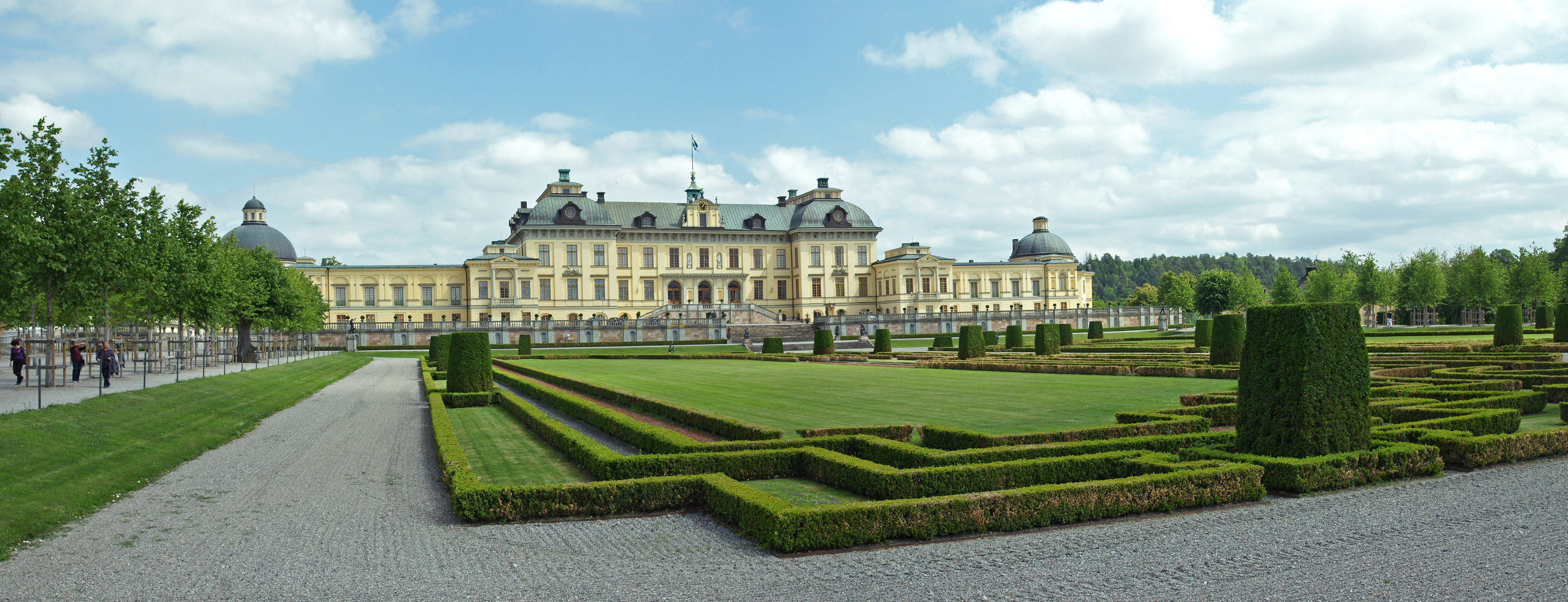
Drottningholm Palace
The bronze statues scattered through the palace gardens spent the first part of their existence in Prague. Created by the Dutch master Adrian de Vries for the Wallenstein Palace, they were seized by Swedish troops during the Thirty Years' War and shipped north as spoils. The marble lions guarding the main gate came from Warsaw's Ujazdow Castle, another conquest. At Drottningholm Palace, military victory literally decorates the landscape. This estate on Lovon Island in Lake Malaren, now the private residence of the Swedish royal family, tells four centuries of Scandinavian history through architecture, gardens, and carefully arranged plunder.
The Queen's Islet
The name Drottningholm translates as 'Queen's islet,' and queens have shaped this place from the beginning. John III of Sweden built the first stone palace here in 1580 for his wife Catherine Jagiellon, on a site that had housed a royal mansion called Torvesund. The current palace owes its existence to fire and female determination. Queen Dowager Hedwig Eleonora purchased the estate in 1661, but before the year ended, flames destroyed the original building. Rather than retreat, she hired architect Nicodemus Tessin the Elder to create something grander. During the twelve years of construction that followed, Hedwig Eleonora served as regent for the child king Charles XI, effectively ruling Sweden. Her palace announced that power to visitors arriving by boat across the lake.
Father, Son, and Stone
Nicodemus Tessin the Elder died in 1681 with his masterwork nearly complete. His son, Nicodemus Tessin the Younger, finished the elaborate interior designs, creating a seamless transition between generations. The Flemish sculptor Nicolaes Millich filled the great staircase and hall with marble figures of the nine muses and busts of Gothic kings. He captured the royal family in stone as well, portraits of Charles X Gustav, Hedwig Eleonora, and the young Charles XI that survive as three-dimensional glimpses of the Swedish Baroque court. Millich and his assistant Burchard Precht carved decorative woodwork for the Queen Dowager's bedchamber, each surface announcing wealth and cultivation. When Charles XII left Sweden to fight the Great Northern War from 1700 to 1721, Hedwig Eleonora became the undisputed host of the royal court at this summer palace she had willed into existence.
Gardens of Conquest and Cultivation
The palace grounds layer different eras of landscape design. The formal Baroque garden, laid out in the late 17th century under Hedwig Eleonora's direction, creates geometric precision with tree-lined avenues flanking the palace. Here stand the Adrian de Vries bronzes from Prague, their muscular classical forms unexpected in the northern light. Gustav III added the English landscape garden in the 18th century, a deliberate contrast to Baroque formality. Winding paths lead past ponds and canals to carefully composed views called vistas. Marble statues purchased by Gustav from Italy appear at calculated intervals, surprising visitors with classical beauty in green clearings. The antique figures serve as focal points for those sight lines, drawing eyes toward choreographed perspectives that make the garden itself a theatrical production.
The Chinese Fantasy
At the far end of the gardens stands one of Europe's finest examples of chinoiserie. The Chinese Pavilion, built between 1763 and 1770, reflects the 18th-century European fascination with East Asian aesthetics filtered through Western imagination. The building's red lacquer colors, dragon motifs, and pagoda-influenced rooflines create an architectural daydream that has nothing to do with actual Chinese design and everything to do with Swedish court taste during the reign of Adolf Frederik and Lovisa Ulrika. Inside, the decorations blend imported Chinese objects with European interpretations, a cultural mashup that scholars today study as evidence of early globalization. The pavilion survived the changing fashions that destroyed similar structures elsewhere, its preservation now part of the UNESCO World Heritage designation that covers the entire Drottningholm domain.
A Living Palace
Unlike many royal residences that serve only as museums, Drottningholm remains the Swedish royal family's actual home. The current king and queen moved here in 1981, making these Baroque halls and formal gardens the backdrop for contemporary monarchy. The palace church, designed by Tessin the Elder and completed by his son in 1746, still welcomes the residents of Lovon parish on the last Sunday of each month. A Cahman organ from 1730 fills the space with sound, while a church tapestry made by King Gustav V adds a personal royal touch. This mixing of public heritage site and private residence gives Drottningholm a vitality that purely historical properties lack. The gardens where tourists stroll, the theater where summer operas play, and the palace where a family lives form a single coherent estate that has functioned continuously for over three centuries.
From the Air
Located at 59.3217°N, 17.8861°E on Lovon Island in Lake Malaren, 10km west of central Stockholm. The yellow palace complex is highly visible from the air, with formal Baroque gardens extending south and the English landscape garden to the north. The Chinese Pavilion appears as a red-roofed structure at the garden's far end. Look for the theater building northwest of the main palace. The entire island creates a distinctive shape in the lake. Recommended viewing altitude 2,000-4,000 feet to appreciate the gardens' geometric patterns. Stockholm Bromma Airport (ESSB) is 6km east, with approaches to runway 12 passing almost directly overhead. Stockholm Arlanda (ESSA) lies 35km northeast.