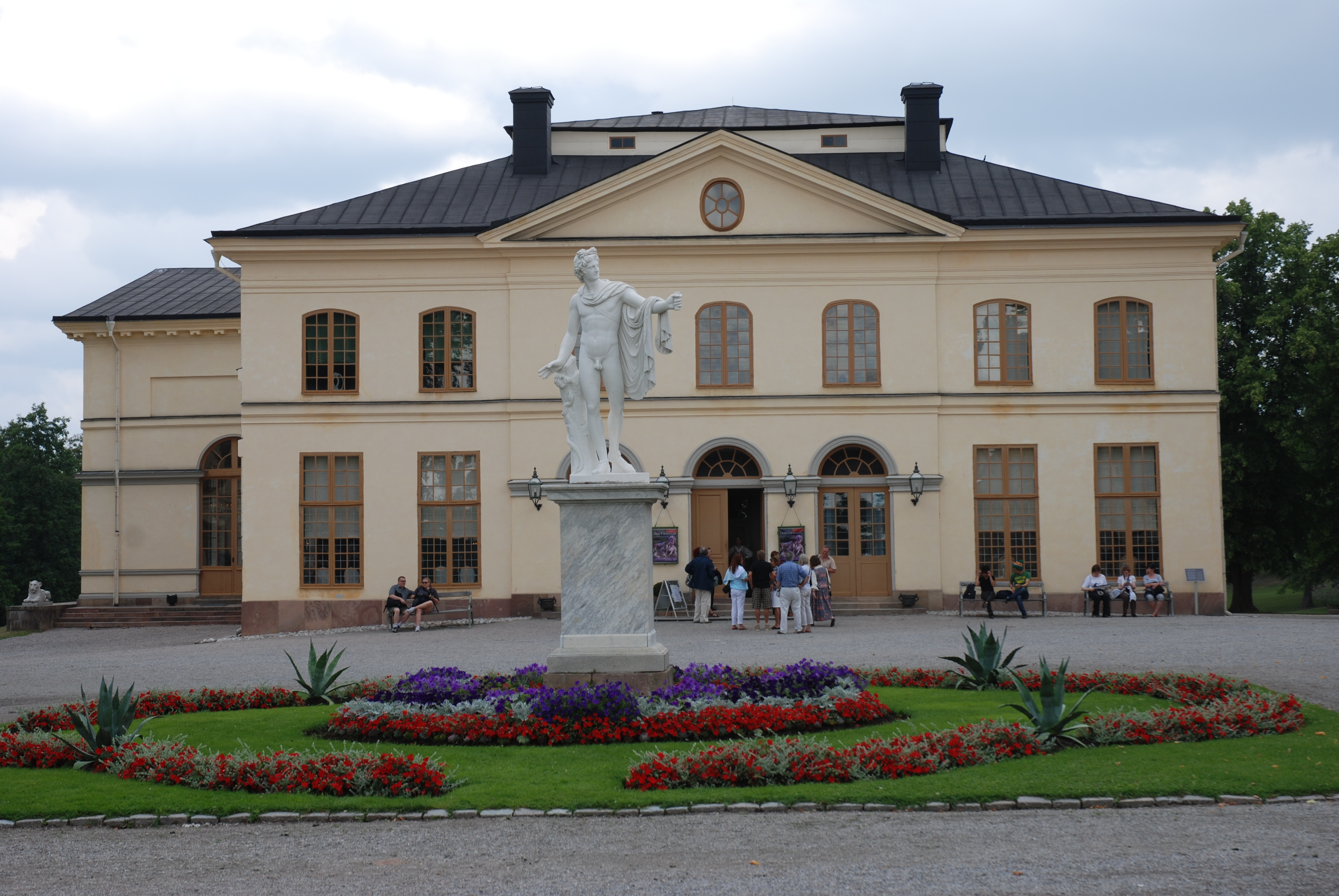
Drottningholm Palace Theatre
The gears turn, ropes pull taut, and suddenly a forest transforms into a palace courtyard. The machinery producing this theatrical magic at Drottningholm Palace Theatre dates to 1766, and it still works. This unassuming building on an island west of Stockholm looks like a country manor from the outside, offering no hint that behind its plain walls lies one of Europe's most complete surviving examples of 18th-century theater technology. The chariot-and-pole system, the original backdrops, the hand-operated winches beneath the stage, all remain functional, making every summer opera performance here a journey through time that neither recordings nor modern theaters can replicate.
Born from Ashes
The first theater at Drottningholm opened in 1754, commissioned by Queen Lovisa Ulrika to host French actors and Italian opera for the royal court. It lasted eight years. On August 27, 1762, during a comic opera performance, fire consumed the building. The queen wasted no time. She commissioned architect Carl Fredrik Adelcrantz to design a replacement, and construction began in 1764. The new theater would be different, born of necessity rather than abundance. The Swedish treasury lacked the funds for a Versailles-style extravagance, so Adelcrantz and decorator Adrien Masreliez worked creative magic. They used trompe l'oeil painting, papier-mache, and stucco to imitate marble, gold, and precious materials. The illusion succeeded. Visitors today still pause to verify that the gilded surfaces are merely painted plaster.
Wheels, Ropes, and Capstans
The theater's true treasure lies beneath the stage and behind the wings. The chariot-and-pole system, possibly designed by Italian theatrical engineer Donato Stopani, allows scenery changes in seconds. Wings mounted on wheeled carts run in floor tracks, connected by ropes to a capstan below stage. When stagehands turn the capstan, entire sets of wings slide simultaneously, transforming the visual environment as audiences watch. Cloud machines lower gods from the heavens. Wave machines simulate the sea. Thunder sheets and wind machines complete the atmospheric arsenal. Most remarkably, the original equipment still operates. Only the ropes have been replaced, and some delicate backdrops substituted with replicas. The mechanism that changed scenes for Queen Lovisa Ulrika's guests still does so today.
The King Who Wrote Operas
After King Adolf Frederik died in 1771, the French acting troupe was dismissed and the theater fell silent. Six years later, Queen Lovisa Ulrika gave it to her son, Gustav III. The new king was obsessed with theater. He hired his own troupe, wrote plays, directed productions, and championed a revolutionary idea for Swedish culture. Rather than merely importing French and Italian entertainment, Gustav encouraged the creation of distinctly Swedish opera, with Swedish stories performed in the Swedish language. The Dejeuner Salon he added still serves as the foyer. Then in 1792, at a masked ball in Stockholm, an assassin's bullet ended Gustav's theatrical reign. The theater at Drottningholm became a furniture storage room. For more than a century, the machinery sat idle, protected by neglect from the modernizing hands that would have replaced it.
Resurrection and Recognition
In 1921, theater historian Agne Beijer discovered what time had preserved. With royal permission, he began careful restoration. Electric lights were added, but designed to flicker like candles. Original ropes were replaced to ensure safety, but the mechanisms they operated remained untouched. In 1991, the theater joined Drottningholm Palace, the Chinese Pavilion, and the surrounding park as Sweden's first UNESCO World Heritage Site. Today the Drottningholm Theatre Museum operates summer opera seasons focusing on Haydn, Handel, Gluck, and Mozart. Musicians wear period costumes and play authentic instruments or careful reproductions. Productions demonstrate the original stage effects, making audiences participants in a living museum where art and artifact merge. Ingmar Bergman so admired the space that he wanted to film his 1975 Magic Flute here, though the fragile scenery forced him to build an exact replica in the Swedish Film Institute studios instead.
The Hidden Opera House
From the air, Drottningholm Palace Theatre reveals nothing of its interior wonders. The plain rectangular building sits near the palace on Lovon Island in Lake Malaren, resembling an administrative structure or perhaps a stable more than a royal opera house. This architectural modesty resulted from budget constraints, but creates an effect that theaters with grand facades cannot match. Visitors approaching on foot receive no preparation for the intimate auditorium within, where the T-shaped seating plan places two thrones at the front and nobles on wooden benches. The stage depth exceeds what the building's exterior suggests possible, a spatial trick that helps the original scenery create convincing illusions of distance. The contrast between exterior and interior captures something essential about Swedish royal culture, where restraint masks remarkable sophistication.
From the Air
Located at 59.323°N, 17.885°E on Lovon Island in Lake Malaren, approximately 10km west of central Stockholm. The theater sits adjacent to Drottningholm Palace within the UNESCO World Heritage site. From the air, look for the yellow palace complex on the island's eastern shore. The theater building is the plain rectangular structure northwest of the main palace. Recommended viewing altitude 1,500-3,000 feet to see the entire palace grounds and their relationship to the lake. Stockholm Bromma Airport (ESSB) is 6km east. The approach to Bromma's runway 12 passes almost directly over the Drottningholm grounds.