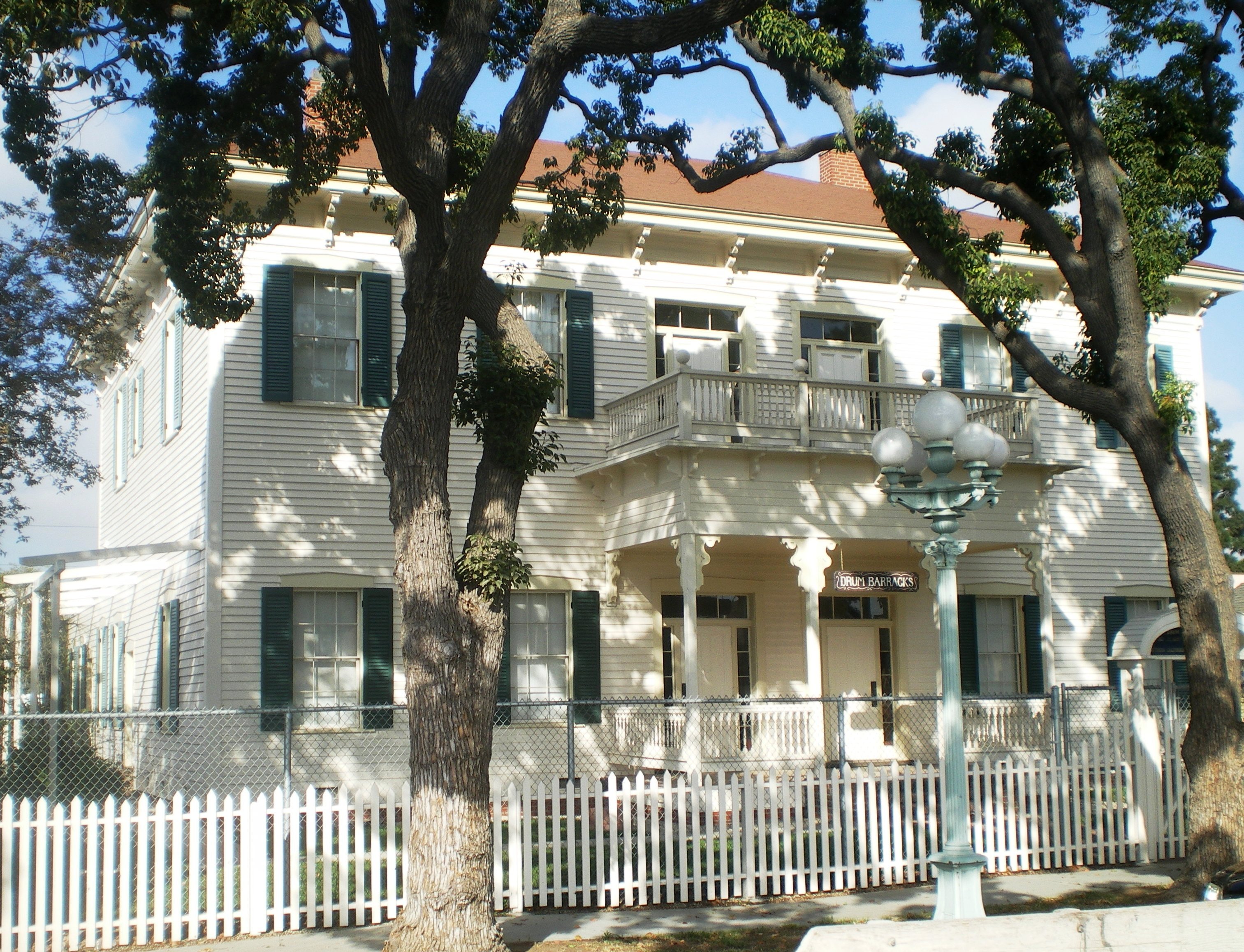
Drum Barracks
The Confederacy had a plan for California. If Confederate forces could push up through Texas and New Mexico, securing Tucson and then marching for the Pacific, they would gain access to the gold and silver of the Southwest — and a coastline. The Union knew this. In the summer of 1861, Confederate Colonel John R. Baylor declared the Confederate Territory of Arizona and occupied Tucson. The Union response was Drum Barracks: nineteen buildings on sixty acres in the harbor town of Wilmington, south of Los Angeles, purpose-built to serve as the headquarters for the defense of Southern California and the entire New Mexico Territory. Nothing like it existed west of the Mississippi.
The Donors and the Decision
The land for Drum Barracks was donated by two men who understood that California's loyalty to the Union was not foregone. Phineas Banning, the freight and stagecoach magnate who had almost single-handedly developed the Wilmington waterfront, contributed twenty acres. Benjamin 'Don Benito' Wilson, a former mountain man turned Southern California landowner and politician, contributed additional land. Both were committed Unionists at a moment when Southern California's sympathies were genuinely divided — the region had significant Confederate sentiment, and the military presence the barracks represented was as much about internal security as external threat. The facility cost approximately $1 million, a staggering sum for 1862, funded entirely by the federal government.
The California Column
The Union organized its available western troops into the California Column and marched them east to confront the Confederate forces in Arizona. They met at Picacho Pass in April 1862 — the westernmost land battle of the Civil War. The Confederates were pushed back; Tucson was retaken. The threat of a Confederate Pacific was extinguished. Drum Barracks served throughout the war as the logistical hub for this entire western theater, supplying and coordinating the troops who held the New Mexico Territory for the Union. The Quartermaster's Corps processed enormous quantities of supplies through the Wilmington waterfront. The railroad connection that Phineas Banning had championed made the whole operation possible.
Confederate Sympathizers in the Jails
The barracks' role extended beyond projecting force outward. Southern California was full of people whose sympathies lay with the Confederacy, and the Union Army was not subtle about managing this. Henry Hamilton, editor of the Los Angeles Star newspaper, was arrested and imprisoned at Drum Barracks for his openly Confederate editorial positions. E.J.C. Kewen, a prominent Southern California attorney who had made no secret of his Confederate sympathies, was similarly arrested. The arrests were part of a broader Union effort to suppress Confederate organizing and recruitment in California — a campaign that was largely successful, though it generated lasting resentment in some quarters of the local population.
After the War
When the Civil War ended in 1865, the strategic rationale for Drum Barracks evaporated. The military began decommissioning the facility almost immediately; most of the nineteen buildings were sold, demolished, or repurposed. By the early 1870s, only a handful of structures remained. The junior officers' quarters — a modest two-story Italianate building — survived through a combination of private ownership and benign neglect, passing through several hands before the City of Wilmington recognized its historical significance. Today it operates as the Drum Barracks Civil War Museum, housing one of the more complete collections of Civil War-era military artifacts on the West Coast. The powder magazine, three blocks away on private property, survives behind a chain-link fence.
The War at the End of the World
For most people, the Civil War is Gettysburg and Antietam, Vicksburg and Appomattox — battles fought in the East and South, on terrain soaked with American memory. Drum Barracks is a reminder that the war reached here too, to the harbor of a small California town, to the desert passes of Arizona, to the question of whether the Pacific belonged to the United States or to a Confederate republic that never came to be. The Union soldiers who shipped out from Wilmington's docks and marched into the Sonoran Desert were fighting the same war as the men at Chancellorsville. They were just fighting it at the edge of everything, three thousand miles from anyone who would remember.
From the Air
Located at approximately 33.78°N, 118.26°W in the Wilmington neighborhood of Los Angeles, near the port complex. The Drum Barracks Civil War Museum is at 1052 Banning Boulevard. Long Beach Airport (KLGB) is approximately 5 miles northeast; Los Angeles International Airport (KLAX) is approximately 10 miles northwest. The Wilmington waterfront and the Port of Los Angeles are visible nearby from altitude.