Drumheller: The Town the Dinosaurs Built
The hills around Drumheller are made of dead dinosaurs. That's an exaggeration, but not by much. The Red Deer River Valley cuts through formations that were swamp and river 70 million years ago, when dinosaurs died and sank into mud that eventually became stone. Now that stone is eroding, and bones emerge constantly - skulls of tyrannosaurs, skeletons of hadrosaurs, the tiny teeth of prehistoric crocodiles. The fossil wealth is so concentrated that Drumheller became a dinosaur town: the Royal Tyrrell Museum holds 160,000 specimens and keeps finding more. Visitors come for fossils and find an alien landscape of hoodoos and badlands that looks like it should still have dinosaurs walking through it.
The Bones
Joseph Tyrrell found the first dinosaur skull near Drumheller in 1884 - an Albertosaurus, a tyrannosaur cousin. More skulls followed. The Horseshoe Canyon and Dinosaur Park formations exposed around Drumheller proved to be among the world's richest dinosaur graveyards. The conditions were perfect: river systems 70 million years ago buried bodies quickly in fine sediment; the sediment became stone; erosion now exposes the stone faster than fossils can be collected. Every spring thaw and summer storm reveals new specimens. The supply seems inexhaustible.
The Museum
The Royal Tyrrell Museum opened in 1985 as Canada's premier paleontological institution. The collection now exceeds 160,000 specimens, with over 40 complete dinosaur skeletons on display. The museum is built into the badlands landscape, emerging from the earth like a fossil itself. Exhibits trace life from the Cambrian explosion through the age of dinosaurs to modern ecosystems. Research programs run active digs throughout the Alberta badlands; the museum's scientists have named dozens of new species. The gift shop sells fossil replicas and T-rex everything. It's impossible to overstate dinosaurs' grip on this town.
The Badlands
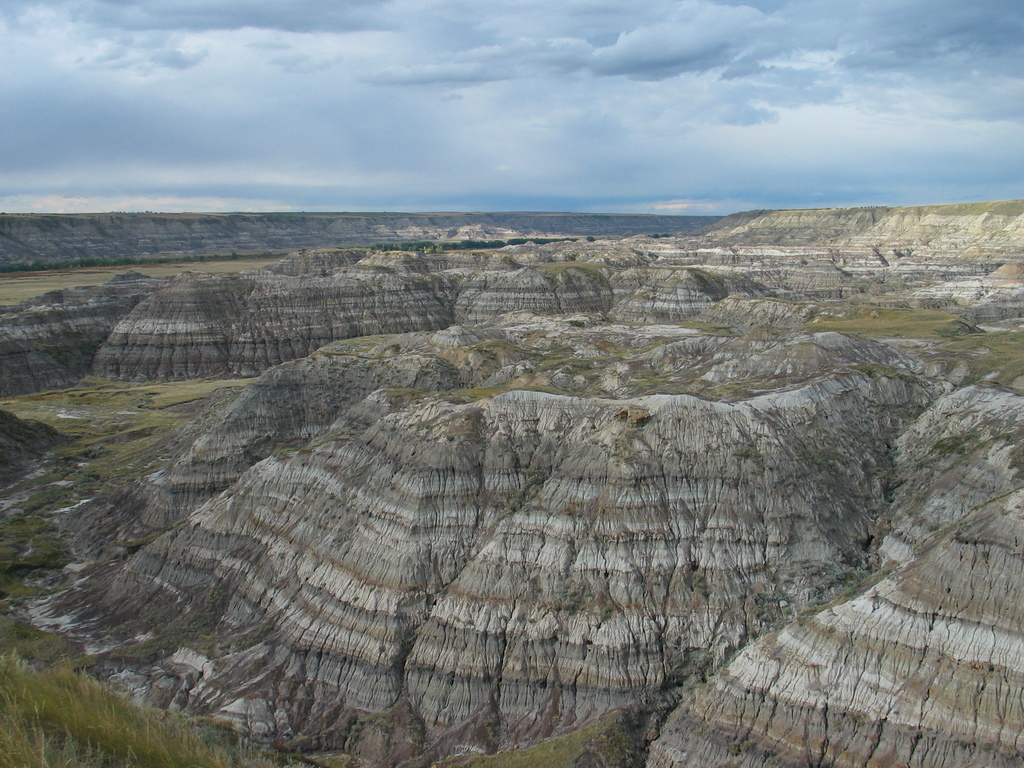
The landscape around Drumheller is otherworldly - hoodoos, coulees, striped cliffs in rust and gray, and almost no vegetation. The Red Deer River cut through 70 million years of sediment, exposing layers like the pages of a book. Different formations hold different fossils: the Horseshoe Canyon Formation has hadrosaurs and tyrannosaurs from 74 million years ago; the Dinosaur Park Formation, exposed downstream, has even richer deposits from 76 million years ago. The terrain is beautiful, hostile, and constantly changing as erosion does its slow work.
The Town
Drumheller leaned into its dinosaur identity completely. The downtown has the 'World's Largest Dinosaur' - a 86-foot T-rex statue with an observation deck in the jaw. Dinosaur statues appear on every corner. Businesses have dinosaur names, dinosaur logos, dinosaur mascots. The commitment is total and slightly surreal: a small prairie town transformed by prehistoric dead animals into a tourist destination that draws 400,000 visitors annually. The coal mining that originally built Drumheller is long gone; dinosaurs are now the only economy that matters.
Visiting Drumheller
Drumheller is located 135 kilometers northeast of Calgary via the Trans-Canada Highway and Highway 9. The Royal Tyrrell Museum is the primary attraction - plan at least half a day; fossil enthusiasts need longer. The Dinosaur Trail scenic drive loops through the badlands with viewpoints and hoodoo formations. The World's Largest Dinosaur is downtown and climbable. Dinosaur Provincial Park, a UNESCO World Heritage Site, is 170 kilometers southeast with even richer fossil beds and guided dig programs. Drumheller has hotels, restaurants, and services. Calgary has the nearest airport. Visit in spring or fall; summer gets hot and crowded. The badlands are photogenic in any light; evening shadows define the hoodoos best.
From the Air
Located at 51.46°N, 112.71°W in the Red Deer River Valley, Alberta. From altitude, the Drumheller badlands appear as a dramatic incision in the prairie - flat farmland suddenly giving way to eroded terrain of hoodoos and coulees. The striped sediment layers are visible from high altitude; the Royal Tyrrell Museum is visible as a distinctive structure in the valley. The town of Drumheller clusters where the valley meets the plains. The World's Largest Dinosaur is technically visible from low altitude. The landscape looks prehistoric because it is - exposed sediment from 70 million years ago, still releasing the bones of creatures that once walked here.