Drumheller: The Valley Where Dinosaurs Became Oil
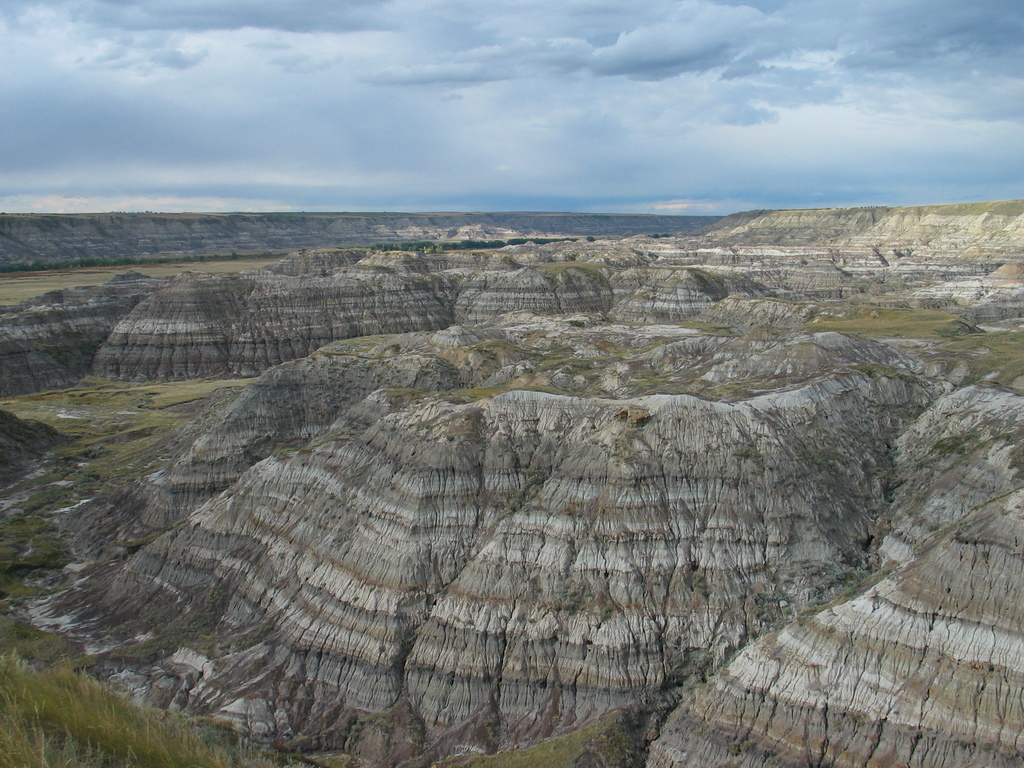
The Red Deer River Valley looks like another planet. Hoodoos - towering pillars of rock capped with harder stone - stand like sentinels across a landscape stripped to bare geology. The badlands around Drumheller, Alberta expose millions of years of sediment in striated cliffs of red, brown, and gray. And buried in those layers: dinosaurs. More dinosaur fossils have been found in the Drumheller badlands than in any other location on Earth. The Royal Tyrrell Museum holds over 160,000 specimens. Every year, spring floods and summer storms erode new bones from the earth, making paleontology an ongoing excavation rather than a finished inventory. The dinosaurs that lived here 75 million years ago never really left.
The Exposure
The badlands exist because of ice. During the last ice age, glacial meltwater carved through the Alberta prairie, cutting down through millions of years of sediment to create the Red Deer River Valley. The glaciers themselves passed over this region without directly eroding it, but the meltwater floods stripped away the topsoil and exposed the Cretaceous-era rock beneath. What emerged was a window into the past: layers of sediment deposited when Alberta was a subtropical coastal plain, home to dinosaurs that died, were buried, fossilized, and waited 75 million years for flowing water to reveal them again.
The Fossils
Joseph Tyrrell found the first major specimen in 1884 - an Albertosaurus skull that launched decades of excavation. The dinosaurs preserved here died in an environment perfect for fossilization: river deltas where carcasses were quickly buried by sediment, protected from scavengers and decay. Species found include tyrannosaurs, ceratopsians, hadrosaurs, and ankylosaurs - the full ecosystem of late Cretaceous North America. The bone beds at Dinosaur Provincial Park, 100 miles southeast, contain such dense concentrations that paleontologists have extracted thousands of specimens from single quarries. This was dinosaur country, and the evidence is overwhelming.
The Museum
The Royal Tyrrell Museum of Palaeontology opened in 1985, named for the geologist who started it all. It houses one of the world's largest collections of dinosaur fossils - over 160,000 specimens, with roughly 40 complete dinosaur skeletons on display. The museum is also a working research facility; paleontologists actively prepare specimens, conduct research, and lead field programs. Visitors can watch technicians free bones from surrounding rock in visible preparation labs. The collection grows continuously as erosion exposes new finds. The museum exists because the fossils keep coming, and because someone needed to house what the badlands refuse to stop revealing.
The Landscape
Beyond the fossils, the Drumheller badlands are simply beautiful in their stark, alien way. Hoodoos rise throughout the valley - columns of soft rock protected by harder capstones, eroding into impossible shapes. The Horseshoe Canyon offers accessible hiking through multicolored sediment layers. The Orkney Viewpoint provides panoramas of the entire valley. The landscape is fragile; visitors are asked to stay on trails to prevent erosion. Summer temperatures can exceed 35°C; the terrain offers no shade. This is geology laid bare, a landscape that reveals its bones just as it reveals the bones of creatures 75 million years dead.
Visiting Drumheller
Drumheller is located 135 kilometers northeast of Calgary via Highway 9. The Royal Tyrrell Museum is 6 kilometers northwest of town; allow several hours for a thorough visit. The town embraces its dinosaur identity with a 26-meter T. rex statue, dinosaur-themed businesses, and the World's Largest Dinosaur (climbable, with viewing deck). Dinosaur Provincial Park, a UNESCO World Heritage Site with extensive bone beds, is 100 kilometers southeast. The badlands are best photographed in early morning or late afternoon light. Drumheller has lodging and restaurants. Summer is peak season; spring and fall offer cooler temperatures and fewer crowds. Bring water and sun protection for any hiking.
From the Air
Located at 51.46°N, 112.70°W in southern Alberta's badlands. From altitude, the Drumheller area appears as a dramatic erosional landscape cut into the surrounding prairie - the Red Deer River Valley visible as a deep, winding gash with exposed rock layers in reds and browns. The contrast with the flat agricultural land surrounding the valley is stark. The Royal Tyrrell Museum is visible as a modern building set into the valley walls northwest of town. The hoodoo formations are visible from lower altitudes as irregular columns dotting the landscape. This is one of Earth's great fossil repositories, visible from the air as a geological wound that exposes millions of years of history.