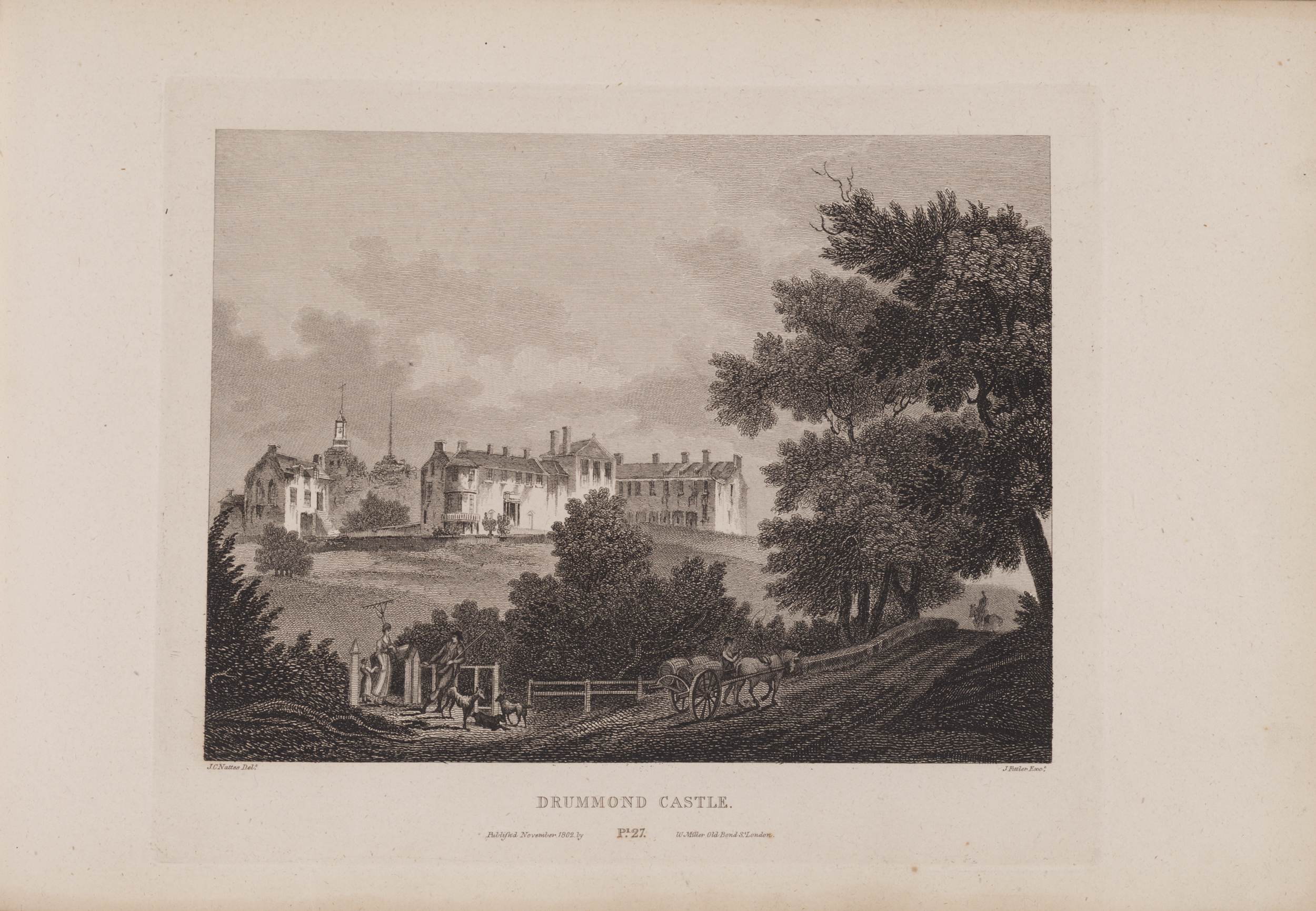
Drummond Castle
When Dior chose Drummond Castle for its Cruise 2025 show -- the fashion house's first Scottish catwalk in nearly 70 years -- creative director Maria Grazia Chiuri was tapping into something the Drummond family understood five centuries ago: the power of spectacle set against raw landscape. The castle rises from a spine of volcanic basalt that cuts across Perthshire like a geological blade, its terraced gardens cascading down the southern slope in an intricate geometry of box hedges, topiary, and gravel paths that Historic Environment Scotland has called "the best example of formal terraced gardens in Scotland."
A Ridge of Deep Time
The rock beneath Drummond Castle tells a story that dwarfs the human one above. The ridge is a dyke of tholeiitic basalt, part of a late Carboniferous swarm intruded roughly 300 million years ago into older Devonian sandstone. This same geological feature can be traced east to Perth and west to Glen Artney, where it terminates within the Highland Boundary Fault complex. The Romans recognized its strategic value too -- several miles east, the same ridge was used as a line of fortlets and signal towers along the Gask Ridge, one of the earliest Roman frontier systems in Britain. When John Drummond, 1st Lord Drummond of Cargill, chose this spot for his tower house around 1490, he was building on a natural fortress shaped by forces far older than any clan.
Clan and Crown
The Drummond family held these lands from the 14th century, and their rise mirrored Scotland's own shifting fortunes. The 4th Lord Drummond was created Earl of Perth in 1605, cementing the family's place among Scotland's aristocracy. His descendant, the 2nd Earl, laid out the first terraced gardens in the 1630s, transforming the castle's southern slope into a formal landscape that balanced wild Highland scenery with Continental elegance. The tower house itself is adjoined by a gatehouse built between 1629 and 1630, originally designed to control access to the courtyard behind -- and to frame the view over those emerging gardens.
Gardens Fit for a Queen
The gardens visitors see today took shape in the 1830s, when Clementina Drummond and her husband Peter Robert Willoughby inherited the estate and commissioned Lewis Kennedy to redesign the grounds. Kennedy's layout amplified the drama of the site, using the steep natural contours to create descending terraces that pull the eye outward toward the Perthshire hills. Queen Victoria and Prince Albert visited in 1842, lending royal approval to what was already considered one of Scotland's horticultural treasures. The grounds later served as a backdrop for the 1995 film Rob Roy, their formal symmetry providing an almost theatrical contrast to the wild landscape Liam Neeson's character was meant to inhabit.
Where Geology Meets Grandeur
From the air, Drummond Castle's position on its narrow basalt ridge is unmistakable -- the gardens laid out in their cross-shaped parterre pattern, the keep and gatehouse clustered at the ridge's high point, and the long access road following the spine eastward toward Crieff. The castle sits four kilometres south of the market town, in Muthill parish, where the landscape shifts between Highland edge and lowland strath. The tower house is no longer a dwelling, but the gardens remain very much alive, protected as a Category A listed building and included on the Inventory of Gardens and Designed Landscapes in Scotland. Visitors walking the gravel paths today tread on the same volcanic rock that drew the Romans, the Drummonds, and eventually the fashion houses of Paris.
From the Air
Drummond Castle sits at 56.34N, 3.87W on a prominent basalt ridge 4 km south of Crieff, Perthshire. The formal gardens are clearly visible from 2,000-3,000 ft AGL as a geometric pattern on the ridge's south slope. Nearest airfield is Perth/Scone (EGPT), approximately 20 nm east. The Highland Boundary Fault lies just to the north, marking the transition from lowland to Highland terrain.