Dry Tortugas
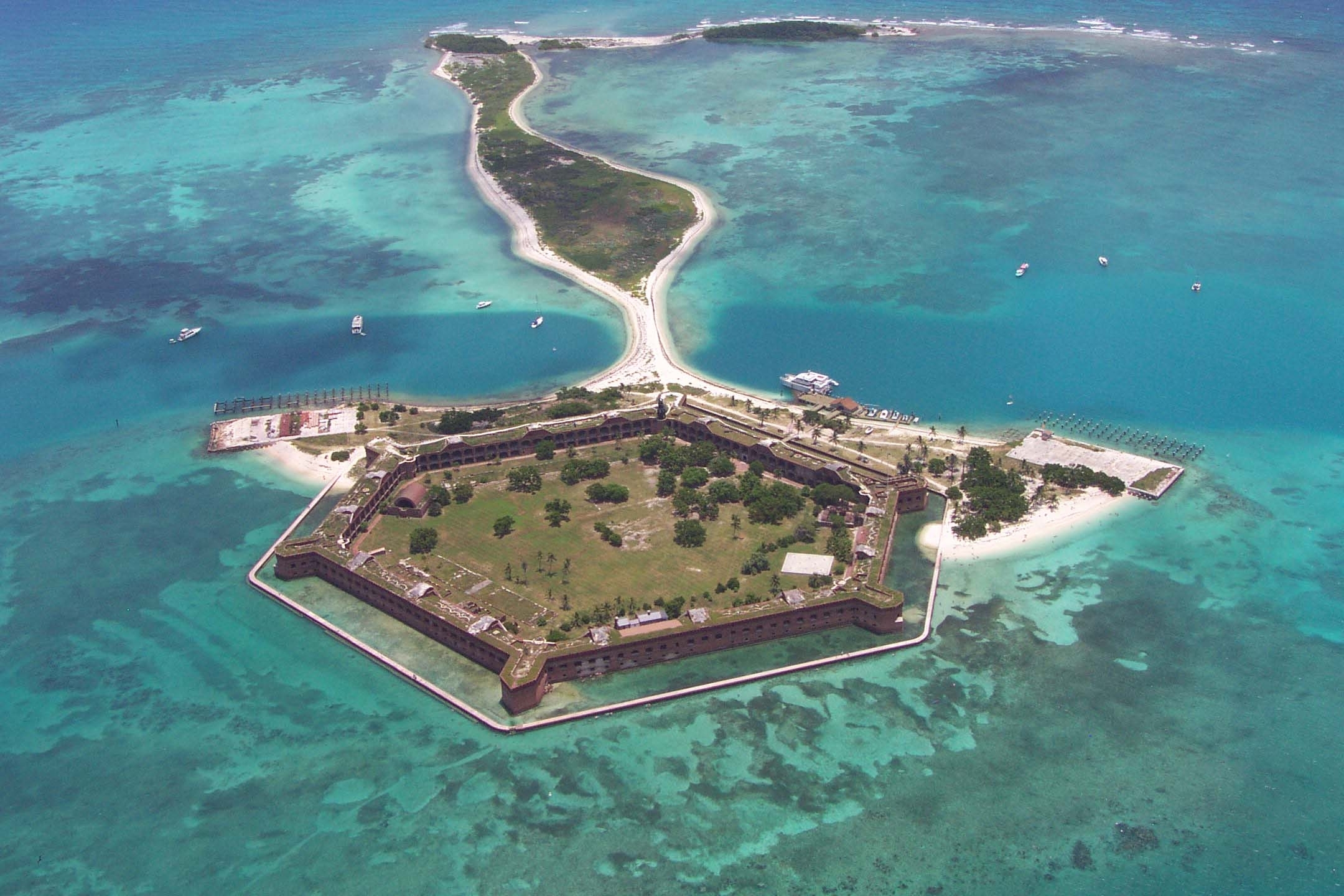
Fort Jefferson sits on Garden Key, a 16-acre island in the Dry Tortugas, 70 miles west of Key West in the Gulf of Mexico. The massive hexagonal fort - the largest masonry structure in the Americas - was intended to control shipping through the Gulf. Construction began in 1846 and continued for decades, but the fort was never finished and never saw combat. Its most famous role was as a military prison during and after the Civil War. Dr. Samuel Mudd, convicted of conspiracy for treating John Wilkes Booth's broken leg after Lincoln's assassination, spent four years here. The fort is now the centerpiece of Dry Tortugas National Park, one of the most remote and least-visited units in the system. Reaching it requires a seaplane, ferry, or private boat. Those who make the journey find crystal-clear water, pristine coral reefs, and a monument to military ambition in an impossible location.
The Fort
Fort Jefferson was designed to house 1,500 troops and 450 cannons, controlling the shipping lanes between the Gulf of Mexico and the Atlantic. Construction began in 1846 using enslaved labor and continued for 30 years. The hexagonal structure has walls 8 feet thick and covers most of Garden Key. It was never completed: rifled cannons developed during the Civil War made masonry forts obsolete, and the foundation began settling into the sand. By 1874, the Army abandoned Fort Jefferson as a military post. Despite its massive construction, the fort never fired a shot in anger.
The Prison
Fort Jefferson served as a military prison during and after the Civil War, holding Union deserters and Confederate prisoners. Its most famous inmates arrived in 1865: Dr. Samuel Mudd, Samuel Arnold, Michael O'Laughlen, and Edmund Spangler - all convicted of conspiracy in Lincoln's assassination. Mudd had set Booth's broken leg; his knowledge of the assassination remains debated. Prison conditions were brutal: heat, isolation, and yellow fever epidemics that killed O'Laughlen in 1867. When yellow fever struck the fort, Mudd took over medical care after the fort's doctor died, earning a partial pardon. He was released in 1869.
The Isolation
The Dry Tortugas are among the most isolated islands in the continental United States. 'Dry' refers to the lack of fresh water - there is none. 'Tortugas' (turtles) was Ponce de León's name for the islands, noted for their sea turtle populations. The isolation that made Fort Jefferson impractical as a military base makes it remarkable as a national park. The marine environment is pristine; coral reefs surround the islands. Sea turtles still nest on the beaches. Magnificent frigatebirds nest on nearby Bush Key. The night sky, free from light pollution, is spectacular.
The Park
Dry Tortugas became a national park in 1992, protecting both the historic fort and the surrounding marine environment. The park covers 64,701 acres, almost all of it water. The coral reefs are among the healthiest in the Florida Keys. Snorkeling around the fort walls is remarkable - the moat teems with fish. Camping on Garden Key is possible but requires bringing everything, including water. Bird watching, especially during spring migration, brings rare species to this isolated rest stop. The combination of historical site and marine sanctuary is unique in the park system.
Visiting Dry Tortugas
Dry Tortugas National Park is accessible only by seaplane or ferry from Key West (70 miles), or by private boat. The Yankee Freedom ferry makes daily trips (2.5 hours each way), including snorkel equipment and lunch. Seaplanes offer faster transport and spectacular aerial views. Day trips allow several hours to explore the fort and snorkel; camping requires ferry transport and careful planning - bring everything. There is no fresh water, food, or services on the island. Camping is first-come, first-served with limited sites. The best snorkeling is around the fort walls and on the reef offshore. Key West International Airport (EYW) provides access.
From the Air
Located at 24.63°N, 82.87°W in the Gulf of Mexico, 70 miles west of Key West, Florida. From altitude, Fort Jefferson is visible as a hexagonal structure covering most of Garden Key, surrounded by the turquoise waters of the Dry Tortugas. The other keys - Bush Key, Long Key, and smaller islands - dot the shallow waters. The isolation is absolute - no other land is visible in any direction. The dark blue of deep water contrasts with the turquoise shallows over coral reefs. This is genuinely remote territory.