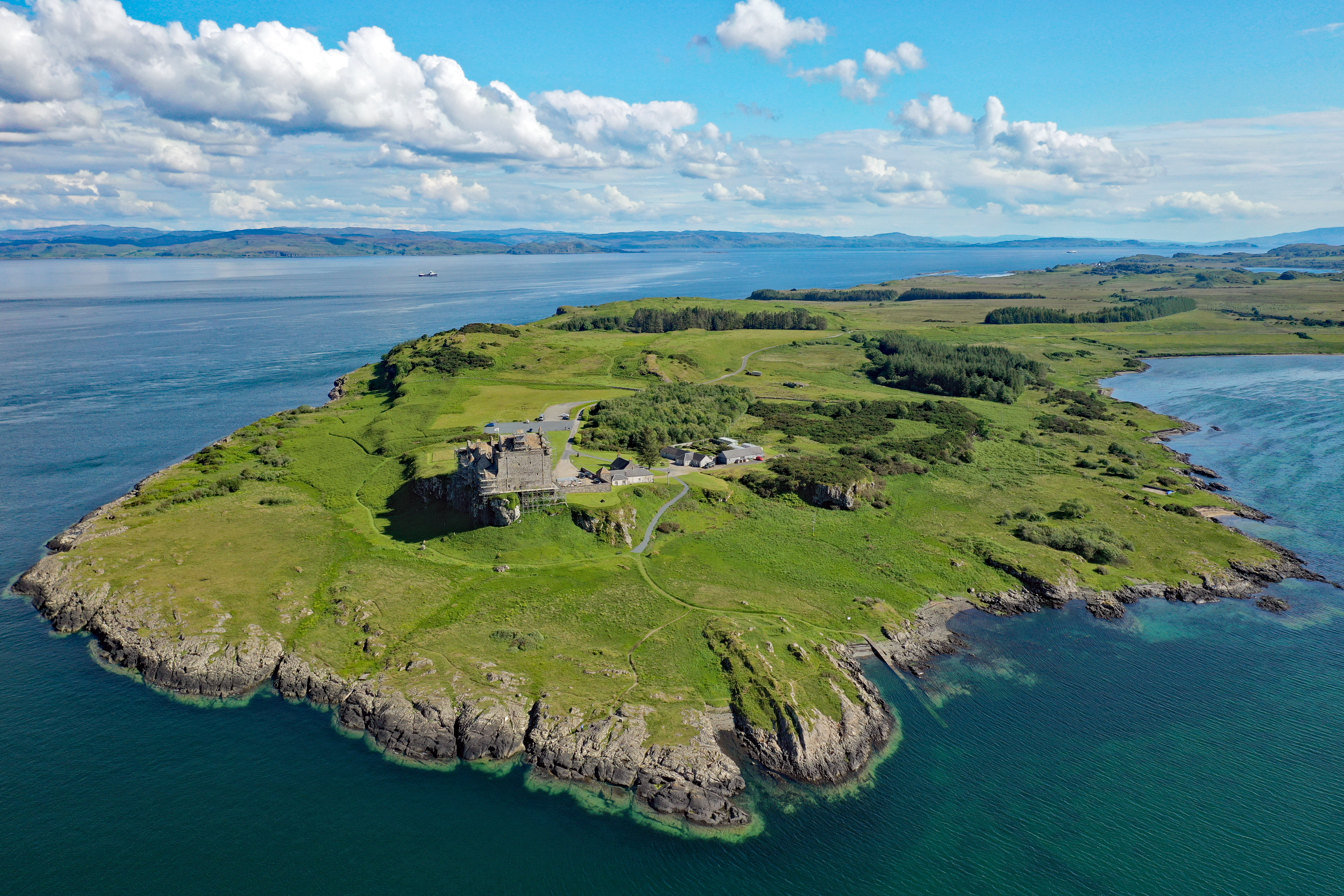
Duart Castle
Sean Connery had MacLean blood on his mother's side, which may explain why he agreed to film at Duart Castle for the 1999 movie Entrapment. But this fortress on the eastern tip of Mull needs no celebrity endorsement. Built on an elevated rock overlooking the Sound of Mull, its silhouette is the first thing ferry passengers see as they approach from the mainland -- a dark, blunt-faced tower that has been warning visitors and invaders alike for over seven hundred years that this is MacLean country.
A Dowry in Stone
Duart was probably built by Clan MacDougall in the 13th century, but it became a MacLean stronghold through marriage. In 1350, Lachlan Lubanach Maclean, the 5th clan chief, married Mary Macdonald, daughter of John of Islay, Lord of the Isles. Duart came as part of her dowry, and in 1390 her brother Donald confirmed the castle by charter to the MacLeans. For three centuries it served as the clan's principal seat, its position on the headland giving command over the approaches to the Sound of Mull and the wider sea lanes of the western Highlands. The castle grew piecemeal: a curtain wall, a keep, ranges of domestic buildings within the enclosure. Its Gaelic name, Caisteal Dhubhairt, speaks to its prominence in the Gaelic-speaking world of the medieval Highlands.
Siege, Storm, and Surrender
Duart's walls have absorbed centuries of violence. In 1647, during the Wars of the Three Kingdoms, Clan Campbell's Argyll government troops besieged the castle but were driven off by the Royalist MacLeans. Six years later, a Cromwellian naval task force of six ships anchored offshore, but the MacLeans had already fled to Tiree. A storm on 13 September 1653 destroyed three of the ships, and the remains of one -- believed to be the warship Swan -- lie in a Historic Marine Protected Area north of the castle. The final blow came in 1678, when the 9th Earl of Argyll, chief of Clan Campbell, successfully invaded Mull. Sir John Maclean, the 4th Baronet, fled to Cairnbulg Castle and then to Kintail. In 1691, he formally surrendered Duart to the man who would become the 1st Duke of Argyll. By 1751, the castle was abandoned.
The Homecoming
For 160 years, Duart stood empty, its walls crumbling, its ownership passing through Campbell descendants until they sold it in 1801. It changed hands twice more -- to MacQuarrie, then to Carter-Campbell of Possil, who kept it as a picturesque ruin on his Torosay estate. But on 11 September 1911, Sir Fitzroy Donald Maclean, the 26th Chief of Clan MacLean, bought back the ruin and began restoring it. The purchase was an act of clan pride, an assertion that the MacLeans had not forgotten their ancestral seat. Restoration has continued ever since -- Phase 7 of the ongoing project was underway in 2020. Today Duart is open to visitors, its Great Hall displaying the regimental colours of the WW1 Canadian Expeditionary Force's 236th Battalion (New Brunswick Kilties). A lighthouse at Duart Point, built in 1900 as a memorial to Scottish novelist William Black, stands sentinel to the southeast.
From the Air
Duart Castle sits at 56.456N, 5.655W on the easternmost point of the Isle of Mull, commanding the entrance to the Sound of Mull. The castle is highly visible from the air on its rocky headland. Nearest airfield is Oban Airport (EGEO) approximately 10 nm east on the mainland. The castle is directly visible from the Oban-Craignure ferry route. The Duart Point lighthouse is just southeast of the castle.