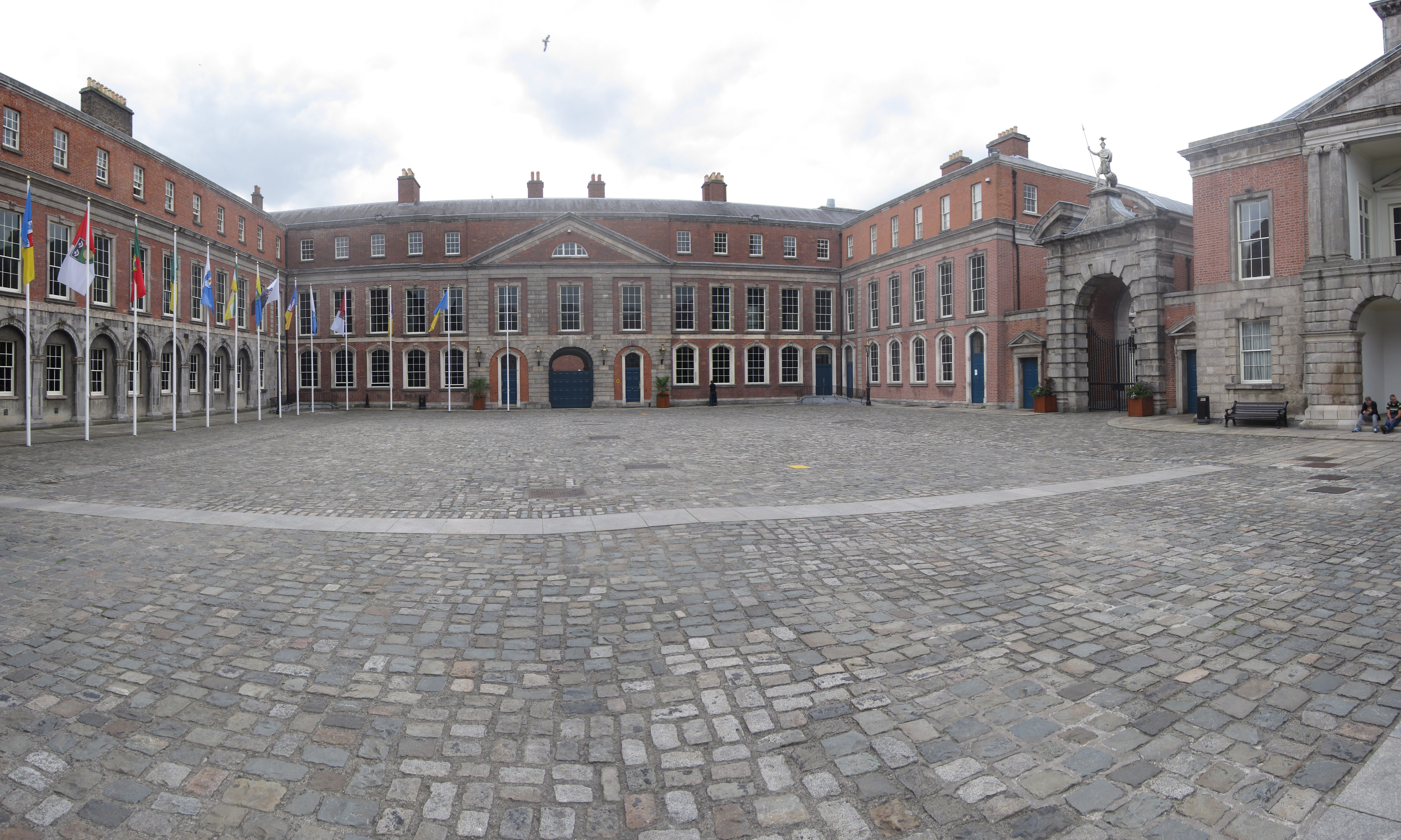
Dublin Castle
The dark pool is still down there. Beneath the Georgian courtyards and state apartments of Dublin Castle, the River Poddle flows through medieval foundations, tracing the same course it followed when the Normans chose this spot -- the highest ground in central Dublin -- to build a fortress in 1204. For over seven centuries, this castle was the engine room of British rule in Ireland. When Michael Collins came to accept the handover in January 1922, the outgoing Viceroy remarked that he was seven minutes late. 'We've been waiting seven hundred years,' Collins is said to have replied. 'You can have the seven minutes.'
The King's Command
King John ordered the castle built in 1204, commanding strong walls and good ditches for the defence of the city and the protection of the King's treasure. By 1230, the fortress was largely complete: a Norman courtyard design with circular towers at each corner, no central keep, and the River Poddle diverted to flood its moat. The castle formed one corner of Dublin's defensive perimeter, its walls connecting to the city's own fortifications. Parts of the original structure survive below ground -- the base of the Powder Tower, with its 3.7-metre-thick calp limestone walls, sits along the old course of the Poddle, and Viking-era defenses have been uncovered beneath it. In January 1592, the Gaelic chieftain Red Hugh O'Donnell escaped from the castle in a dramatic winter breakout, fleeing south through the snow to the rebel stronghold of Glenmalure.
Seat of Power, Seat of Scandal
The medieval fortress gradually transformed into something more administrative than military. By the 18th century, most of the original castle had been replaced by Georgian buildings arranged around two courtyards. The Lord Lieutenant held court here during the social season, hosting balls in Saint Patrick's Hall beneath a painted ceiling by Vincenzo Valdre depicting George III's coronation and Saint Patrick converting Ireland. The castle also collected scandals. In 1884, a homosexuality scandal among officers shook the administration. In 1907, the Irish Crown Jewels -- a diamond-encrusted star and badge of the Order of Saint Patrick -- vanished from the castle. Suspicion fell on the Officer of Arms, Sir Arthur Vicars, but the jewels have never been recovered, making it one of Ireland's most enduring mysteries.
Revolution at the Gate
At the start of the Easter Rising in 1916, twenty-five members of the Irish Citizen Army seized the castle's entrance and guard room before reinforcements arrived to repel them. During the Anglo-Irish War that followed, the castle served as the nerve center of the British intelligence effort against Irish separatism. On the night of Bloody Sunday in November 1920, three Republican prisoners -- Dick McKee, Conor Clune, and Peadar Clancy -- were tortured and killed within its walls. These events transformed the castle from a symbol of governance into a symbol of oppression, making the ceremonial handover to the Irish Free State in 1922 one of the most charged moments in Irish history.
From Fortress to Forum
After independence, the castle's role shifted from political control to political ceremony. The first President of Ireland, Douglas Hyde, was inaugurated here in 1938, establishing a tradition that continues today. The state apartments, once the Lord Lieutenant's private quarters, now host presidential inaugurations, state banquets, and diplomatic receptions -- including the historic dinner for Queen Elizabeth II in 2011, the first state visit by a British monarch to the Irish Republic. The Throne Room still contains a throne built for George IV's 1821 visit. The last dignitary to sleep in the former royal bedrooms was Margaret Thatcher, who spent a night there during a European Council meeting in the 1980s.
Layers Beneath Layers
What makes Dublin Castle remarkable is not any single era but the accumulation of them all. Visitors can descend to the medieval undercroft and stand beside the original Viking-age defenses, then walk through Norman tower bases, past the spot where the dark pool -- the Dubh Linn -- once lay, and emerge into Georgian state rooms decorated with Italian painted ceilings. The complex also houses the Chester Beatty Library, one of Europe's finest collections of Islamic and East Asian manuscripts, tucked into a purpose-built facility in the castle gardens. Above ground, the former dark pool has been remodeled into a garden with a water feature commemorating fallen members of the Garda Siochana, Ireland's police force. The castle that once defended a colony now hosts the ceremonies of a republic.
From the Air
Dublin Castle is located at 53.3431N, 6.2674W in central Dublin, just south of the River Liffey. From altitude, look for the large Upper and Lower Yards surrounded by Georgian buildings, with the distinctive Bedford Tower clock tower visible. Adjacent to Christ Church Cathedral to the west. Nearest airports: Dublin Airport (EIDW) 10km north, Casement Aerodrome (EIME) 10km southwest.