Ducal Palace of Vila Viçosa
No duke would sleep where his father had been dragged to execution. When Jaime, 4th Duke of Braganza, returned from exile in Castile in 1498, he refused to set foot in the medieval castle of Vila Viçosa -- the fortress where, fifteen years earlier, King John II had ordered the beheading of his father Fernando II for treason. Instead, Jaime looked beyond the town walls, to a landscape of olive groves and abundant water, and began building something entirely new. Construction started between 1501 and 1502, and what rose from that patch of Alentejo countryside would become one of Portugal's most important royal residences, the seat of a dynasty that would shape the nation's destiny.
From Exile to Empire
The Braganza family's story is one of dramatic reversals. The first dukes had accumulated enormous power and land, descending from Nuno Alvares Pereira, one of Portugal's greatest military heroes. But that power made them targets. When Fernando II was executed in 1483, the entire family fled to Castile. They returned only after the king who condemned them had died. Jaime, though restored to his titles, carried the weight of that betrayal. His decision to build outside the castle walls was not merely architectural preference -- it was a statement. He would start fresh. His close kinship with King Manuel I, being the king's nephew, and his victorious military expedition to Azamor in 1513 gradually restored the House of Braganza to its former wealth and influence, all of which poured into the growing palace.
Halls of Virtue and Ambition
The palace expanded across the horizontal plane, room after room linked by a single long corridor -- a progression through Portuguese history rendered in stone, tile, and paint. The Sala das Tapecarias gleams with 17th-century blue-and-white azulejo tiles covering every surface, its white marble fireplace anchoring a vaulted ceiling alive with botanical motifs. In the Sala dos Duques, the largest room in the entire building, seventeen framed portraits of successive Dukes of Braganza stare down from the walls, a dynasty watching over its own legacy. Perhaps most striking is the Hall of Virtues, where the ceiling presents paintings of Faith, Hope, Charity, Prudence, Justice, Strength, Temperance, and Wisdom -- the qualities every Braganza duke aspired to embody, even if history sometimes proved otherwise.
A Crown Reluctantly Worn
The palace's greatest moment came in 1640, when the 8th Duke of Braganza was proclaimed King Joao IV, launching the Portuguese Restoration War that ended sixty years of Spanish rule. According to tradition, the duke had to be persuaded to accept the crown. From that point forward, the palace was no longer merely a noble residence but a royal one, its rooms filled with the apparatus of governance and ceremony. The Braganza dynasty would rule Portugal continuously until 1910, when King Manuel II -- the last of the line -- was deposed in the October Revolution that ushered in the Republic. The palace, which had witnessed the family's rise from disgraced exiles to kings, outlasted them all.
Layers of Stone and Style
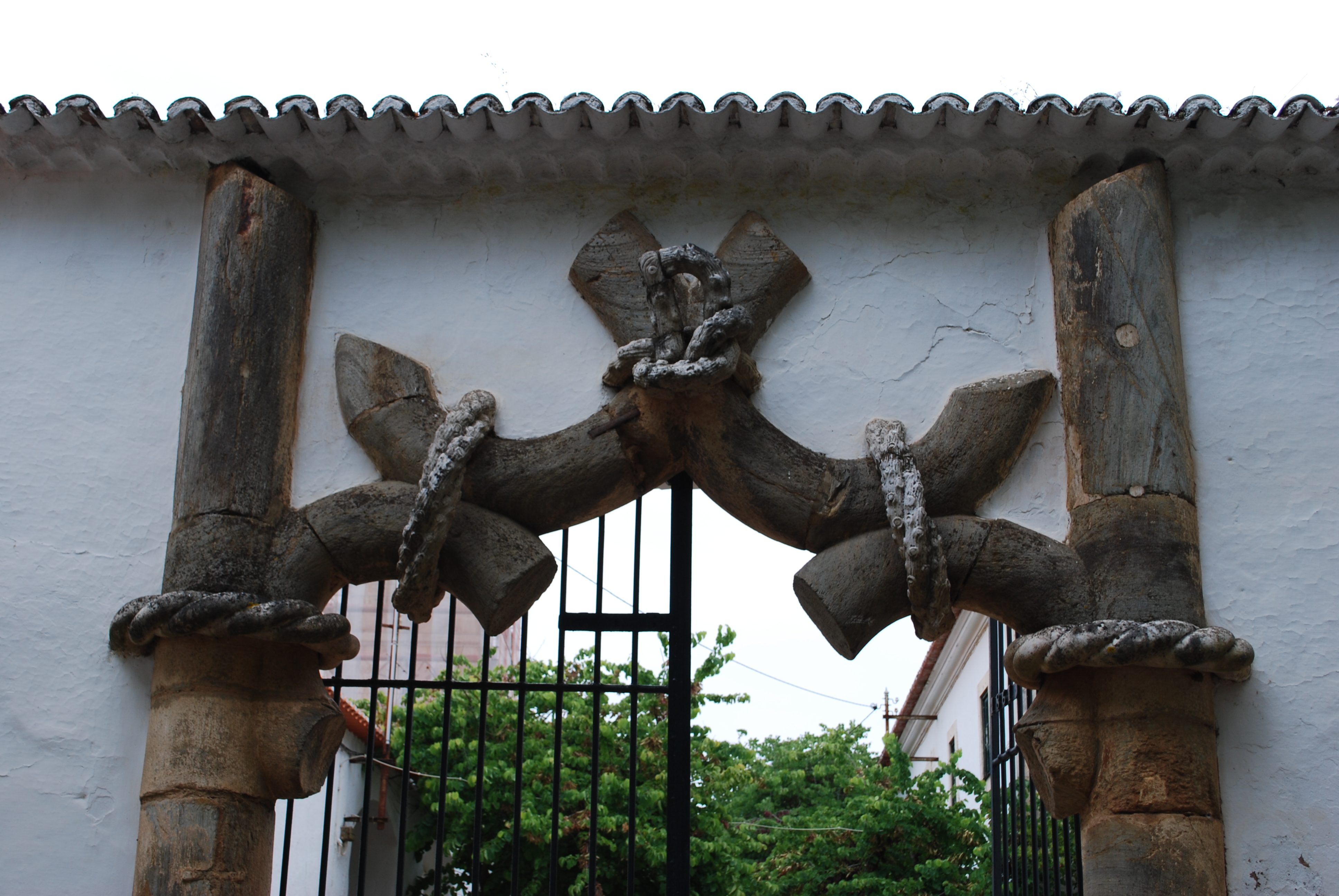
Walk the grounds today and you read centuries of architectural ambition. The original Manueline doorway, with its characteristic knotted stonework, still marks the earliest phase of construction. The classical facade that dominates the front was designed by royal architect Nicolau de Frias and later expanded by Pedro Vaz Pereira and Manuel Pereira Alveneo, its long horizontal sweep modeled on Lisbon's Ribeira Palace. Through five doorways, the Dining Hall opens onto the Jardim das Damas, a garden where the women of the court once walked. In the chapel, a vaulted ceiling carries painted frames that echo the grandeur of the formal rooms, while some of the palace's finest historical azulejos were crafted by the celebrated Spanish workshops of Talavera de la Reina.
From the Air
Located at 38.78N, 7.42W in the Alentejo region of eastern Portugal, roughly 150 km east of Lisbon. The palace's long classical facade is visible from lower altitudes, set within the town of Vila Viçosa. Nearest airports include Badajoz (LEBZ) across the Spanish border, approximately 60 km to the northeast. The flat Alentejo landscape typically offers good visibility.