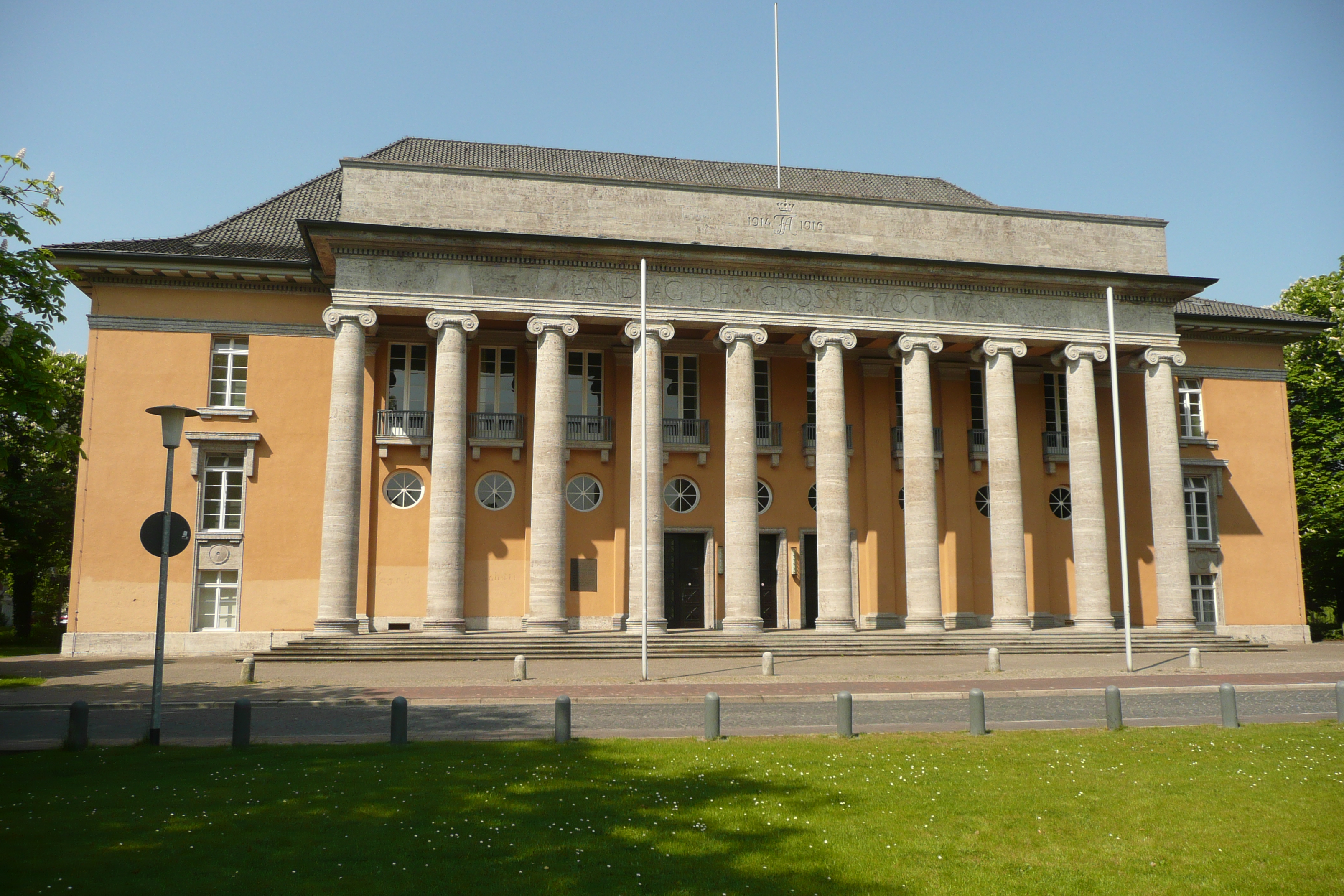
Duchy of Oldenburg
Sometimes a small German territory gets created not because anyone in the territory wants it but because the great powers need a place to set down a chess piece. The Duchy of Oldenburg is one of those cases. In 1773, at her summer palace south of St Petersburg, Catherine the Great signed the Treaty of Tsarskoye Selo, which solved a long-running family quarrel between the Russian and Danish branches of the Holstein-Gottorp dynasty by handing the obscure county of Oldenburg to a different cousin. The following year the new ruler was elevated from count to duke. The Duchy of Oldenburg, born of imperial diplomacy in 1774, would survive exactly thirty-six years before Napoleon swallowed it whole.
The Deal in the Garden
The mess that produced the duchy reached back to 1544, when Christian III of Denmark had divided his Schleswig and Holstein lands among his brothers. From one of those brothers, Adolf, descended the Holstein-Gottorp dukes, and from them in turn descended Tsar Peter III, the unlucky Romanov who was deposed and murdered by his wife Catherine in 1762. As regent for their son Paul, Catherine inherited the Gottorp claims to Schleswig and Holstein, claims that threatened Denmark with war. The 1773 Treaty of Tsarskoye Selo cut the Gordian knot. Denmark got full title to Schleswig and Holstein. Catherine's young son Paul renounced his Gottorp inheritance, and in compensation his great-uncle Frederick Augustus, the Prince-Bishop of Lubeck, received the county of Oldenburg. The Holy Roman Emperor obligingly raised it to a duchy in 1774. Oldenburg had been transferred between three sovereigns in the space of a year, none of whom had set foot in the town.
Frederick Augustus and a Fresh Start
The new duke was a Lutheran prince-bishop in his fifties who had spent his life administering church territories. Oldenburg under Frederick Augustus reasserted itself as a dynastic capital after a long Danish administrative drowsiness. Old buildings came down. New ones went up, this time in the clean Classical style of the late eighteenth century. The Schloss was restored to use as a princely residence. For the first time in over a century, Oldenburg had its own ruler living in it. Frederick Augustus's son William inherited the throne in 1785 but suffered from a mental illness severe enough that his cousin Peter served as regent for the duchy and the attached Prince-Bishopric of Lubeck.
Expansion Just in Time
In 1803, in the great reshuffling known as the German Mediatisation, Oldenburg picked up the Catholic district called the Oldenburg Munsterland from secularized church territories, and formally incorporated the Prince-Bishopric of Lubeck. The duchy was bigger now and more diverse, with Lutheran north and Catholic south sharing a single ruler. It was also unintentionally squarely in the path of Napoleon. In 1806 most of the Holy Roman Empire dissolved into the Confederation of the Rhine, but Oldenburg held out at the edge of the new French sphere, governed by an aging regent.
Napoleon Erases the Map
On 13 December 1810 Napoleon annexed the Duchy of Oldenburg outright into the French Empire. It was a small act of imperial bookkeeping that turned out to matter enormously. Oldenburg's ruler, Peter, was related by marriage to the Romanov court, and the seizure infuriated Tsar Alexander I. Historians count the annexation of Oldenburg as one of the proximate triggers of the diplomatic rupture that led to Napoleon's 1812 invasion of Russia, an invasion that ended in the destruction of his army and the unraveling of his empire. The Grande Armee froze on the road from Moscow in part because Napoleon had not been able to leave one small north German duchy alone.
Restoration and Beyond
When the Congress of Vienna sat down to rebuild Europe in 1815, it restored Oldenburg and threw in the Principality of Birkenfeld as a bonus, elevating the territory from duchy to grand duchy. Duke Peter took up the new style in practice, though he and his successors continued to call themselves duke for another fourteen years before assuming the grand-ducal title formally in 1829. The Duchy of Oldenburg as such had lasted from 1774 to 1810, a brief four-decade chapter framed by Catherine's diplomacy at one end and Napoleon's at the other. As an independent territorial state Oldenburg would last more than a century longer in its grand-ducal form, until the German Revolution of 1918 ended monarchies across Germany at a stroke. From above, the territory is the flat green country between the Weser and the Ems, the kind of landscape that great empires routinely promise themselves they will return to and then forget.
From the Air
Capital city of Oldenburg at 53.14 N, 8.21 E, with the former duchy's territory stretching across the flat farmland of present-day Lower Saxony between the Weser and Ems rivers. Recommended viewing altitude 4,000-8,000 feet for the surrounding country. Nearest commercial airport is Bremen Airport (EDDW) about 25 nautical miles east-southeast; the former Oldenburg Air Base lies just north of the city. The Hunte river winds visibly through the center on clear days.