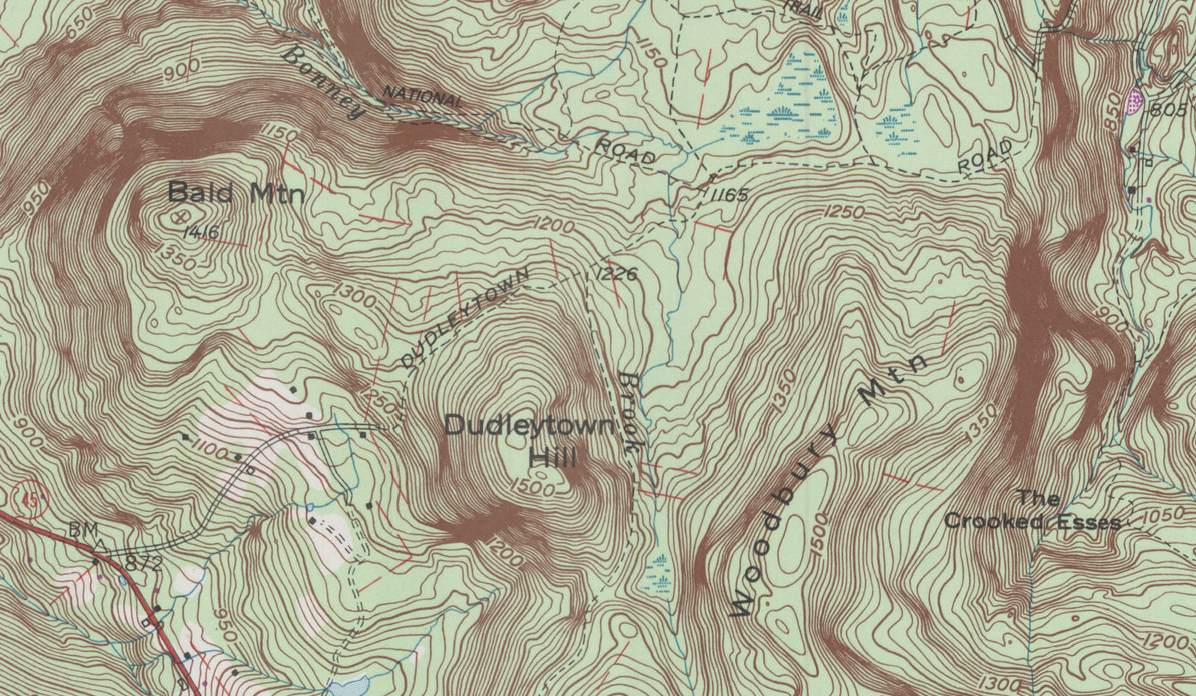
Dudleytown, Connecticut
Deep in the forests of northwest Connecticut, on a plateau called Owlsbury, lie the scattered remains of a village that died over a century ago. Dudleytown was founded in the 1740s by the Dudley family and abandoned by the early 1900s, a victim of poor soil, changing economics, and the drift to cities. That should have been the end of it. But starting in the 1970s, legends began to accumulate: the Dudley family was cursed, stretching back to England; residents went mad, committed murder, were possessed by demons; the forest itself is evil, supernaturally silent, devoid of birdsong. The legends are nonsense - the product of bored teenagers and credulous paranormal writers - but they transformed a forgotten village into Connecticut's most infamous haunted site. The landowners have closed it entirely; visitors risk arrest.
The Settlement
Thomas Griffis settled the land in 1738; the Dudley family - Gideon, Barzillai, and Martin - arrived in the 1740s and gave the village its name. It was never really a town, just a loose settlement of farms on a high, remote plateau. The soil was poor; the winters were harsh; the location was isolated even by 18th-century standards. Families came and went. By 1800, the settlement had perhaps three dozen families. By 1900, almost no one remained. The abandonment was gradual, unremarkable, and entirely explainable by economics. Young people moved to cities or better farmland. The old died. The forest reclaimed the clearings.
The Legend
Sometime in the 1970s or 1980s, Dudleytown acquired a mythology. Writers claimed the Dudley family was cursed - that an ancestor had been beheaded for treason in England under Henry VIII, and the curse followed the family to America. They claimed residents had lost their minds, committed murders, fallen victim to demons. They claimed the forest was unnaturally silent - that birds wouldn't sing there. None of this has historical basis. The Dudleys' English ancestor wasn't actually beheaded. Dudleytown had no unusual rate of tragedy. The forest silence is explained by the presence of visitors - birds flee from people.
The Visitors
The legends drew visitors. By the 1990s, Dudleytown was overrun with paranormal enthusiasts, thrill-seekers, and teenagers looking for scares. They trampled the ruins, started fires, and left garbage. They broke into the property at night with flashlights and Ouija boards. The landowners - a dark forest association that had preserved the area as a nature sanctuary - grew increasingly frustrated. The ruins were being destroyed by the very attention the legends had attracted. In 1999, the association closed the property entirely, posting it against trespassing with a warning of arrest.
The Reality
Dudleytown is not haunted. It's an abandoned settlement in a forest, no different from hundreds of others in New England. The foundation stones that remain are unremarkable. The forest is ordinary deciduous woodland. The silence visitors report is the natural response of wildlife to human presence. The 'curse' is a literary invention, created and amplified by writers who found a good story irresistible. What's real is the damage done by legend - the ruins disturbed, the habitat trampled, the landowners driven to close their property. The myth of Dudleytown destroyed more than any curse.
Visiting (Not Visiting) Dudleytown
Dudleytown is located in the town of Cornwall, Connecticut, off Dark Entry Road. The property is owned by the Dark Entry Forest Association and is strictly closed to visitors - no access is permitted, and trespassing is enforced with fines and arrest. The police are regularly called for visitors who ignore the postings. There is nothing to see from public roads - the ruins are deep in the forest. Cornwall and the surrounding Litchfield Hills are beautiful and worth visiting legitimately; the town has several covered bridges and the Mohawk Mountain ski area. Bradley International Airport near Hartford is 45 miles east. Respect the private property; the legends aren't worth a criminal record.
From the Air
Located at approximately 41.82°N, 73.37°W in the Litchfield Hills of northwest Connecticut. From altitude, the Dudleytown area appears as unbroken forest on a plateau above the Housatonic River valley. No structures are visible; the ruins are entirely overgrown. The forest is dense second-growth deciduous woodland. Cornwall and other small towns are visible in the surrounding valleys. The terrain is typical southern New England - rolling, forested hills dissected by river valleys. Bradley International Airport is 45 miles east. The isolation that contributed to the village's abandonment is evident from the air.