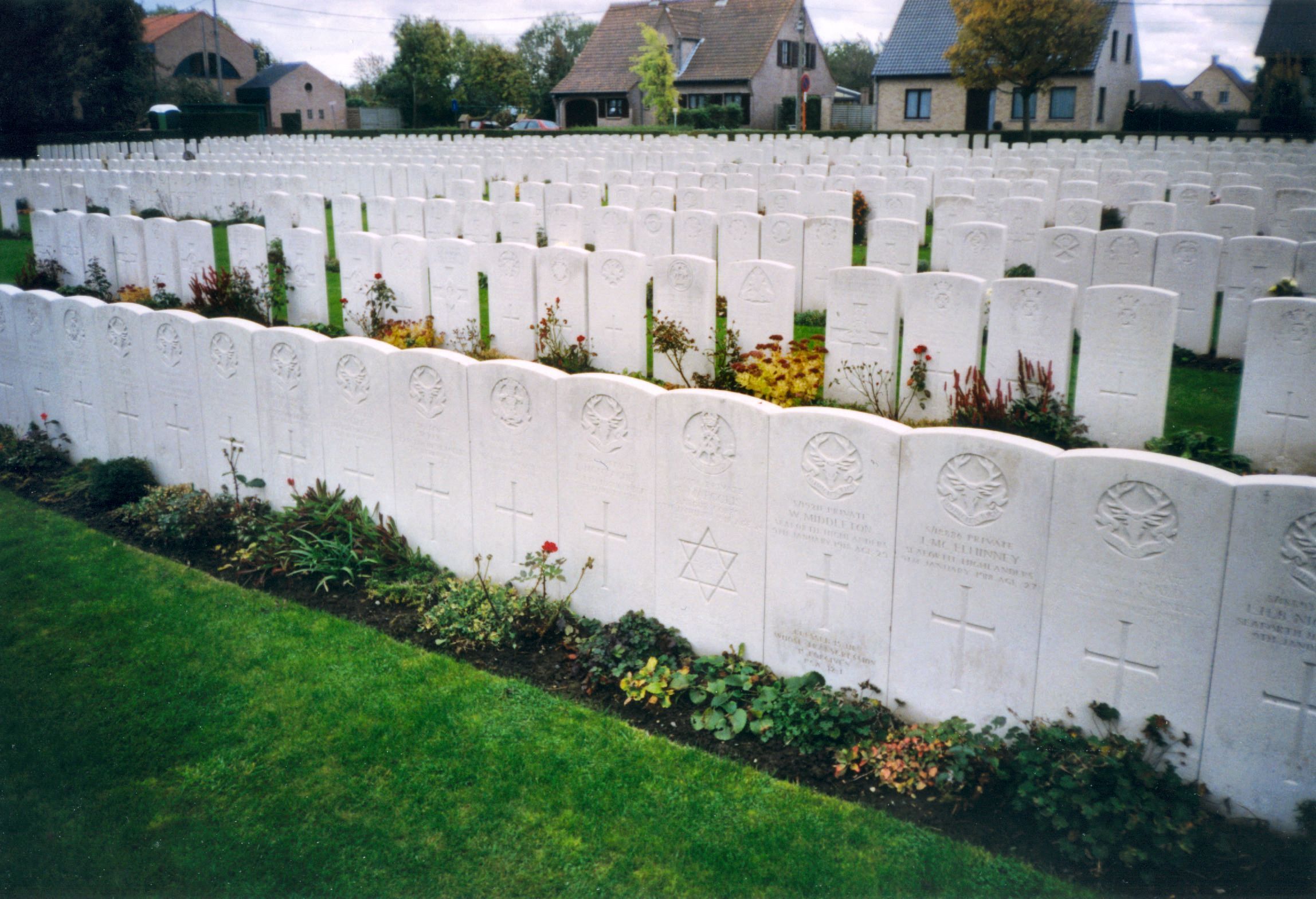
Duhallow ADS Cemetery
An Advanced Dressing Station was where a wounded man went next. After the regimental aid post in the trench, before the Casualty Clearing Station further back, the ADS was the middle link in the chain that pulled the injured out of the line and tried to keep them alive long enough to reach a hospital. It was set up close enough to the front to be reached by stretcher in an hour, but far enough back to be out of small-arms range. Tents, dugouts, sometimes a half-ruined farmhouse. The ADS north of Ypres on the Yser canal bank was nicknamed Duhallow by the soldiers who staffed it - the name of a fox hunt in County Cork, brought to Belgium by Irish doctors and orderlies. Some of the men carried in to Duhallow lived. Some did not. The ones who did not are buried beside the place they were brought, in a cemetery that grew up around the first-aid post.
The Name From County Cork
Duhallow is a barony in northwest County Cork in Ireland, a stretch of farmland and bog at the foot of the Boggeragh Mountains. It is also the name of a fox hunt founded there in the 18th century - one of the famous old Irish hunts, kennelled near Mallow. Irish soldiers and medical staff at the dressing station north of Ypres gave their post the name as a piece of home, the way British and Commonwealth soldiers across the Salient named their dugouts and pillboxes after streets in Liverpool, hills in Yorkshire, country pubs in New South Wales. The names are scattered all through the Salient maps - some absurd, some homesick, some simply functional. Duhallow lasted. The cemetery kept the name. It is buried, now, in CWGC paperwork as Duhallow Advanced Dressing Station Cemetery, but the local Belgians who tend the road past it still call it by the syllables that came from a hunt in Cork.
What an ADS Was
An Advanced Dressing Station did not heal anyone. That was not its purpose. Its purpose was triage and stabilisation. Wounded men, brought up by stretcher-bearers from the regimental aid posts in the line, arrived bloody, soaked, sometimes unconscious, sometimes screaming. The medical officer assessed them. Those who could be patched were patched - tourniquets adjusted, dressings replaced, morphine given. Those who could not be helped were eased toward death. Those needing surgery were marked for transport to the Casualty Clearing Stations a few miles back. The ADS at Duhallow operated through 1917 and 1918, taking in casualties from the Third Battle of Ypres and the German Spring Offensive of 1918. It also took the dead from the Casualty Clearing Stations behind it, who could not be transported to the larger cemeteries further back. The graves accumulated. 1,544 men are buried there today.
The Labour Corps Truck
Among those buried at Duhallow are men of the 13th Company Labour Corps, who were not infantry but support troops - older men, men medically downgraded, men of colour from the colonies who had volunteered or been recruited for war work. The Labour Corps moved ammunition, dug trenches, repaired roads, buried the dead. On one day during the war - the date is not preserved in the cemetery records, but the incident is - a German aircraft bombed an ammunition truck the company was working on near the dressing station. The truck exploded. The men around it were killed. They were carried the short distance to the cemetery and buried where they had died. The Labour Corps was, throughout the war, the part of the army that did the work nobody else wanted to do, and that the army did not always remember to remember. Their graves are at Duhallow alongside the front-line dead.
The Duhallow Block
Duhallow gave its name to a specific kind of memorial used across the CWGC. A 'Duhallow Block' is a stone marker for men whose graves were destroyed - usually by later shellfire or trench warfare - so that no body could be identified for re-burial. The first such blocks were built at this cemetery to commemorate men originally buried in the nearby Malakoff Farm and Fusilier Wood cemeteries, both of which had been ploughed under by shelling. The block records the names. The bodies, somewhere in the surrounding Flemish soil, were not recovered. There are two such blocks at Duhallow, each carrying the names of the lost. The CWGC adopted the design for use across other cemeteries where the same problem occurred. The vocabulary of how to remember the dead expanded, in small and pragmatic ways like this, year by year through the 1920s, as the Imperial War Graves Commission tried to make a system out of the wreckage.
Private James Crozier
One of the men buried at Duhallow was Private James Crozier of the Royal Irish Rifles, executed by the British Army on 27 February 1916 - though his grave records an earlier death of February 1916 from the cemetery list. He was sixteen years old when he enlisted in 1914, lying about his age. By late 1915 he had broken down. He had been promised by his recruiting officer that he would never be left alone, but his platoon commander had been transferred away. He walked from the line during a long march, was caught, court-martialled and shot. He was twenty-one. He was one of 306 British and Commonwealth soldiers executed during the war for desertion, cowardice or related charges. In 2006 the British government issued a posthumous pardon to all of them. The headstone at Duhallow gives only his name, his unit, and his date of death. The man buried beneath it was, by every measure available to us now, a child broken by a war his own army would later admit should not have killed him.
From the Air
Located at 50.864 N, 2.878 E - 4 km north of Ypres on the road to Boezinge, on the west bank of the Yser canal. Nearest airport is Ostend-Bruges (EBOS), 50 km northwest. Lille (LFQQ) is 40 km south. Recommended viewing altitude 1,500-3,000 ft. From the air the cemetery sits in a strip of flat ground between the canal and the road - the same strip of ground where the original dressing station tents and dugouts stood. The canal itself is one of the most legible features of the northern Salient from the air; the front line ran roughly parallel to it through much of the war.