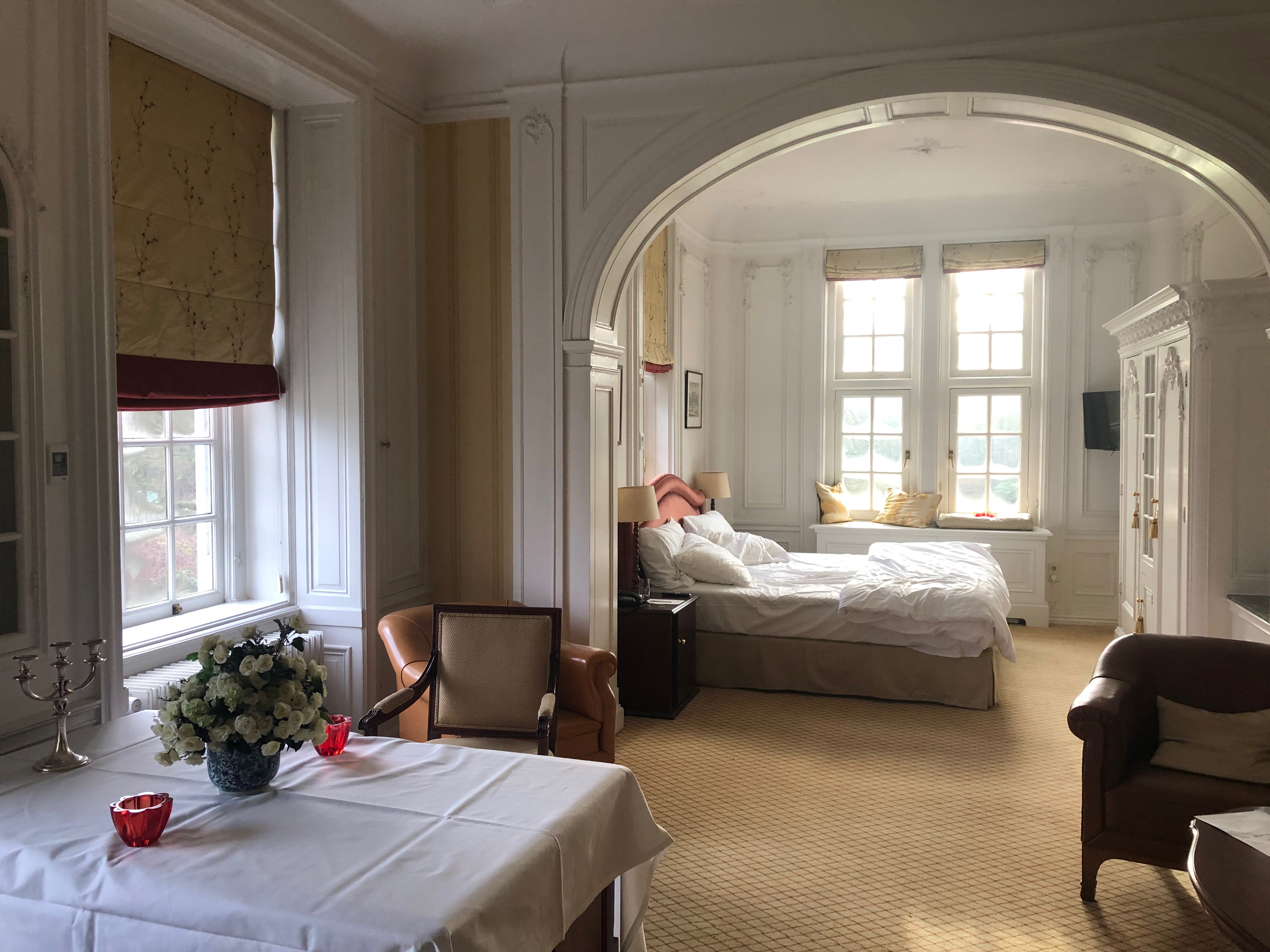
Duin en Kruidberg
In the summer of 1688, behind the closed doors of a hunting lodge tucked into the dunes north of Haarlem, men were sketching the maps that would change the shape of European history. The Prince of Orange - William III, soon to be king of England - was using Kruidberg to plan the Dutch invasion of his wife's homeland. That campaign would become the Glorious Revolution. The lodge itself is gone, but the place remembers. Today a vast Renaissance Revival mansion rises on the same ground, surrounded by the dunes and woods of South Kennemerland, and the dunes still keep their secrets.
Victorious Kennemerland
Wealthy Amsterdam merchants began buying up estates here at the start of the 17th century, escaping the canals each summer for the relative wildness of the coast. From Heemskerk in the north down to Vogelenzang in the south, an almost unbroken chain of stately homes rose along the dune edge, each with its formal gardens and hunting grounds. Locals called the strip Victorious Kennemerland, a nickname that captured both the merchants' new aristocratic pretensions and the easy reach of Amsterdam by boat or horse. Most of those houses are gone now, demolished by changing fortunes and a century of war. Duin en Kruidberg, which absorbed two of the original estates, is the great survivor.
A Tobacco Lord's House
The current mansion was built by Jacob Theodoor Cremer, a Zwolle-born businessman who had made his name and fortune in the Dutch East Indies after sailing east in 1868. By the time he commissioned architect Johannes van Nieukerken in the early 1900s, Cremer had been a colonial entrepreneur, a member of parliament, and would soon serve as Queen Wilhelmina's appointed president of the Nederlandsche Handel-Maatschappij from 1907 to 1913. The new house was meant to match that resume. Its design borrowed the great tower of the long-lost Zuylestein Castle, transposed onto Dutch Renaissance Revival lines. In July 1907 Cremer's five-year-old grandson laid the foundation stone - a small ceremony in the dunes for a house that would soon be one of the largest country residences in the country.
The Rooms Inside
Step inside and the house becomes a sourcebook of borrowed grandeur. The central hall holds an Amsterdam longcase clock from 1750 - Atlas hoisting a celestial globe - and two cast bronze Meiji-era Japanese vases moulded with fish in relief. The staircase ceiling carries the zodiac, painted by Johannes Evert van Leeuwen. The dining room, finished in revival Louis XV, was given a wholesale transplant of 1741 wall paintings by the Dordrecht artist Aert Schouman, rescued from the demolished Huis 't Zeepaert and reinstalled here in 1908. In the salon, grisailles by the 18th-century master Jacob de Wit hang where similar works once did, some salvaged from a former Amsterdam bank. Even the billiard room reaches abroad: the furniture was made by Hampton & Sons of London, and three Japanese kakemono scroll paintings hang between the pilasters.
The Gardens that Vanished
Both Duin en Berg and Kruidberg once had French formal gardens - geometric parterres, fountains, a maze of clipped shrubs. Not a trace remains. What surrounds the house today is an English landscape garden, all winding paths and irregular plantings, designed by the Haarlem landscape architect Leonard Springer, who also laid out Thijsse's Hof in nearby Bloemendaal. Beyond the garden the estate spills into the dunes themselves. Most of it now belongs to Vereniging Natuurmonumenten, and since 1995 the broader area has been protected as part of the Zuid-Kennemerland National Park - a Natura 2000 site where rabbits, foxes, and orchids share ground that once belonged to merchant princes.
After the Bankers
For decades after the Second World War the house belonged to ABN AMRO, which used it first as a holiday retreat for staff and later opened parts of it to the public. The bank sold the estate two days before Christmas 2019 to Lucas Petit, whose company Hoscom operates several other Dutch hotels. Today Duin en Kruidberg is a hotel and conference center, the mansion's grand rooms hired out for weddings and corporate retreats. The original restaurant closed in 2020, an early casualty of the COVID-19 pandemic. But the building itself stands intact - the tower, the dune views, the rooms full of imported history - quietly remembering the night William of Orange decided to sail for England.
From the Air
Coordinates 52.434°N, 4.626°E, in the dune belt of South Kennemerland between Haarlem and IJmuiden. Best viewed from 2,000-4,000 ft AGL: the mansion's distinctive corner tower rises clearly above the surrounding wooded estate, with the open dunes of Zuid-Kennemerland National Park to the west and the Spaarndam-Velsen area to the east. Nearest airfield is Schiphol (EHAM) about 15 nm southeast; the small grass field at Hilversum (EHHV) lies further east. The North Sea Canal at IJmuiden provides an unmistakable navigation reference just to the north.