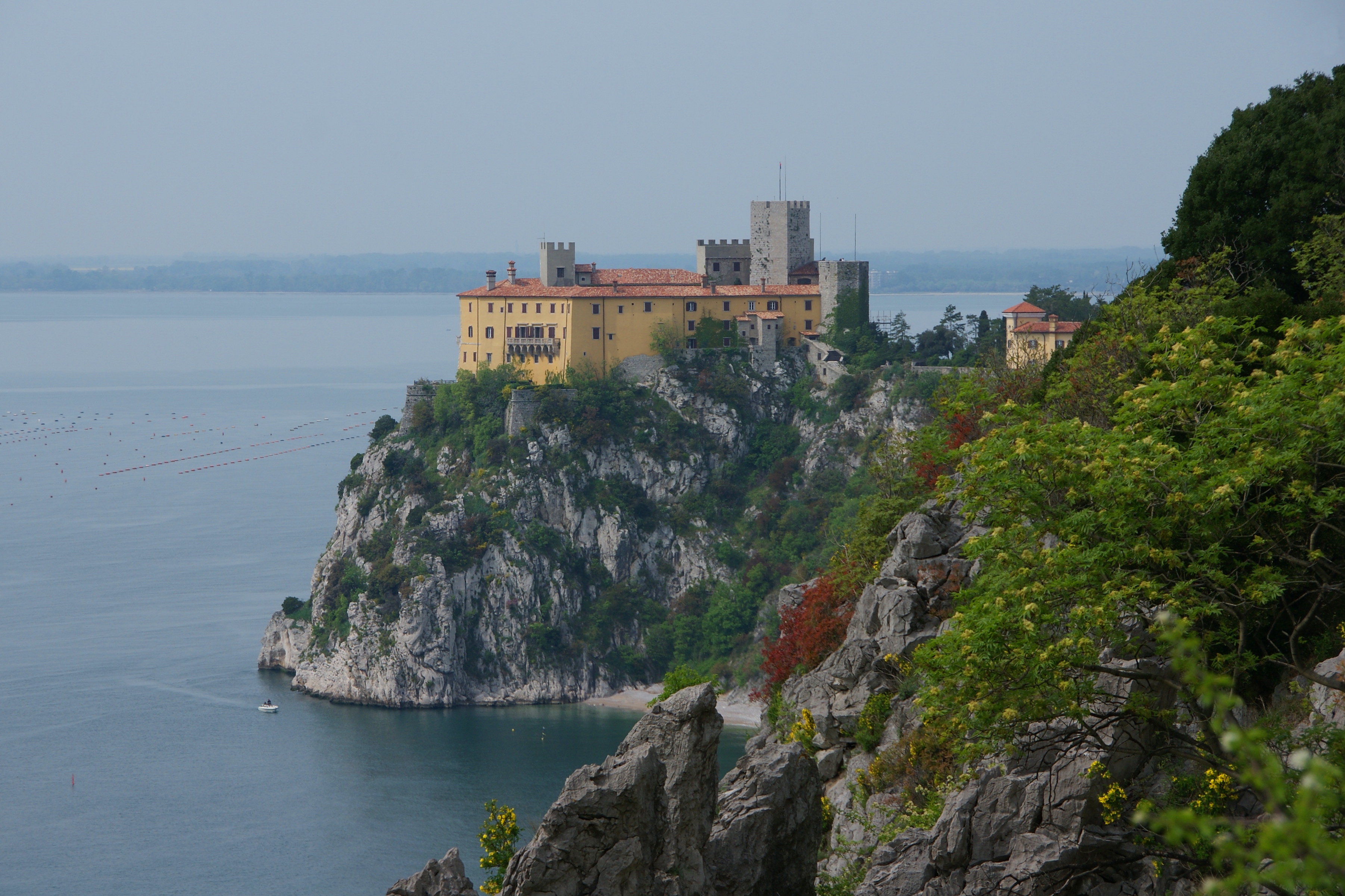
Duino Castle
"Who, if I cried out, would hear me among the hierarchies of angels?" In January 1912, the Bohemian-Austrian poet Rainer Maria Rilke was walking along the cliffs below Duino Castle when he claimed to hear these words spoken by a voice in the wind off the Adriatic. He pulled out his notebook and wrote them down on the spot. Within days, he had drafted the first two of what would become the Duino Elegies, ten poems that bridged German Romanticism and Modernist poetry. The castle that gave them their name still stands on those cliffs near Trieste, a fourteenth-century fortress that has witnessed more layers of history than most buildings survive.
Fortress on the Edge
Duino Castle dates to 1389, when the Wallsee family ordered the construction of a fortified stronghold on the limestone cliffs above the Gulf of Trieste. But the site's history reaches further back. The ruins of an older castle, built in the eleventh century by the Patriarch of Aquileia, still stand on the grounds, a skeleton of stone overlooking the water. Over the centuries, the Wallsee line died out, and the castle passed through other hands. For a time it served as a prison, then as a residence for the Luogar and Hofer families. The building absorbed each era without losing its essential character: a place perched between land and sea, between shelter and exposure, where the Adriatic wind never stops.
A Princess and Her Poets
In the late nineteenth century, Duino Castle became the property of Prince Alexander von Thurn und Taxis of the Czech branch of that storied postal dynasty. He and his wife, Princess Marie, were not the wealthiest members of the Thurn und Taxis line, but they were among the most culturally ambitious. Marie became a patron of artists and writers, and it was her invitation that brought Rilke to Duino in the winter of 1912. The poet was struggling with depression and creative paralysis when he arrived. The castle and its setting broke something open in him. After that visionary walk along the cliffs, he produced drafts of the first two elegies and fragments that would appear in later poems. Then the creative momentum stalled. A decade of silence followed, marked by depression and existential crisis, before Rilke finished the cycle in Switzerland in February 1922. He dedicated the completed work to Princess Marie, whom he regarded as one of his greatest patrons and closest friends.
Wars and Headquarters
The twentieth century brought violence to the cliffs. World War I turned the nearby Isonzo valley into one of the most savage battlefields in Europe, with twelve battles fought along the river between 1915 and 1917. Duino survived, only to find itself drafted into another war. During and after World War II, the castle served as headquarters for the British XIII Corps under Lieutenant General Sir John Harding. The corps was part of the Allied Mediterranean Theater of Operations, and Duino's clifftop position made it both strategically useful and symbolically resonant, a fortress that had weathered six centuries of conflict pressed into service once more. When the war ended, the castle returned to the Thurn und Taxis family.
Castle as Classroom
Today Duino Castle belongs to Prince Carlo Alessandro della Torre e Tasso, Duke of Castel Duino, the great-grandson of Alexander and Marie. Most of the castle and its grounds are open to the public as a museum and park, where visitors walk the same cliffside paths that Rilke walked in 1912. Since 1982, part of the castle has housed the United World College of the Adriatic, one of eighteen international schools in the United World College network. Students from dozens of countries study within walls that once sheltered medieval lords, aristocratic poets, and Allied generals. The juxtaposition is deliberate and fitting: a place that inspired one of the twentieth century's great meditations on beauty and suffering now educates young people from around the world. From the air, the castle appears as a pale stone mass anchored to the cliff edge, the blue-green Adriatic stretching away below, the Karst Plateau rising behind it.
From the Air
Duino Castle sits at 45.772°N, 13.604°E on the limestone cliffs overlooking the Gulf of Trieste in northeastern Italy. From 2,000-4,000 feet AGL, the castle is clearly visible as a pale structure on the cliff edge, with the ruins of the older eleventh-century castle nearby. The Adriatic Sea stretches to the south and west. Trieste-Friuli Venezia Giulia Airport (LIPQ/TRS) is approximately 20 km to the southeast. The Karst Plateau rises behind the coast. The coastline and castle are best viewed on approach from the sea side in clear weather.