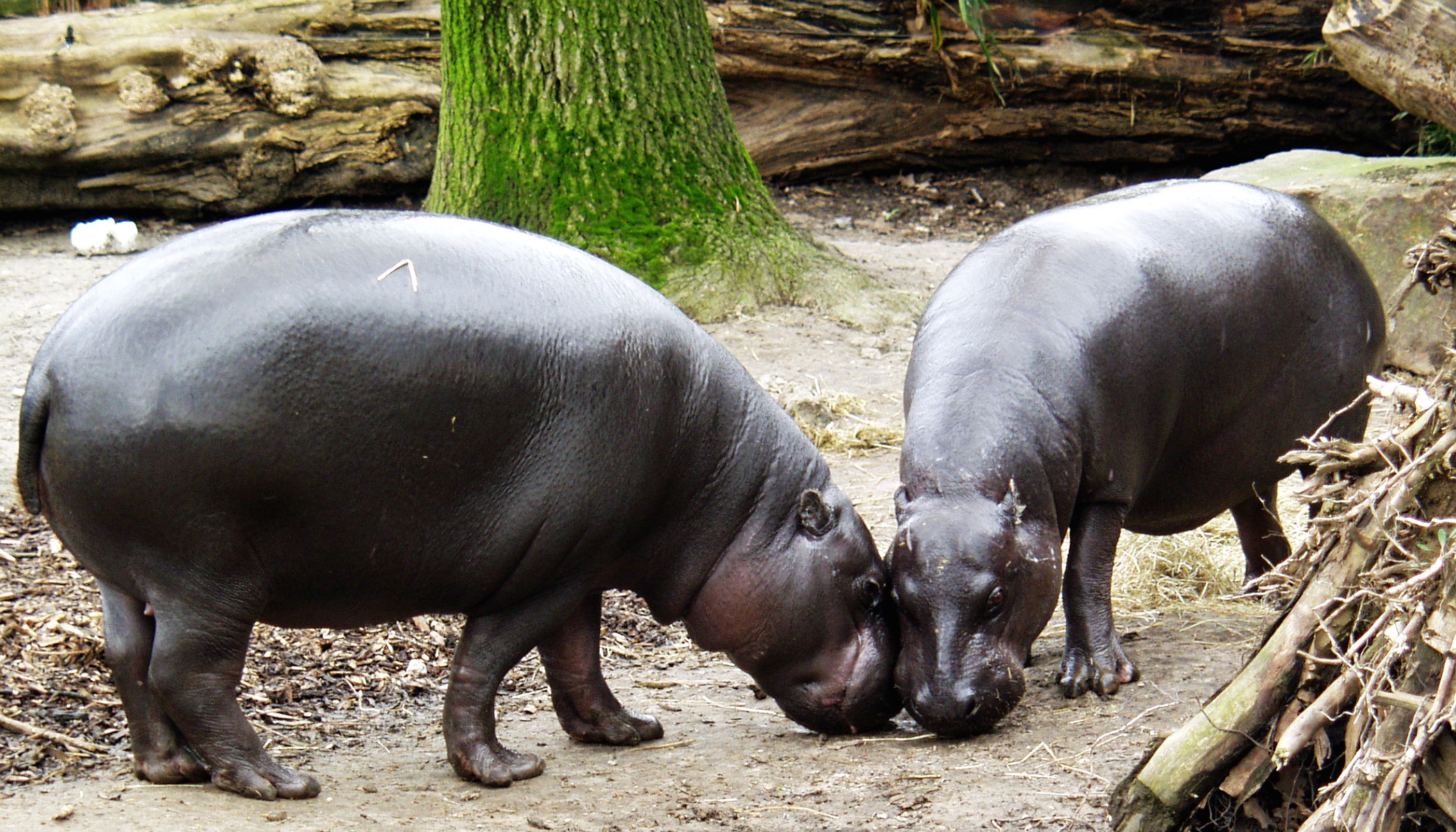
Duisburg Zoo
There are koalas in the Ruhr. This is the first thing that does not quite compute. You are in a city built on coal seams and blast furnaces, two hundred kilometers inland on a sluggish industrial river, and somewhere among the chestnut trees of the Kaiserberg urban forest a small Australian marsupial is asleep in a eucalyptus tree. Duisburg Zoo has been breeding koalas since 1994, runs the most successful fossa breeding program in the world, and has the German autobahn A3 running straight through the middle of it. Visitors barely notice. A leafy bridge carries them across the cars from the western half to the eastern half, and the zoo keeps doing what it has done since 1934: making the unlikely look ordinary.
Opened, Closed, Reopened
The Duisburg-Hamborner Tierpark am Kaiserberg opened on 12 May 1934. By 1936 it had its first elephant, on loan. By 1939 the war shut it down. When the zoo reopened in 1946, the cages were filled with animals the Hellabrunn Zoo in Munich had agreed to send up - a small act of cross-Germany solidarity in a year when most of the country was rebuilding far more than zoos. The first owned elephant did not arrive until 1952. A penguin and seal facility followed in 1958, funded by the businessman Helmut Horten. By 1965 Duisburg had one of Europe's largest dolphinariums. Like most dolphinariums of that era, it eventually grew controversial: the generous pool was still a small fraction of what a wild dolphin uses, and the zoo's director Wolfgang Gewalt was sharply criticized for personally leading an expedition to capture a beluga whale for the tanks.
Ferdinand Flies to San Diego
In the summer of 2004 a beluga named Ferdinand and a Commerson's dolphin named Yogi - the last of their respective species in Duisburg - were loaded onto a plane to San Diego. They were the oldest known animals of their kinds in captivity, and the move from Germany to a SeaWorld tank with others of their species seemed, by the standards of geriatric marine mammals, to suit them. Ferdinand has his own commemorative website, kept up by visitors who remember him. The Rio Negro complex opened in 2005 to house two Amazon river dolphins, including one named Apure who at his death in 2006 was thought to be at least 45 years old, the oldest of his species ever recorded. His tank-mate Baby died in December 2020. The era of large captive cetaceans in Duisburg is, quietly, over.
Why Koalas, Why Here
The Koala House opened in 1994 and has done more than almost any single exhibit to define the zoo's modern identity. The animals live behind a single sheet of glass, on perches that put them roughly at face height, and they spend most of the day doing what koalas do, which is almost nothing. A long-running photographic exhibition by the nature photographer Ingo Öland shows the Australian landscape they came from, in 22 large-format prints. The keepers will tell you, if asked, that running a koala program in the German climate is mostly an exercise in eucalyptus logistics - the leaves have to be fresh, sourced and trucked from greenhouses, every single day. The reward is one of the very few breeding koala colonies in Europe.
Madagascar in the Ruhr
Less famously but more impressively, Duisburg coordinates the European preservation program for the fossa, the strange cat-like predator endemic to the rainforests of Madagascar. The enclosure, donated and financed by the Verein der Duisburger Zoofreunde in 2000, is laid out to mimic the small pools and dense foliage of the fossa's native habitat. The breeding program here is the largest in the world. Next door, the Equatorium is the zoo's largest section, a redeveloped complex of lowland gorillas and De Brazza's monkeys, orangutans, macaques, gibbons, sloths, pygmy hippos, and a walk-through enclosure where mountain loris come over to inspect you while you feed them. In 1982 the city of Duisburg paired with Wuhan in a sister-city partnership, and the zoo built a Chinese Garden to mark it, complete with appropriate fauna - an unexpected diplomatic gesture preserved in stone and koi pond.
Ruhrpott-Schnauzen
From June 2006 the German public broadcaster ZDF aired a daily documentary called Ruhrpott-Schnauzen, following the keepers and animals of Duisburg Zoo. It ran for two years before being folded into the broader Tierische Kumpel program covering zoos across the Ruhr. The series turned ordinary workdays - cleaning a fossa enclosure, weighing a koala joey, coaxing a tortoise into a warming shelter - into prime-time viewing for a country that already understood that the people doing this work were doing something genuinely difficult. The zoo today is in the slow business of modernizing its older enclosures, retiring species like the polar bears whose facilities no longer meet contemporary standards, and trying to do less, better. The autobahn still runs underneath. The visitors still barely notice.
From the Air
Duisburg Zoo is at 51.44 degrees north, 6.81 degrees east, on the wooded ridge of the Kaiserberg in the northeastern part of the city, on the border with Mülheim an der Ruhr. From the air, look for the distinctive cut of the A3 autobahn running roughly north-south through a green forested patch - the zoo wraps both sides of the highway and is joined by an overhead pedestrian bridge. Düsseldorf International (EDDL) is about 20 km south; Essen/Mülheim airfield (EDLE) is just a few kilometers east. Recommended viewing altitude 2,500 to 4,000 feet. The Tropical House and Dolphinarium dome are the most identifiable structures within the forest canopy.