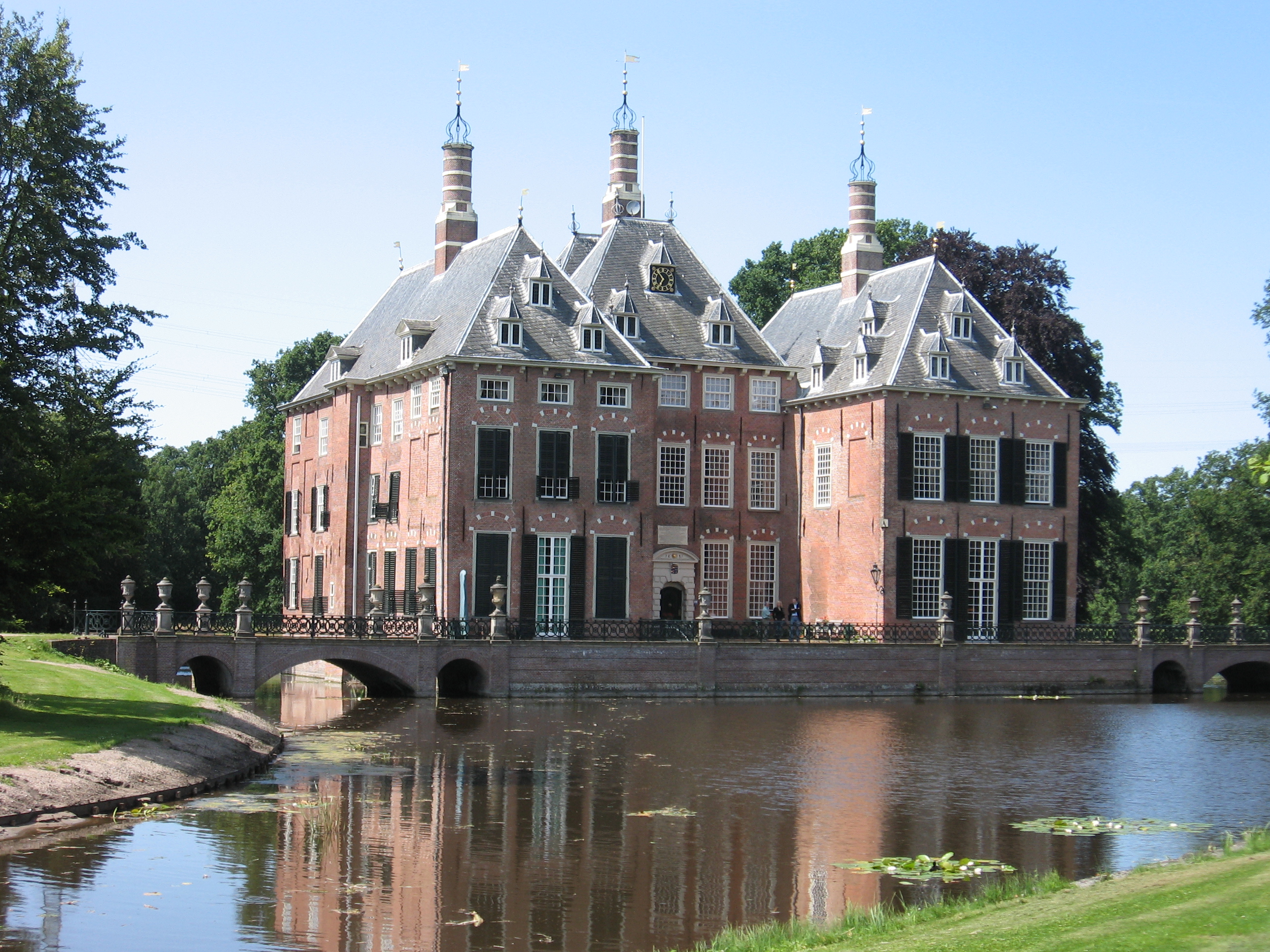
Duivenvoorde Castle
The remarkable thing about Duivenvoorde is not its age, though it is older than most things in the Netherlands. The remarkable thing is that it has never been sold. In a country that has changed hands more times than anyone can count - Spanish, French, Republican, Bonapartist, German, Dutch again - one family held this house from 1226 through 1965. Seven hundred and thirty-nine years. They added wings. They lost the name and got it back. They installed Roman stones in the front hall in 1717 and they were still arguing about where those stones came from three centuries later. At the end, the last baroness did the only thing that could keep the story going: she gave the house away.
Seven Centuries Under One Roof
The Van Duivenvoordes - in their earliest spelling, Van Duvenvoirde - were a branch of the great House of Wassenaer, one of the oldest noble families in Holland. They built the castle in Voorschoten and they did not let it go. Inheritance moved through sons and, when there were no sons, through daughters and matrilineal lines that kept the same blood threading through the same rooms. Toward the end of the 17th century, an owner named Johan van Duvenvoirde looked at the family tree and decided to take back the older name. He started calling himself Van Wassenaer. The house stayed the same. The family stayed the same. Only the letterhead changed.
The Roman Stones in the Hall
Walk into the front hall and you will see two Roman stones set into the wall. The larger one was installed in 1717, when the castle was being restored. Its front carries an inscription about Roman troops repairing an armory, dated between 196 and 198 AD; its reverse, older still, runs from somewhere between 103 and 111 AD. When the Romans recut the back into the front, they made the stone smaller and damaged the older text. The smaller stone dates to around 205 AD. Local legend has long claimed both stones came from Brittenburg, the ghostly Roman ruins that surfaced off the coast of Katwijk in 1520 before the North Sea swallowed them again. But the larger stone was almost certainly turned up by a plough in 1502 near the Monastery of Roomburg - a military chronicle written down in 1517 quotes it verbatim. The Brittenburg story is romance. The plough is history.
The Last Baroness Decides
Jonkvrouwe Ludolphine Henriette, Baroness Schimmelpenninck van der Oye, was born in 1891. She lived at Duivenvoorde and she understood, as she aged, exactly what would happen when she died. The house would be sold. The Dutch porcelain would be auctioned. The portraits of her ancestors would scatter across the European art market. The textiles, the clothing, the entire layered accumulation of seven centuries, would dissolve in an afternoon at Christie's. In 1960 she did something different. She closed the house, transferred it to a foundation, and instructed the foundation to restore it to the way it had looked in 1717. She died in 1965. The portraits stayed where she had hung them.
A House That Is Not Quite a Museum
The Duivenvoorde Foundation took her instructions seriously, though not literally. The 1844 terrace was kept because it was beautiful. Some sealed windows were reopened to let light into the living room - which broke the symmetry, but it was worth it. The interior was repainted to match the colors of 1717. Later stucco on the ceilings was left in place because removing it would have damaged the plaster underneath. The central and north wings, instead of being roped off behind velvet, were arranged as if the family had stepped out for an hour. A book on the table. A chair pulled back. The fire ready to be lit. Visitors walk through and feel, oddly, like they are intruding on someone who will be back any minute.
Still Lived In
The south wing is not empty. Ludolphine Emilie van Haersma Buma, also a Baroness Schimmelpenninck van der Oye, has lived there since 2003. Her brother lives in the castle's garden house. The family did not leave when they gave the castle away. They just moved into a different part of it. The house, first mentioned eight hundred years ago, still has people in it whose ancestors built it. The portrait of Lysbeth van Duvoorde, who died in 1472, hangs at the Museum Boijmans Van Beuningen in Rotterdam - on her dress, in gold letters, runs the medieval line: Mi verdriet lange te hopen, wie is hi die syn hart hout open. It grieves me to hope so long. Who is he who keeps his heart open.
From the Air
52.1114 N, 4.4175 E in Voorschoten, South Holland, between Leiden and The Hague. The castle sits in mature parkland with formal gardens and a moat, recognizable from the air by the long approach drive and surrounding wooded estate. Best viewed from 2,000-3,500 feet. Nearest airports: Rotterdam The Hague (EHRD) 18 km southwest, Amsterdam Schiphol (EHAM) 28 km northeast. Rosenburgh Castle grounds lie roughly one kilometer to the north-northeast.