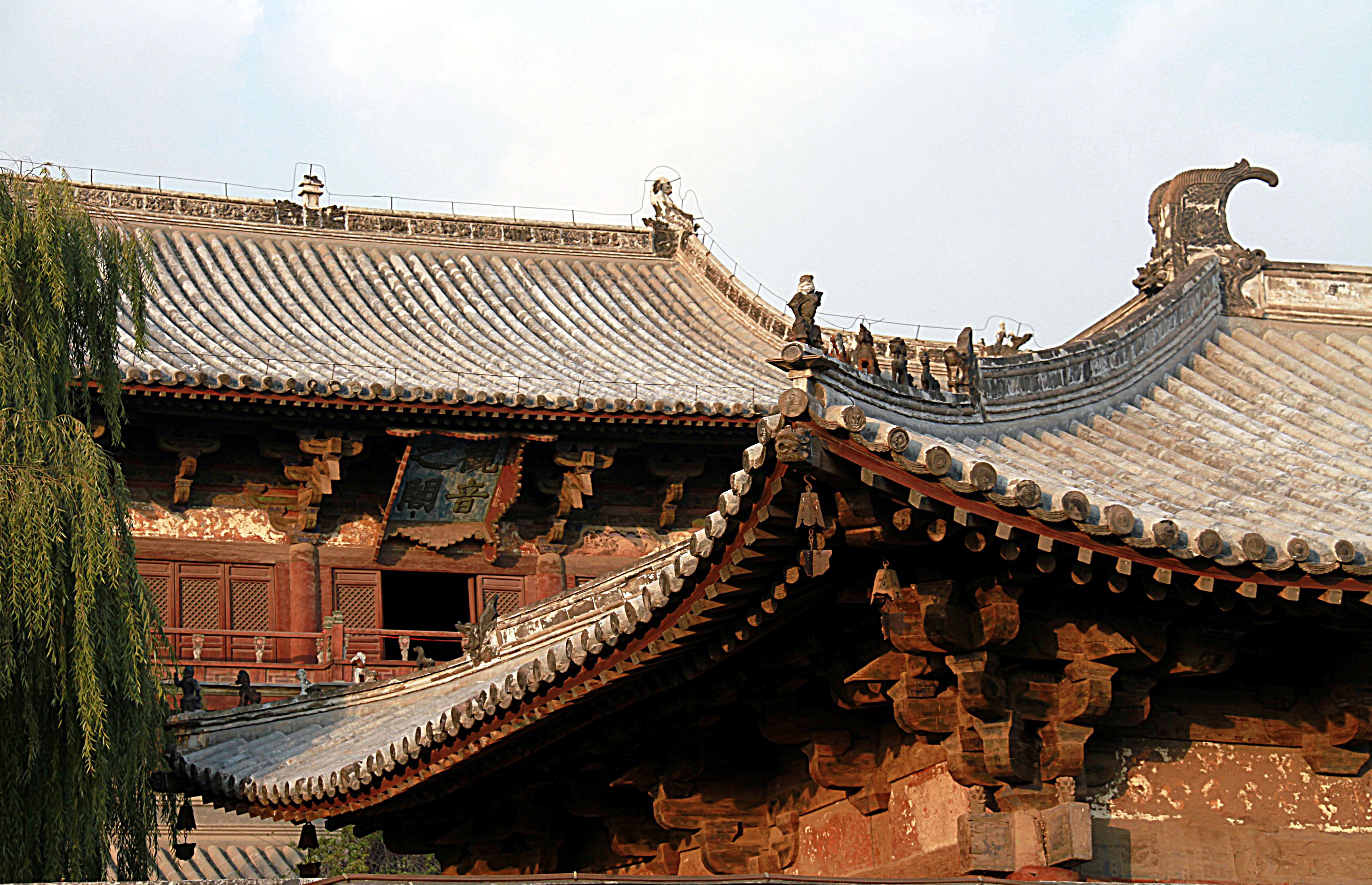
Dule Temple
Look closely at the timber frames of Dule Temple and you will find bullet holes. They were left by soldiers under the command of warlord Sun Dianying, who used the main hall as barracks in 1928 while his troops looted the nearby Eastern Qing Tombs. The bullets punched through wood that was already nearly a thousand years old. The wood survived. So did the eleven-headed clay statue of Guanyin that rises 16 meters through the temple's central pavilion, its thousand-year-old form still intact inside one of the oldest wooden buildings in China.
Rebel Origins, Ancient Timbers
The origins of Dule Temple reach back at least to the early Tang dynasty, though no structures from that era remain. The temple's name may derive from An Lushan, the military governor who rallied his forces here in 755 AD at the onset of his rebellion against the Tang emperor -- An Lushan was also known as An Dule. Alternatively, the name may come from the Dule River that flows northwest of the site. Whatever the etymology, the oldest surviving buildings date to 984 AD, when the temple was renovated during the second year of Emperor Shengzong's reign in the Liao dynasty. The shanmen -- the front gate -- and the Guanyin Pavilion were both rebuilt at that time, making them among the most ancient wooden structures still standing anywhere in China.
A Pavilion of a Thousand Pieces
The Guanyin Pavilion is a three-story timber structure soaring approximately 23 meters high, topped with five single-eaves xieshan roofs. More than a thousand individual wooden components interlock to form its frame -- beams, columns, and architraves arranged with a precision that still impresses structural engineers. The system of dougong brackets, stacked atop pillars with architraves layered between, divides the interior into three distinct levels from which devotees can view the colossal Guanyin statue from different angles. At the center, an octagonal caisson ceiling crowns the open patio around the statue, integrating the entire interior into a single unified space. The statue itself was constructed during the Liao dynasty but displays the artistic style of the Tang dynasty's flourishing period, a deliberate echo of an earlier golden age.
Scholars, Warlords, and Drones
In the early 1930s, two scholars independently recognized Dule Temple's extraordinary significance. Japanese researcher Sadako Sekino and Chinese architect Liang Sicheng both studied the complex, with Liang producing detailed documentation that would form part of China's first modern architectural history. Their work helped establish the temple as a National Priority Protected site in 1961. But the temple's history is not all scholarly reverence. Sun Dianying's soldiers left their mark not just in bullet holes but in the broader story of early-twentieth-century chaos, when ancient sites served as convenient billets for passing armies. Today, restoration work continues under expert supervision. In 2023, a university team led by Professor Wang Huiqin deployed drones to scan the temple's murals, using non-invasive technology to analyze painting techniques and pigment types -- a twenty-first-century approach to preserving a millennium of art.
The Temple of Solitary Joy
Dule Temple is sometimes translated as the "Temple of Solitary Joy," a name that captures something of the experience of visiting this place in Jizhou District. The complex faces south in the traditional arrangement, its shanmen rising ten meters with three wudian-style roofs and guardian king statues flanking the entrance. This gate alone qualifies as one of the Eight Great Architectures of the Liao Dynasty. Beyond it, the Guanyin Pavilion dominates the courtyard, its proportions calibrated to the monumental statue within. The eleven-headed Guanyin -- known as Shiyimian Guanyin, a manifestation of the Bodhisattva Avalokitesvara -- gazes out from multiple faces, each representing a different aspect of compassion. The clay figure has endured earthquakes, rebellions, military occupation, and political upheaval. It stands at 41 Wuding Street in the center of Jizhou District, quietly persisting as empires rise and fall around it.
From the Air
Located at 40.04N, 117.40E in Jizhou District, suburban Tianjin. The temple complex is in the center of the district town, surrounded by low-rise urban development. The nearest major airport is Tianjin Binhai International (ZBTJ/TSN), about 110 km to the south. Beijing Capital International (ZBAA/PEK) is approximately 90 km to the west. The mountainous terrain north of Jizhou leads to the Great Wall sections at Huangya Pass. Best viewed from 3,000-5,000 feet AGL.