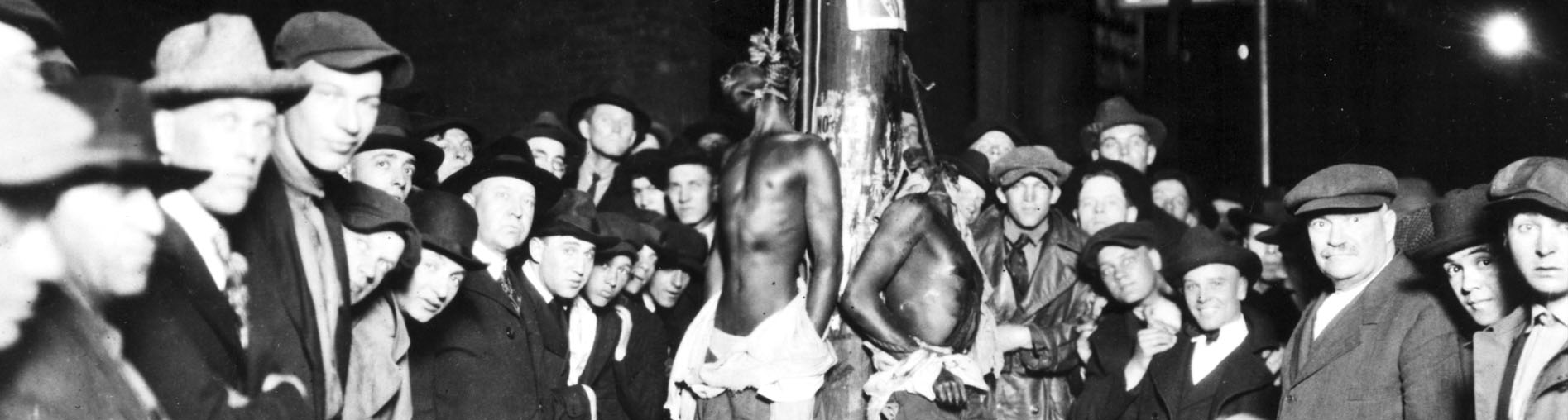
Duluth Lynchings
Three bronze figures stand at the corner of First Street and Second Avenue East in Duluth, Minnesota. They represent Elias Clayton, Elmer Jackson, and Isaac McGhie -- young Black men who were alive on the evening of June 15, 1920, and dead before midnight, murdered by a mob that numbered in the thousands. The men were circus workers, part of the crew for the John Robinson Circus, which had rolled into town the day before for a one-night show. They were accused of a crime that likely never happened. They were killed on a street that shoppers and office workers walk along today. The memorial was dedicated in 2003. The lynchings remain the most widely documented instance of anti-Black racial violence in Minnesota's history.
The Circus Comes to Town
On June 14, 1920, the John Robinson Circus arrived in Duluth for a free parade and a single evening performance. Two white teenagers, Irene Tusken, nineteen, and James Sullivan, eighteen, attended the show and ended up behind the big top, watching Black workers dismantle the menagerie tent and load wagons. What happened between the teenagers and the workers that night remains unknown. Later, Sullivan told his father that six Black circus workers had held him and Tusken at gunpoint and that Tusken had been raped and robbed. Sullivan's father called Duluth police chief John Murphy. In the early hours of June 15, Murphy lined up roughly 150 Black roustabouts, food service workers, and stagehands beside the train tracks and had Sullivan and Tusken attempt to identify their attackers. Six men were arrested and placed in the city jail.
A City Turns Violent
Newspapers printed the allegations. Rumors inflated them: word spread through white neighborhoods that Tusken was dying from her injuries. By evening, a mob estimated at between one thousand and ten thousand men had gathered outside the jail. The commissioner of public safety, William F. Murnian, ordered police not to use their firearms to protect the prisoners. The mob attacked the jail with heavy timbers, bricks, and steel rails, breaking down doors and walls to reach the men inside. Elias Clayton, Elmer Jackson, and Isaac McGhie were dragged from their cells and lynched on the street. The violence unfolded against a national backdrop of racial terror: the Red Summer of 1919 had seen race riots erupt across American cities, and tensions remained raw. In Duluth, a city with a small Black population, the mob acted with impunity. Three men were later convicted of rioting, but none served more than fifteen months. No one was ever prosecuted for the murders.
A Law, a Pardon, and a Song
Minnesota passed anti-lynching legislation in April 1921, and no lynchings have been recorded in the state since. But justice for the victims came slowly, if at all. Max Mason, a Black circus co-worker of the three murdered men, was convicted of rape and sentenced to thirty years in prison. He was released after four years on the condition that he not return to Minnesota for sixteen years. A century later, during the George Floyd protests, Minnesota Attorney General Keith Ellison argued that Mason's conviction was a false charge. On June 12, 2020, the Minnesota Board of Pardons granted Mason the first posthumous pardon in the state's history. Bob Dylan, who was born in Duluth and grew up in Hibbing sixty miles northwest, referenced the lynchings in the opening verse of his 1965 song "Desolation Row." Dylan's father, Abram Zimmerman, was nine years old in June 1920 and lived two blocks from the site.
Bronze Witnesses on First Street
Residents of Duluth spent years working toward a permanent memorial. The Clayton Jackson McGhie Memorial, designed and sculpted by Carla J. Stetson in collaboration with writer Anthony Peyton-Porter, was dedicated on October 10, 2003. The three bronze statues stand across the street from the site of the lynchings. Thousands of Duluth residents and community members gathered for the dedication ceremony. The final speaker was Warren Read, the great-grandson of one of the most prominent leaders of the lynch mob. Read later wrote a memoir, The Lyncher in Me, published in 2008, exploring what it meant to discover his family's role in the murders and his decision to seek out the descendants of Elmer Jackson. A scholarship fund established in 2000 awarded its first grant in 2005.
One Hundred Years Later
On June 15, 2020, the centennial of the lynchings, Minnesota Governor Tim Walz visited the memorial and proclaimed the date Elias Clayton, Elmer Jackson, and Isaac McGhie Commemoration Day. Three weeks earlier, George Floyd had been murdered by a Minneapolis police officer, and Walz drew a direct line between the two events, calling them part of an unbroken history. The commemoration underscored what the memorial's existence already declared: that a city's willingness to name its darkest chapter is itself a form of reckoning. The bronze figures on First Street do not look away. They face the intersection where the mob gathered, standing in permanent witness to what happened and what must not happen again.
From the Air
The Clayton Jackson McGhie Memorial is located at 46.7893°N, 92.0968°W in downtown Duluth, Minnesota, at the corner of First Street and Second Avenue East. The site is approximately half a mile northeast of the Duluth Depot and Canal Park. Duluth Sky Harbor Airport (KDYT) is about 2.5 miles southeast on Minnesota Point. Duluth International Airport (KDLH) lies roughly 7 miles northwest. From the air, the memorial is within the dense downtown grid between the hillside and the waterfront. The broader Duluth waterfront, including the Aerial Lift Bridge and Lake Superior shoreline, provides visual orientation. Best viewed in context with the downtown area at 2,000-3,000 feet.