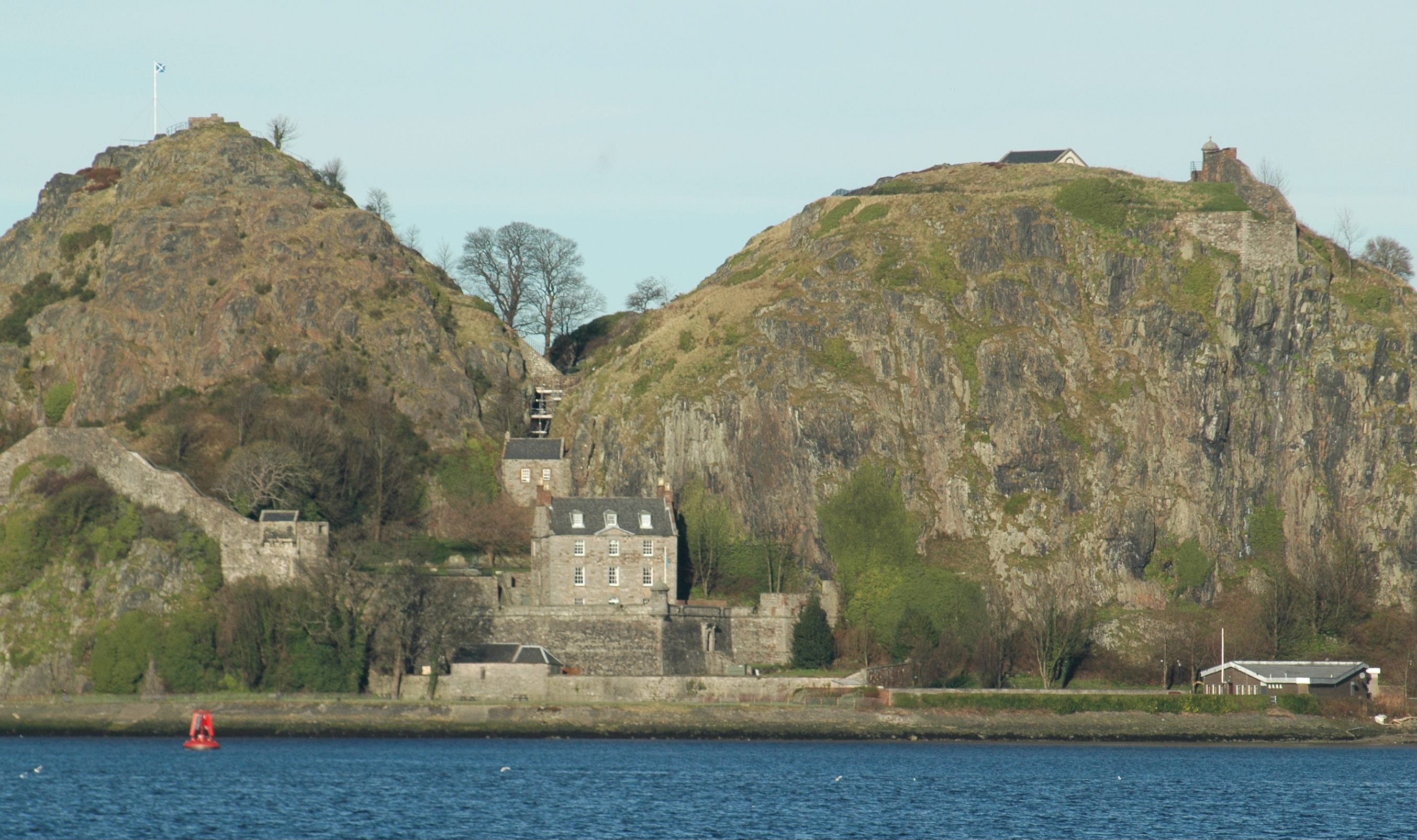
Dumbarton Castle
The rock came first. Between 330 and 340 million years ago, during a period of volcanic activity that shaped the landscape where Glasgow now stands, magma cooled inside the vent of an active volcano. Over geological time, the softer surrounding rock weathered away, leaving behind a twin-peaked plug of basalt 240 feet high, jutting from the flat ground where the River Leven flows into the Clyde. Humans have been building on it for at least two thousand years. Dumbarton Castle, perched on this ancient rock, has the longest recorded history of any stronghold in Scotland.
Alt Clut: Rock of the Clyde
The Brythonic people who settled on Dumbarton Rock called it Alt Clut -- 'Rock of the Clyde' -- and the name became a metonym for an entire kingdom. From the 5th century to the 9th, this was the capital of the independent Kingdom of Strathclyde, one of the successor states that emerged from Roman Britain. The first written reference to the settlement appears in a letter from Saint Patrick to King Ceretic of Alt Clut in the late 5th century, making it one of the earliest documented places in Scotland. The king of Dumbarton around AD 570 was Riderch Hael, a figure who appears in both Welsh and Latin literature. David Nash Ford has proposed that Dumbarton was the Cair Brithon -- 'Fort of the Britons' -- listed by Nennius among the twenty-eight cities of Sub-Roman Britain.
The Viking Siege
In 870, a Norse-Danish fleet under Olaf the White and Ivar the Boneless besieged Alt Clut for four months. The fortress, considered virtually impregnable, finally fell when the Vikings cut off the water supply -- the well that served the garrison ran dry. The capture of Alt Clut was a catastrophic blow to the Kingdom of Strathclyde. The Norse carried away a great number of captives, including Artgal, King of Strathclyde, who was subsequently killed. The kingdom survived the fall of its capital but never fully recovered its former power, eventually merging with the Kingdom of Alba to form what would become Scotland.
A Castle Between Kingdoms
Through the medieval period, Dumbarton Castle sat at the intersection of competing powers. William Wallace was reportedly held here briefly after his capture in 1305, before being transported to London for trial and execution. During the Wars of Scottish Independence, the castle changed hands repeatedly between Scottish and English forces. In 1333, Sir Andrew Moray, Guardian of Scotland, prepared ships at Dumbarton to harass English supply lines. The castle's strategic importance lay in its position: controlling access to the Clyde, it commanded the sea approach to the Scottish Lowlands. Anyone who held Dumbarton Rock held the key to western Scotland.
The Young Queen's Refuge
In 1548, the five-year-old Mary, Queen of Scots, was brought to Dumbarton Castle to await a ship that would carry her to France and her betrothal to the Dauphin. She sailed from beneath the rock on a French galley, beginning an exile that would last thirteen years. Two decades later, after her forced abdication in 1567, Mary attempted to reach Dumbarton again -- the castle was still held by loyalists under Lord Fleming, and its near-impregnability made it the ideal base from which to rebuild her power. She never made it. Her forces were intercepted and defeated at the Battle of Langside in 1568, and she fled south into English captivity instead. The castle she had been trying to reach remained in loyalist hands until 1571, when Captain Thomas Crawford scaled the rock face at night with a small party and captured it by surprise.
Garrison and Ruin
Dumbarton Castle served as a military garrison into the 19th century. The twin peaks of the rock -- the Beak and the White Tower Crag -- are connected by a saddle where the main fortifications stand. A magazine was built in the 18th century, and the castle housed French prisoners during the Napoleonic Wars. The rock itself, visible for miles along the Clyde, remains one of the most dramatic natural features of the Scottish Lowlands. Today the castle is maintained by Historic Environment Scotland, its ramparts offering views downriver to Glasgow and out across the widening Firth of Clyde. The volcanic plug that cooled 340 million years ago still performs the function it has served since before recorded history: it watches over the river, and whoever stands on top of it can see everything that approaches.
From the Air
Dumbarton Castle sits at 55.94°N, 4.56°W on Dumbarton Rock, a prominent twin-peaked volcanic plug at the confluence of the River Leven and the River Clyde. The rock rises 240 feet and is clearly visible from the air, standing dramatically above the flat surrounding terrain. The town of Dumbarton lies to the north and east. Nearest airport: Glasgow International (EGPF, 8 nm east-southeast). The Firth of Clyde widens to the west. The Erskine Bridge crosses the Clyde approximately 3 nm to the east.