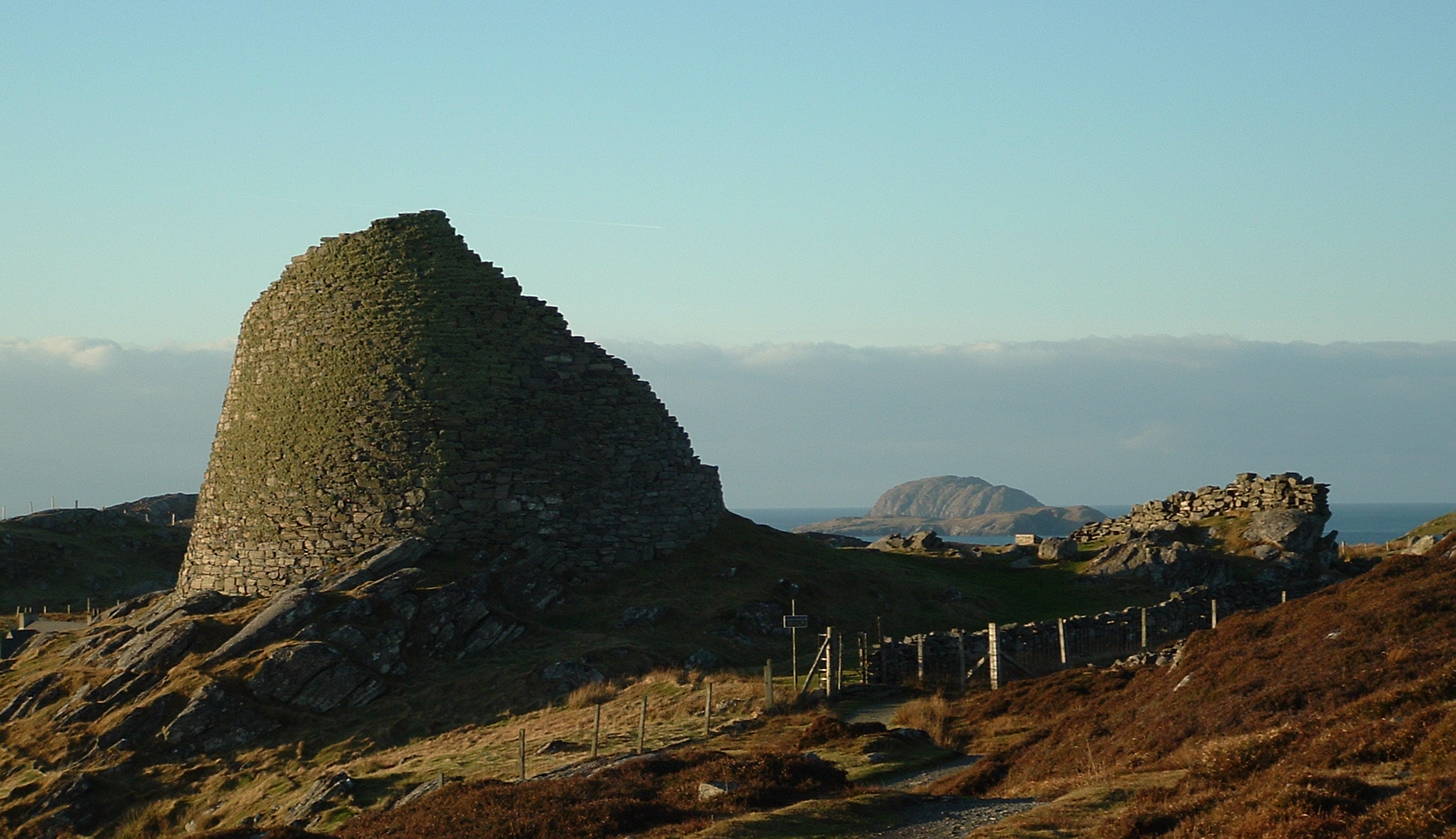
Dun Carloway
Donald Cam MacAuley climbed the outer wall using two daggers. The year was 1601, the Morrisons of Ness had stolen cattle from the MacAuleys of Uig, and they had retreated into the ancient broch at Carloway, presumably thinking that a two-thousand-year-old fortress would still serve as one. They were wrong. MacAuley jammed his blades into the gaps between stones, hauled himself up the outer face, threw burning heather into the interior, and smoked the Morrisons out. Then the MacAuleys destroyed the broch -- or tried to. Parts of the wall on the south side still stand 9.2 metres tall, as stubbornly upright as anything in the Hebrides.
The Builders of the Broch
Most brochs were built between 100 BC and 100 AD, and Dun Carloway probably dates to the first century AD. The people who raised these hollow-walled towers across northern and western Scotland left no written records, but they left architecture of startling sophistication. The external diameter of Dun Carloway is 14.3 metres; the internal courtyard measures 7.4 metres across. The entrance is just 75 centimetres wide and one metre high -- narrow enough that anyone entering had to duck and turn sideways, making it effectively impossible to rush the door in force. On the south side of the entrance passage sits a 'guard cell,' a small side room with an opening 61 centimetres square. Two large wall voids are visible in the southeastern wall, part of the hollow construction that gave brochs their combination of strength and insulation. The name Carloway probably derives from the Norse Karlavagr -- Karl's bay -- a trace of the centuries when Lewis was part of the Kingdom of the Isles.
Living in the Walls
Through the centuries, Dun Carloway remained in use until the accumulated layers of occupation raised the floor level too high for practical habitation. Excavations in the northeastern room uncovered at least three peat-fired ovens dating to the period between 400 and 700 AD, along with pottery fragments, a piece of quern-stone, and a collection of snail shells. Intriguingly, the fireplaces contained no animal bones, suggesting the ovens were not used for cooking meals -- their purpose may have been industrial, perhaps for drying grain or processing hides. On the north side of the interior, the natural rock upon which the broch was built protrudes through the floor. It is likely that an upper wooden floor once existed, though whether the structure had one storey above ground level or several remains uncertain. The broch overlooks Loch Carloway, and its builders chose the site with care: the elevation provides clear sightlines along the coast in both directions.
Among Scotland's First Protected Monuments
By 1861, when Captain Thomas published a drawing of the site, Dun Carloway was already showing signs of deterioration beyond what the MacAuleys had inflicted in 1601. To prevent further decay, the broch was designated in 1882 as one of the first officially protected monuments in Scotland -- a recognition that came remarkably early in the history of archaeological conservation. Only Mousa Broch in Shetland and Dun Telve in Glenelg have walls that stand higher. The original height of Dun Carloway is unknown, but the surviving sections give a powerful impression of scale: standing inside and looking up at nine metres of dry-stone wall, fitted without mortar and still plumb after two millennia, is an encounter with engineering skill that transcends its era.
A Landscape of Stone
Dun Carloway sits within a landscape dense with prehistoric monuments. From its base, the stone circle at Steinacleit is clearly visible to the northeast. The Callanish standing stones are twenty miles to the southwest. Lewis, more than any other Hebridean island, preserves the full chronological range of Scotland's stone-building traditions, from Neolithic circles through Iron Age brochs to medieval churches. The broch today is owned by Historic Scotland, and the visitor centre is operated by the Carlaway Estate Trust. The community ownership of the interpretive center reflects a broader pattern across the Outer Hebrides, where the people who live among ancient structures are increasingly the ones who tell their stories. The broch requires no embellishment. Its stones, fitted two thousand years ago by hands that understood weight and wind and the particular demands of a Hebridean winter, continue to stand. That is the story they tell, and it is enough.
From the Air
Located at 58.27N, 6.79W on the west coast of the Isle of Lewis in the Outer Hebrides. The broch is a compact circular stone structure on elevated ground overlooking Loch Carloway. Nearest airport is Stornoway (EGPO), approximately 15 miles northeast. Best viewed at 1,500-3,000 feet. The Callanish Stones are visible approximately 8 miles to the south-southwest.