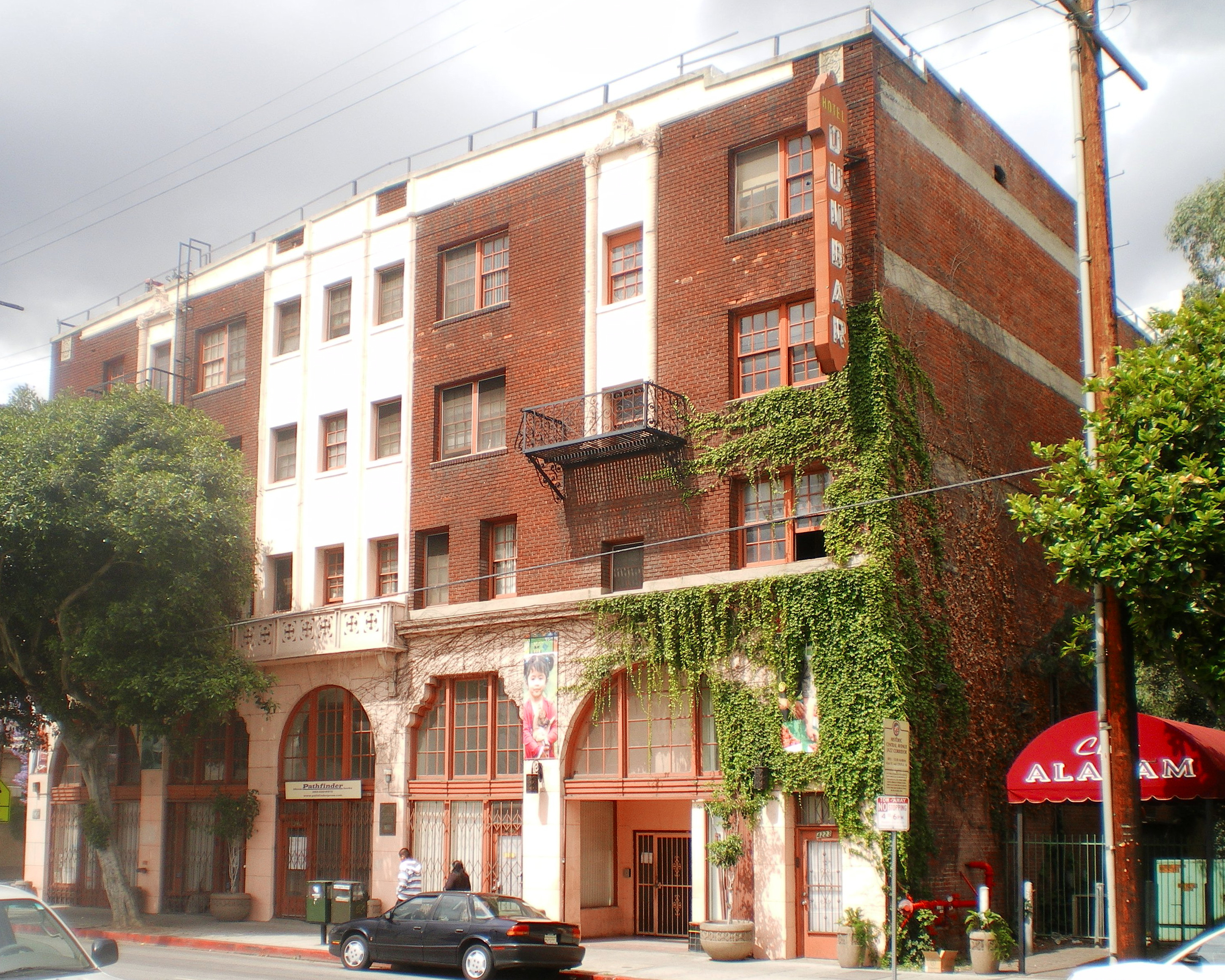
Dunbar Hotel
The Dunbar Hotel was built because other hotels in Los Angeles wouldn't admit Black guests. That's the practical origin of a place that became, in the 1930s and 1940s, one of the most culturally significant gathering spots on the West Coast—where Billie Holiday and Duke Ellington played, where Thurgood Marshall planned legal strategy, where the lines enforced everywhere else in the city simply didn't apply.
The Somervilles
John Alexander Somerville and Vada Somerville built the hotel in 1928 at 4225 South Central Avenue in the neighborhood then known as the Central Avenue Corridor. John was the first Black graduate of USC's School of Dentistry; Vada was the first Black woman to receive a Doctor of Dental Surgery from the same university. They named it the Hotel Somerville.
The choice of location was deliberate. Central Avenue was the main artery of Black Los Angeles—a stretch of clubs, churches, businesses, and cultural institutions that had grown up in the decades since the Great Migration began sending Black Southerners west. The Somervilles built their hotel where their community was, because the rest of the city had made clear it wasn't welcome anywhere else.
The NAACP and the New Name
Within months of opening, the Hotel Somerville hosted the first NAACP national convention held west of the Mississippi. The gathering drew civil rights leaders, attorneys, and activists from across the country. The hotel served as both venue and symbol.
The 1929 stock market crash forced the Somervilles to sell to a syndicate of investors, and the hotel was renamed the Dunbar Hotel that same year in honor of the poet Paul Laurence Dunbar. In 1930, Lucius Lomax purchased it for $100,000, restoring Black ownership. The new name stuck, and so did the hotel's role. Through the Depression and into the war years, the Dunbar was described as a West Coast mixture of the Waldorf-Astoria and the Cotton Club—a place of elegance in a city that denied elegance to Black residents almost everywhere else.
The Guest Book
The list of those who stayed or performed at the Dunbar reads like an atlas of mid-century Black achievement. Duke Ellington, Count Basie, Cab Calloway, Louis Armstrong, Billie Holiday, Lena Horne—all performed in the hotel's jazz club or stayed in its rooms. Joe Louis, the heavyweight champion, stayed here between fights. W.E.B. Du Bois stayed here. Thurgood Marshall, who would go on to argue Brown v. Board of Education before the Supreme Court and later become the first Black justice of that Court, used the Dunbar as his base when working on West Coast cases.
Ray Charles, who moved to Los Angeles in the early 1950s, was a regular. The hotel was one of the anchors of the scene that made Central Avenue a center of American jazz.
What Remains
The Central Avenue Corridor declined after World War II, as discriminatory housing covenants began to fall and Black Angelenos were able to move to other neighborhoods. The concentration of culture on Central Avenue dispersed; the Dunbar's clientele changed; the hotel itself fell into disrepair.
The building was eventually converted to affordable housing as Dunbar Village, providing apartments for low-income seniors. It was designated a Los Angeles Historic-Cultural Monument and is listed on the National Register of Historic Places. The architecture of the original hotel—a dignified five-story building with Spanish Renaissance detailing—survives largely intact. The story of what happened inside it, during the decades when it mattered most, is the kind of story that doesn't make itself obvious from the street. You have to know to look.
From the Air
The Dunbar Hotel is located at 4225 South Central Avenue in South Los Angeles, about four miles south of downtown. Central Avenue runs north-south through South LA, parallel to the 110 Harbor Freeway to the west. From the air, the neighborhood sits in the flat basin south of downtown, between the 10 freeway to the north and the 105 to the south. The Dunbar's five-story building is not easily identifiable from altitude, but the Central Avenue corridor is traceable as a commercial strip through the residential grid. Nearest airports: KLAX (Los Angeles International) to the west, KHHR (Hawthorne Municipal) to the southwest.