Dunblane Massacre
The snowdrops were blooming in the gardens of Dunblane on the morning of 13 March 1996. It was a Wednesday, an ordinary school day in a small cathedral town five miles north of Stirling, where children walked to Dunblane Primary School past stone houses and the medieval cathedral that gave the settlement its quiet identity. By mid-morning, sixteen children and their teacher were dead, killed in a gymnasium by a gunman who then took his own life. The Dunblane massacre remains the deadliest mass shooting in British history, and the community's response to it changed the law of the land.
Fourteen Minutes
The attack began at approximately 9:30 a.m. and lasted roughly three minutes. A man armed with four handguns entered the school gymnasium, where a class of five- and six-year-olds was having a physical education lesson with their teacher, Gwen Mayor. He opened fire immediately. Mayor died shielding her pupils. Sixteen children, all aged five or six, were killed. Twelve more children and three adults were wounded. The gunman then turned a weapon on himself. The first ambulance arrived at 9:57 a.m., fourteen minutes after the emergency call. Medical teams from Dunblane, Doune, Callander, and Stirling Royal Infirmary converged on the school within the hour. The town's small health centre became an emergency triage point. Parents gathered at the school gates, waiting for news that in some cases would never be anything but the worst.
A Community Broken Open
Dunblane had a population of roughly 8,000. In a town that size, sixteen children represent an entire generation of a neighbourhood. Every family knew someone who was touched. Two days after the shooting, a vigil at Dunblane Cathedral drew people of all faiths. On Mothering Sunday, four days later, Queen Elizabeth II and Princess Anne attended a memorial service at the cathedral. In October, the families of the victims organised their own service, attended by more than 600 people and broadcast live on BBC. The gymnasium where the children died was demolished within a month and replaced by a memorial garden. Future tennis champions Andy and Jamie Murray, who attended Dunblane Primary at the time, were in the school during the attack. Andy Murray has spoken of it rarely, saying he was too young to fully understand what was happening.
The Laws They Changed
The grief of Dunblane became a political force. Bereaved families, joined by survivors of the 1987 Hungerford massacre, campaigned for a ban on private handgun ownership. The public inquiry led by Lord Cullen recommended tighter controls and raised the question of an outright ban. In 1997, the Conservative government passed the Firearms Amendment Act, prohibiting most cartridge handguns. After the general election that year, the incoming Labour government went further with a second act that banned the remaining .22 calibre handguns. Britain effectively ended the private ownership of handguns, one of the most comprehensive gun control measures ever enacted by a democracy. The legislation did not apply to Northern Ireland, where handgun ownership under licence remained legal. The Cullen Inquiry also drove reforms in school security and the vetting of adults who work with children, changes whose effects rippled far beyond Dunblane.
What Endures
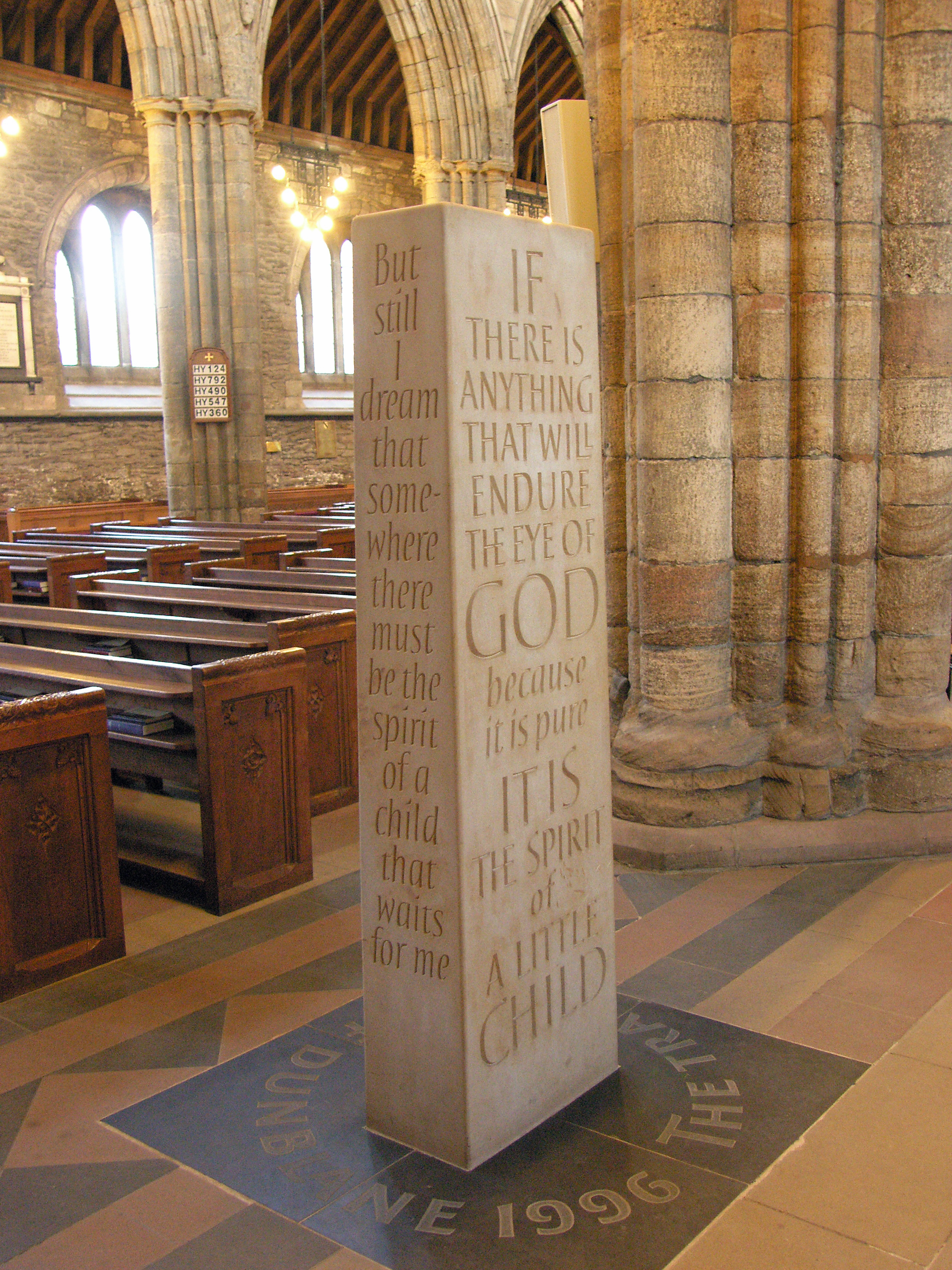
The memorials are quiet and deliberate. Two rose varieties, 'Gwen Mayor' and 'Innocence,' were developed by a nursery in Aberdeen and planted at a roundabout in Dunblane. A snowdrop cultivar found in a local garden was renamed 'Sophie North' in memory of one of the children. Inside Dunblane Cathedral, a standing stone carved by the sculptor Richard Kindersley bears quotations about childhood, including W. H. Auden's line: 'We are linked as children in a circle dancing.' With Bob Dylan's permission, musician Ted Christopher wrote a new verse for 'Knockin' on Heaven's Door,' recorded with the siblings of victims singing the chorus and Mark Knopfler on guitar. It reached number one. In 2025, Gwen Mayor was posthumously awarded the Elizabeth Emblem, an honour given by the monarch to public servants killed in the line of duty. Dunblane did not let its tragedy define it, but it never pretended the wound had closed. The town chose, instead, to make certain it would never happen again.
From the Air
Located at 56.19N, 3.97W in the small town of Dunblane, approximately 5 nm north of Stirling. Dunblane Cathedral is visible from the air near the centre of town, adjacent to the Allan Water. The primary school is on the northern edge of the town. Nearest airports: Glasgow (EGPF) approximately 28 nm west-southwest; Edinburgh (EGPH) approximately 30 nm east. Best viewed at 2,500-3,500 ft AGL.