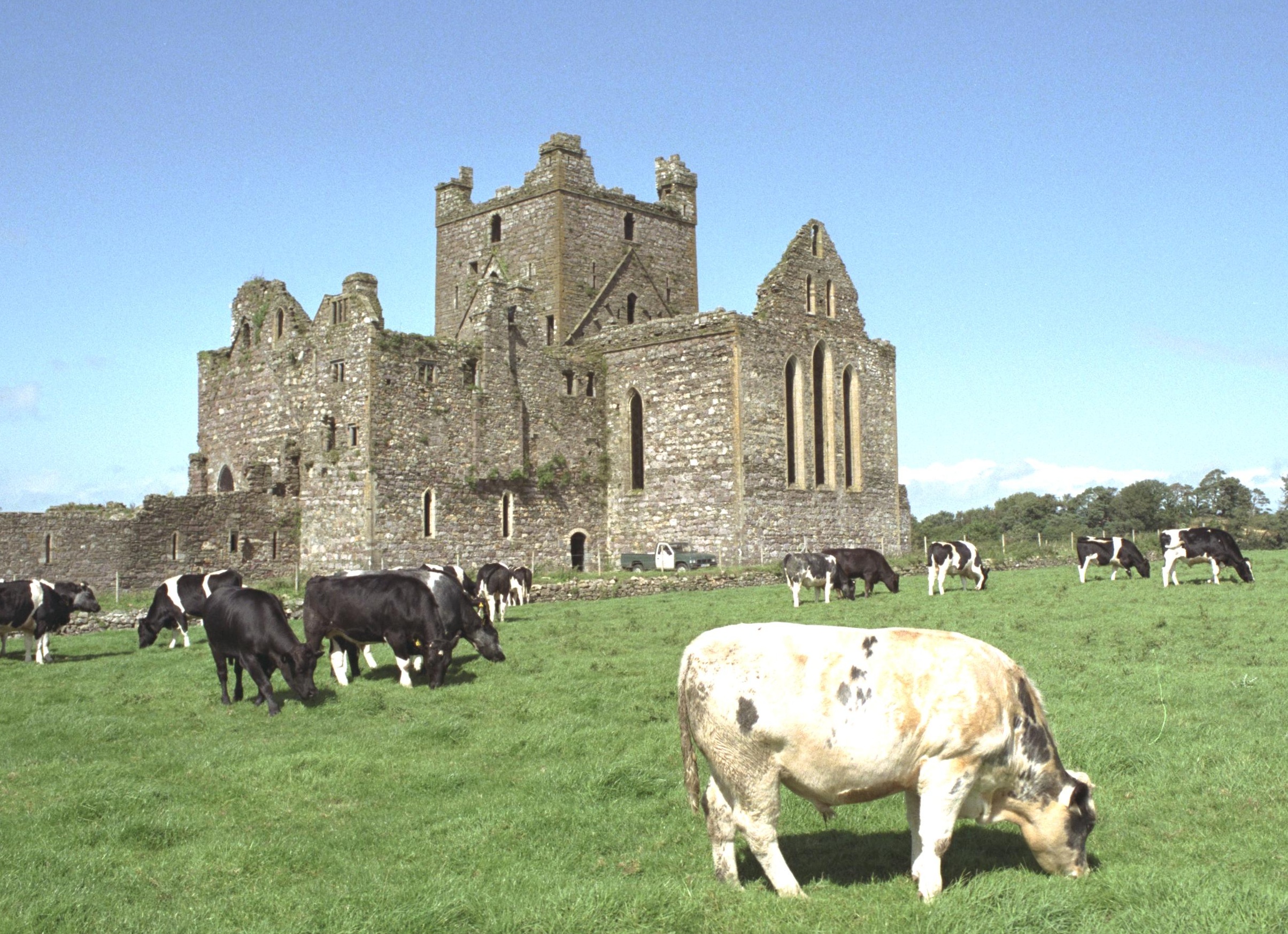
Dunbrody Abbey
The English monks at Buildwas Abbey in Shropshire surveyed the land in County Wexford and said no. Too remote. Too wild. Too Irish. So the offer passed to St. Mary's Abbey in Dublin, and from that rejection rose Dunbrody Abbey -- a Cistercian monastery whose cross-shaped church stretched 59 meters, making it one of the longest in all of Ireland. The building that one abbey refused to build would stand for four centuries before Henry VIII dissolved it, and its ruins would endure four more before a Christmas Eve storm brought the south wall crashing down.
The Norman Commission
Dunbrody Abbey owes its existence to the Norman conquest of Ireland. In 1169, Anglo-Norman knights led by Dermot MacMurrough invaded the country, and within two years Henry II had claimed it as a territory of England. Richard de Clare -- Strongbow -- was among the most powerful figures in the conquest, and it was Strongbow who instructed his uncle Herve de Montmorency to found a Cistercian monastery in the newly conquered County Wexford. Montmorency donated the land to Buildwas Abbey in England, following the Cistercian practice of having established houses sponsor new foundations. When Buildwas declined after a lay brother's unfavorable survey, the property was offered instead to St. Mary's Abbey in Dublin, which was in the filial line of Clairvaux -- the mother house of the entire Cistercian order. From Dublin, monks came south to build.
A Church Built Like a Cross
The Cistercians built according to a consistent architectural template, and Dunbrody followed the plan faithfully. The church is cruciform: a long nave with side aisles, north and south transepts each containing three chapels, and a choir at the eastern end. The nave was separated from its aisles by an arcade of five bays. Each transept chapel was topped with apartments -- living or working spaces built into the roof, accessed by circular stairs and passages across the triforium. The south transept apartments had fireplaces and windows across two floors, suggesting they served as quarters for senior monks or visiting dignitaries. A 15th-century tower was added above the crossing, giving the abbey a vertical emphasis it had lacked in its earlier centuries. Four large buttresses in the north aisle are all that held the north wall upright over the centuries -- and they are the reason it still stands today.
Dissolution and Decay
Henry VIII's dissolution of the monasteries reached Dunbrody as it reached every religious house in Ireland. The last Abbot, Alexander Devereux, made the pragmatic transition from monastic to episcopal life, becoming Bishop of Ferns in 1539. The abbey buildings passed into private hands, and centuries of neglect followed. Without the monks to maintain the stonework, weather and gravity began their slow work. The critical blow came on Christmas Eve 1852, when a violent storm brought down the south arcade and the entire south aisle wall. The collapse destroyed a significant portion of the church and some of the adjoining monastery buildings. It was a dramatic end to what had been a gradual decline -- centuries of slow erosion capped by a single night of destruction.
Ruins and Roses
Today, Dunbrody Abbey stands as one of the finest Cistercian ruins in Ireland, managed as a visitor center by the current Marquess of Donegall. The north arcade survives thanks to those four massive buttresses, and the architectural detail that remains -- clerestory windows, rib vaulting, the foundations of the cloister lavabo -- gives a clear sense of the original structure's ambition. The grounds include one of only two full-sized hedge mazes in Ireland, an unexpected addition that draws families as well as history enthusiasts. The ruins still convey the scale of what the Normans built here: a church longer than most cathedrals, raised in a landscape that another group of monks had dismissed as unworthy. What Buildwas refused, Dunbrody made magnificent.
From the Air
Dunbrody Abbey is located at 52.284N, 6.960W in County Wexford, near the village of Campile on the western side of the Hook Peninsula. The ruins are visible from the air as a large cruciform church outline with a prominent tower, surrounded by green fields. Waterford Harbour lies to the west. Nearest airports: Waterford Airport (EIWF) approximately 20 km northwest; Wexford is about 25 km northeast. Recommended viewing altitude: 1,500-2,500 ft for best visibility of the abbey ruins and surrounding landscape.